
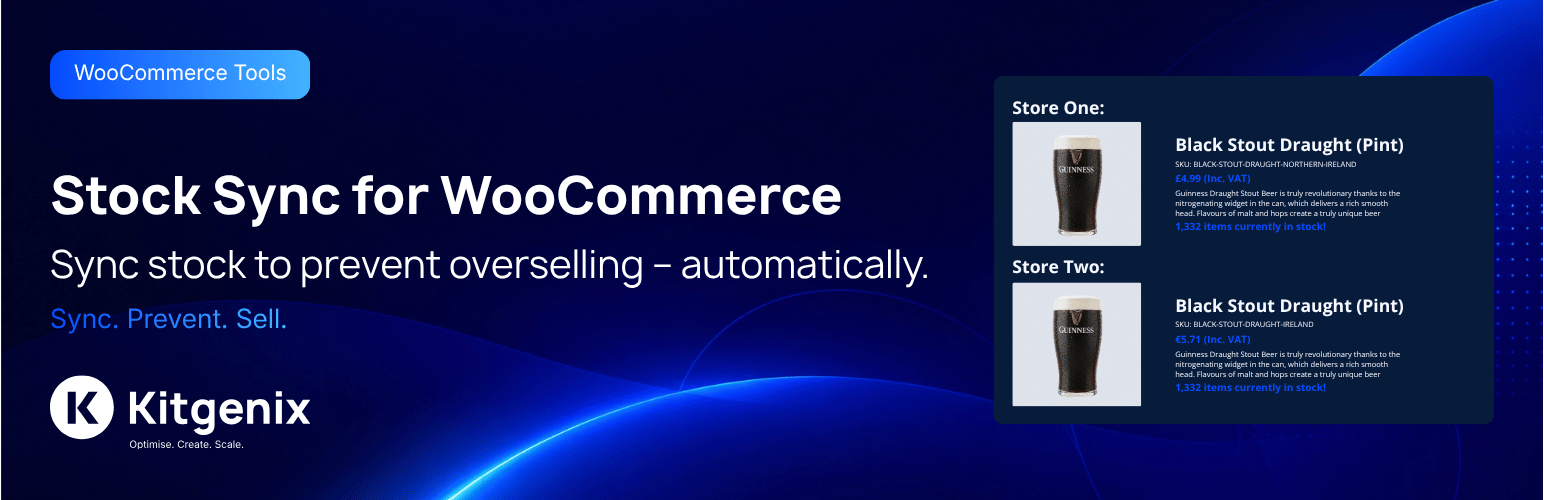

Kitgenix Stock Sync for WooCommerce

Status tab on a Master store, showing role, last inbound/outbound timestamps, the last outbound error, and a per-store Connection Health table with status, last activity, and remote WooCommerce/plugin versions for each connected Child.
Kitgenix Stock Sync for WooCommerce synchronizes inventory between WooCommerce stores using a Master/Child architecture. The Master store acts as the authoritative inventory source while Child stores send stock-changing events back to the Master and receive the resulting authoritative stock state.
The plugin is built for merchants who sell the same physical inventory through several WooCommerce storefronts and need stock quantity, stock status and backorder behaviour to converge without manually exporting/importing inventory files.
Stores communicate directly over signed REST requests; there is no Kitgenix cloud stock relay. Background delivery uses WooCommerce Action Scheduler where available, with retries and backlog handling for temporary failures.
Learn more about Kitgenix at Kitgenix.
WooCommerce Stock Sync Features
- One authoritative Master store with one or more Child stores.
- SKU-based product/variation matching plus plugin global IDs for stable identity.
- Synchronization of stock quantity.
- Synchronization of stock status.
- Synchronization of backorder setting.
- Synchronization of low-stock amount.
- Effective stock-management mode handling, including variation inheritance from a parent product.
- Automatic capture of WooCommerce stock-change hooks.
- Order-processing and stock-restoration handling.
- Asynchronous event delivery with retries/backoff.
- Per-event version numbers to reject stale updates.
- Duplicate-event detection.
- Persistent backlog for recoverable failed deliveries.
- Conflict scanning and reconciliation tools.
- Strict Child-store checkout validation option.
- Cached stock snapshot/failure strategy options for Master reachability problems.
- SKU rename tracking.
- Product/SKU exclusions.
- Shared-secret rotation with overlap window.
- Signed REST authentication and replay protection.
- Scheduled health checks and connection status.
- WordPress Site Health integration.
- Event log and diagnostic code reference.
- WP-CLI status, audit/reconcile, SKU and backlog tooling.
- WooCommerce HPOS compatibility handling.
Master and Child Architecture
The Master owns the authoritative stock state. A Child store can detect a local event that changes stock, send that event to the Master, and then receive the authoritative result that should be applied across the network.
This avoids a simple “last store to save wins” design in which two storefronts can continually overwrite one another with stale quantities.
The Master configuration stores the connected Child sites and the Child configuration stores the Master endpoint/credentials needed for signed communication.
Inventory Fields Synchronized
The state payload includes the stock-related fields needed to keep WooCommerce availability consistent, including quantity, status, backorders, low-stock amount and effective manage-stock state.
Variable products/variations are handled with awareness that a variation may manage its own stock or inherit stock management from the parent product.
The plugin focuses on stock. It is not a general product-catalogue synchronizer for descriptions, images, categories and full pricing; Kitgenix MultiStore Sync is a separate broader plugin for that use case.
Automatic Capture of Stock Changes
The sync engine hooks into WooCommerce product/variation stock updates, stock-status updates, updated product properties, order processing and stock restoration. This means stock changes made by normal WooCommerce operations can enter the sync pipeline without staff having to click a separate “export stock” button.
Because third-party integrations such as POS or marketplace connectors often write stock through WooCommerce’s normal APIs/hooks, their resulting WooCommerce stock changes can also be observed without the Kitgenix plugin calling the third party directly.
Event Versioning and Duplicate Protection
Each synchronized product carries plugin metadata used for global identity and event versioning. The receiver tracks the applied version so an older delayed event can be rejected instead of rolling stock backwards after a newer update has already been applied.
Event IDs are also remembered for a limited period so a duplicated/retried delivery is not applied as though it were a brand-new inventory movement.
Retry and Backlog Handling
Outbound failures are classified and retried using increasing delays. Recoverable failures can be persisted in a capped backlog so administrators can see that inventory delivery is pending rather than assuming a silent request succeeded.
Backlog entries can be retried or discarded from the administrative tools when appropriate. Successful later delivery removes the corresponding outstanding item.
Reconciliation and Conflict Detection
The Master can scan Child stores and compare their current stock state with the authoritative record. Reconciliation processes products in batches and can continue through Action Scheduler rather than requiring a single long-running browser request.
Conflict reports can identify mismatched stock or duplicate-SKU conditions that need manual attention. The plugin also exposes audit/reconciliation functionality through WP-CLI.
Strict Checkout Validation
A Child store can optionally validate cart quantities against the Master during checkout. This is intended to reduce overselling when the local storefront’s last synchronized value is older than the authoritative stock.
Because the Master can be temporarily unreachable, the plugin includes configurable behaviour around failure and stale cached stock snapshots. Stores should choose a strategy that matches whether they prefer checkout availability or strict oversell prevention during network outages.
SKU Rename Handling
The plugin observes SKU metadata changes so identity can remain consistent when a product’s SKU is edited. Global plugin IDs provide another stable identifier used by the sync process, reducing dependence on the assumption that a SKU can never change.
Exclusions
Administrators can exclude specific SKUs from stock synchronization. Excluded products are ignored by normal event delivery and reconciliation so local-only inventory is not continually overwritten.
Secure Signed REST Requests
Master and Child REST requests are signed using the shared-secret authentication layer. Requests include timing/identity information and are rejected when they are invalid, too large, outside the accepted window or fail replay/authentication checks.
The security layer also contains throttling/temporary lockout behaviour for repeated authentication failures and remote URL validation.
Shared secrets can be rotated with a configured overlap period so a network can move from an old secret to a new one without requiring every in-flight request to fail at the exact rotation second.
Health Monitoring
Scheduled health pings update the stored connection status for the Master/Child relationship. The admin interface and Site Health integration can report configuration, connectivity, backlog and Action Scheduler concerns.
WP-CLI
The command base is:
wp kitgenix-stock-sync
The command class includes status, audit/reconciliation, SKU-level actions, backlog/conflict tooling and formatting helpers for operational use from the command line.
Direct Store-to-Store Data Flow
Stock events and stock-state queries are sent only between the WooCommerce sites configured by the administrator. Kitgenix does not receive the store’s inventory feed or act as a remote source of truth.
The shared Kitgenix admin Hub can separately request public plugin metadata from WordPress.org, and the admin stylesheet imports Google Fonts as documented in External Services. Those requests do not contain WooCommerce stock payloads.
Typical Uses
- Separate retail and wholesale WooCommerce stores sharing one warehouse quantity.
- UK and Ireland storefronts selling from the same physical stock pool.
- Brand/domain-specific stores that must not oversell shared inventory.
- A POS/integration updating the Master while web storefronts follow the authoritative result.
- Stores that need backorder and stock-status behaviour kept consistent as well as the numeric quantity.
External Services
This is a store-to-store sync plugin, so connecting to remote services is core to how it works. It talks to two kinds of external endpoint:
1. Your own WooCommerce stores (Master and Child)
The plugin makes signed REST API requests directly between the WordPress/WooCommerce sites you configure as Master and Child – it does not route data through any Kitgenix server or third-party service. Master and Child URLs must use HTTPS (a filter allows plain http:// only for localhost/.local/.test hosts for local development).
- What is sent: product SKUs; stock state (quantity, stock status, backorders, low stock amount, effective stock-management mode); a per-product monotonic version counter and timestamp (see How Stock Sync Works); and, only via the
/pinghealth-check route, the sending store’s name and its WooCommerce/plugin version. Strict checkout validation additionally sends the SKUs currently in a Child’s cart to the Master for a live stock check. - When it happens: automatically, in real time, whenever WooCommerce itself changes a product’s stock (an order, refund, cancellation, REST edit, CSV import, or a compatible integration such as WooCommerce Square) – dispatched asynchronously via Action Scheduler. There is no polling interval to configure. A recurring health-check ping additionally runs roughly every 15 minutes per configured store, and Reconcile/Audit/Manual SKU Sync send requests on demand when you trigger them.
- Authentication: every request carries
X-Kitgenix-Store-Id,X-Kitgenix-Timestamp,X-Kitgenix-Nonce, and anX-Kitgenix-SignatureHMAC-SHA256 header computed from a shared secret you configure on both sides – see Developer Reference below for the full scheme. - Caching: a last-known-good stock snapshot per SKU is cached (transient, 24 hours) on Child stores solely to support the optional “use last-known stock” checkout failure strategy; a GID product ID lookup is cached in the object cache (~1 hour) if a persistent object cache is active.
2. WordPress.org Plugins API (admin screen only, not part of stock sync)
The plugin includes a shared “Kitgenix hub” admin page (Kitgenix top-level menu) listing other Kitgenix plugins. To populate install counts, ratings, and artwork for plugins listed there, it calls WordPress core’s own plugins_api() function, which requests public plugin metadata from api.wordpress.org. No site data, settings, or stock information is sent in these requests – only the public plugin slugs of the Kitgenix plugins shown on that page.
- Cached via transients:
kitgenix_hub_wporg_active_installs_v1,kitgenix_hub_wporg_ratings_v1,kitgenix_hub_wporg_media_v1(24 hours each). - This lookup only runs when a logged-in administrator views the Kitgenix hub screen; it never runs on the front end and is unrelated to stock synchronisation.
No other third-party services, SaaS platforms, or analytics/tracking endpoints are contacted by this plugin.
Developer Reference
Text domain:
kitgenix-stock-sync-for-woocommerce
Option key:
* kitgenix_stock_sync_for_woocommerce_settings
Option schema (high-level):
* this_store_id, this_store_name, role, strict_checkout_validation, schema_version
* checkout_validation_failure_strategy (fail_open | fail_closed | stale_cache), checkout_stale_cache_minutes
* master (child config): url, store_id, secret, secret_previous, secret_previous_expires_at, health
* children (master config): entries with id, name, url, secret, secret_previous, secret_previous_expires_at, enabled, health
* exclusions.skus
* conflicts_report: {generated_at, items[]} – each item has type, sku, gid, child_id, child_name, master_value, child_value, detail
* Diagnostics/admin UI state: notices, event_log, backlog (v2: id, type, store_id, attempt, status, next_retry_at, payload, payload_meta, error, code), reconcile (v2: mode, dry_run, differences_only, selected_skus, processed, total_estimate, differences_found, pushed_count, started_at, finished_at, last_batch_at), health (this store’s own global health, retained alongside the newer per-store master/children[].health)
Product/variation meta keys:
* _kitgenix_stock_sync_for_woocommerce_gid – stable cross-store identity, survives SKU renames. Never regenerated once set.
* _kitgenix_stock_sync_for_woocommerce_version – Master-authoritative monotonic version counter, bumped on every authoritative capture.
* _kitgenix_stock_sync_for_woocommerce_applied_version – last version a receiving store actually applied; the staleness-fencing guard.
REST API routes (POST):
* /wp-json/kitgenix-stock-sync/v1/ping – returns wc_version and plugin_version
* /wp-json/kitgenix-stock-sync/v1/event
* /wp-json/kitgenix-stock-sync/v1/stock (master only; used by strict checkout validation)
* /wp-json/kitgenix-stock-sync/v1/stock-state (used by audit/reconcile/conflict comparisons; returns gid and effective manage_stock)
All four routes register with permission_callback => __return_true and perform authentication inside the callback via the signed-request headers below – this is intentional (a signed server-to-server webhook has no WordPress user/cookie/application-password to authenticate against) and not a missing-permission-callback oversight.
Authentication headers:
* X-Kitgenix-Store-Id
* X-Kitgenix-Timestamp
* X-Kitgenix-Nonce
* X-Kitgenix-Signature
Signatures:
* HMAC SHA-256 over: timestamp + "\n" + nonce + "\n" + request_body
* Timing-safe comparison (hash_equals)
* Timestamp skew allowed: 5 minutes
* Nonce replay protection stored via transients; a nonce is only consumed once a request is confirmed authentic, so a wrong signature can’t burn a legitimate nonce slot
* Verification tries the current secret, then a rotated-out previous secret if it hasn’t expired (see “Rotate Secret”)
* Request bodies over 2MB are rejected before any HMAC work
* Repeated authentication failures from the same sender trigger a temporary lockout (20 failures / 10 minutes 15 minute lockout)
* All authentication failure responses are a single generic 401 (detailed reason logged internally only) so a caller cannot enumerate which store IDs are configured
Action Scheduler hooks:
* (Action group: kitgenix-stock-sync)
* kitgenix_stock_sync_for_woocommerce_process_event
* kitgenix_stock_sync_for_woocommerce_push_to_store – used for both the initial async dispatch (attempt 1) and scheduled retries of the same delivery (attempt > 1)
* kitgenix_stock_sync_for_woocommerce_send_to_master – same dual purpose, Child Master direction
* kitgenix_stock_sync_for_woocommerce_reconcile_batch
* kitgenix_stock_sync_for_woocommerce_process_order_processing
* kitgenix_stock_sync_for_woocommerce_health_ping – recurring, ~15 minutes
Admin capability:
* manage_woocommerce
Admin nonces:
* kss_save_config
* kss_save_connection
* kss_save_children
* kss_test_connection
* kss_tools
* kss_conflicts
* kss_logs
Filters:
* kitgenix_stock_sync_for_woocommerce_parent_menu_slug (change the parent menu slug; default: kitgenix)
* kitgenix_stock_sync_for_woocommerce_secret_rotation_overlap (seconds a rotated-out secret keeps working; default 86400, clamped to 1 hour–7 days)
* kitgenix_stock_sync_for_woocommerce_allow_insecure_url (return true to allow http:// for localhost/.local/.test hosts only – never for a real remote host)
Transients (dynamic keys):
* kitgenix_stock_sync_for_woocommerce_do_activation_redirect (30 seconds)
* kitgenix_stock_sync_for_woocommerce_kss_nonce_{md5(store_id|nonce)} (nonce replay protection, 10 minutes)
* kitgenix_stock_sync_for_woocommerce_kss_seen_{md5(event_id)} (duplicate event detection, 24 hours)
* kitgenix_stock_sync_for_woocommerce_kss_debounce_{md5(key)} (debounce, ~2 seconds)
* kitgenix_stock_sync_for_woocommerce_kss_old_sku_{post_id} (SKU rename helper, 60 seconds)
* kitgenix_stock_sync_for_woocommerce_kss_audit_result_{user_id} (stores last audit result in wp-admin, 10 minutes)
* kitgenix_stock_sync_for_woocommerce_kss_stockcache_{md5(sku)} (last-known-good stock snapshot for the stale_cache checkout strategy, 24 hours; a per-item cached_at timestamp – not the transient TTL – enforces the merchant-configured max age)
* kitgenix_stock_sync_for_woocommerce_kss_authfail_{md5(identity)} / ..._kss_lockout_{md5(identity)} (brute-force throttle)
Object cache (if persistent object cache is enabled):
* Cache group: kitgenix_stock_sync
* Key: kitgenix_stock_sync_for_woocommerce_kss_gid_{md5(gid)} (GID product ID lookup, ~1 hour)
Internal action hooks (called directly, but can be hooked):
* kitgenix_stock_sync_for_woocommerce_process_order_processing
WP-CLI
wp kitgenix-stock-sync status [--format=<table|json|yaml>]
Role, store ID, and a per-store connection health summary.
wp kitgenix-stock-sync audit --skus=<a,b,c> [--format=<table|json>]
Master only. Compare Master vs. every configured Child for the given SKUs.
wp kitgenix-stock-sync reconcile [--skus=<a,b,c>] [--dry-run] [--differences-only] [--batch=<n>]
Master only. Runs to completion synchronously (with a progress bar) rather than relying on Action Scheduler’s own timing, so the command reports a real result. Omit --skus to reconcile the whole catalogue.
wp kitgenix-stock-sync sku push <sku>...
Master only. Push specific SKUs to all children immediately.
wp kitgenix-stock-sync backlog list|retry <id>|discard <id>|retry-all|discard-all [--yes]
Inspect and manage the backlog. discard/discard-all prompt for confirmation unless --yes is passed.
wp kitgenix-stock-sync conflicts [--rescan] [--format=<table|json>]
Print the current Conflict Dashboard report; --rescan runs a fresh duplicate-SKU scan first (Master only).
Security & Privacy
- No tracking cookies are added by this plugin.
- Admin actions are protected with nonces and capability checks.
- REST requests are authenticated using HMAC-SHA256 signatures (timing-safe comparison) with timestamp + nonce replay protection, a request-size cap, and a brute-force lockout on repeated authentication failures.
- Authentication failure responses are generic (a single 401) so a caller cannot enumerate configured store pairings; the specific reason is only recorded in this store’s own Event Log.
- Master/Child URLs must use HTTPS (loopback/
.local/.testhosts can opt intohttp://for local development only, via a filter). - Shared secrets are stored in the plugin settings option (
kitgenix_stock_sync_for_woocommerce_settings), the same way most WordPress integrations store API credentials. Treat secrets like passwords. Secrets are never written to the Event Log, the Backlog, or WooCommerce’s own logs. - Secrets can be rotated from the Stores tab with a short overlap window so both sides of a pairing can be updated without an outage.
- Site Health’s diagnostic “Info” section deliberately excludes secrets and full store URLs – only booleans, counts, and timestamps.
Uninstall
This plugin removes its settings and plugin-only transients on uninstall. It does not remove WooCommerce product/order meta or Action Scheduler records – this is intentional …