


WeDispatch Audio Text to Speech
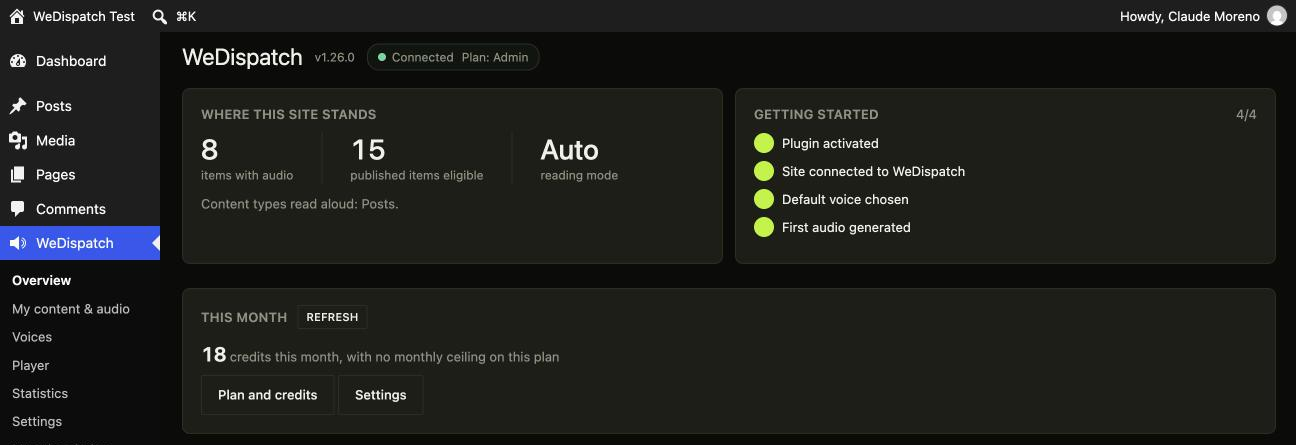
Overview: whether the site is connected, what it is using this month, and what is left to set up. The last card is the one nobody else can build: your monthly volume does not carry over, so it names the published items that have no audio yet and queues them in one click.
WeDispatch gives written content a voice. Every time something is published, the text is sent to
the WeDispatch service, read aloud by professional voices, and an audio player appears on the page.
Writers change nothing about the way they work: they publish, the audio appears.
It was built inside a newsroom, for newsrooms, but nothing about it is specific to news. Any site
that publishes text can use it: a magazine, a documentation site, an online shop, a public body
with an accessibility obligation.
Why a newsroom cares
- Nobody has to remember anything. Audio is produced on publication, not by a separate step someone forgets on a busy day.
- Scheduled content is ready on time. An article scheduled for 6 a.m. has its audio prepared in advance and published at the same moment as the text. The first reader of the day finds audio, not a “preparing” message.
- A voice per section and per author. Sport does not have to sound like the obituaries. The routing is category, then author, then site default, and the editor panel shows which voice will actually be used, before publication.
- Correcting a typo does not spend a generation. When the text of something that already has audio changes, the audio online keeps being served and the item is marked “to regenerate”. You rebuild it once, when the text has settled.
- Subscriber-only audio, with nothing to code. If your full articles are reserved for subscribers, the audio follows the same rule. Your site attests to a status (“subscriber”), never to an identity, and no personal data about your readers leaves your server.
Accessibility
Audio is not a bonus feature for a large part of the audience. It is how blind and partially
sighted readers, people with dyslexia, people with a motor impairment and readers who simply cannot
look at a screen right now get to the same content as everyone else.
- The player is exposed as a labelled landmark, so a screen reader announces it and its user can jump straight to it instead of hunting through the article.
- The player is keyboard operable and does not start on its own.
- The audio version is an alternative to the text, never a replacement for it: the written article stays complete and indexable.
This helps a site meet WCAG 2.1 / 2.2 and the accessibility duties that flow from them: the
European Accessibility Act and EN 301 549 in Europe, RGAA in France, Section 508 and the ADA in the
United States. Accessibility is a property of a whole site, not of one plugin: no plugin can make a
site conformant on its own, and any that claims otherwise is overselling. This one removes one
specific barrier, properly.
What the plugin does
- Two modes: Auto (audio is generated on publication) or Manual (the author generates it from the editor, then publishes).
- Any content type: posts, pages, products, and any custom post type registered by your theme or your plugins. You tick the ones you want.
- Automatic voice routing: category, then author, then site voice, with a preview, inside the editor, of the voice that will actually be used.
- Multilingual reading: French, English, Spanish, German, with a native voice per language. The language of each item is detected automatically (Polylang, WPML, or the site language).
- Scheduled content: the audio is prepared ahead of time and goes live at the same moment as the text.
- The player goes at the top or the bottom of the article, or exactly where you want it: an editor block, a widget, or the
[wedispatch]shortcode. - Optional synchronised text (word-by-word highlighting during playback).
- An optional transcript under the article, folded, for readers who cannot use audio and for search engines.
- An optional “Listen next” list, based on the article being read and never on who is reading it.
- A “My subscription” panel in the settings: plan, monthly usage and a shortcut to subscribe.
- Loaded through the standard WordPress script queue, deferred and in the footer, so caching and performance plugins handle it like any other asset.
Translated, not just translatable
Every screen of this plugin is translated, and a French translation ships with it. Most plugins in
this category are English-only, whatever their settings page claims. If your language is missing,
it can be contributed on translate.wordpress.org and WordPress will distribute it automatically.
Account required
This plugin is the connector for an online service: it requires a WeDispatch account. The service
is paid for (plans are listed on wedispatch.fr). Connecting the site creates its key for you, from
the WeDispatch menu; until a site is connected, the plugin performs no processing at all and makes
no request.
External services
This plugin relies on the third-party service WeDispatch (https://wedispatch.fr) to convert the
text of your content into audio, and to host and serve the audio files. The plugin does not work
without this service.
Data sent, and what triggers it
- Generating an audio version, sent to
https://wedispatch.fr/api/v1/podcasts: the text content of the item, its title, its canonical URL, its WordPress ID, its category, its language, its go-live date if it is scheduled, and the chosen voice. Triggered when an item is published or scheduled (Auto mode), or when someone clicks “Generate audio” (Manual mode). - Voice catalogue, request to
https://wedispatch.fr/api/v1/voices: no personal data, only the API key for authentication. Triggered when the settings screens are displayed (cached for 1 hour). - Subscription and usage, request to
https://wedispatch.fr/api/v1/accountandhttps://wedispatch.fr/api/v1/usage: only the API key. Triggered when the settings page is displayed, to show the plan. - Conditional access, request to
https://wedispatch.fr/api/v1/access: only the API key, to retrieve the signing secret when audio is reserved for signed-in readers. Triggered when the API key changes and once per hour. - Transcript, request to
https://wedispatch.fr/api/v1/podcasts/{id}/subtitles: only the API key and the identifier of the item. Triggered when the transcript is displayed or downloaded (cached for 12 hours). Only if you turn the transcript on. - “Listen next”, request to
https://wedispatch.fr/api/v1/recommendations: only the API key and the identifier of the item being read. Nothing about the visitor is sent. Triggered when the list is displayed (cached for 6 hours). Only if you turn the list on. - Connecting the site, request to
https://wedispatch.fr/api/v1/connect/exchange: the one time code returned by the authorisation screen, and a secret this server generated and never sent anywhere else. Triggered once, when you connect the site. The answer contains the API key. - Player settings, request to
https://wedispatch.fr/api/v1/profile: only the API key to read them, and the settings you change to write them. Triggered when the Player screen is displayed or saved. - Listening figures, request to
https://wedispatch.fr/api/v1/stats: only the API key. Triggered when the Statistics screen is displayed (cached for 15 minutes). The answer contains counters only, never anything about an individual listener. - Audio player (visitor side): the public page loads the script
https://wedispatch.fr/player.jsand plays the audio file from WeDispatch. The visitor’s IP address and user agent are therefore known to the service, and plays are counted for the site’s statistics.
The API key is stored in the WordPress site and is never exposed to the browser: every call is
made from the server. The text that is sent is used only to produce the audio.
Terms of service: https://wedispatch.fr/conditions-generales-de-vente
Privacy policy: https://wedispatch.fr/politique-de-confidentialite