


Voice Feedback – Audio Feedback Form, Voice Comments & Bug Reports
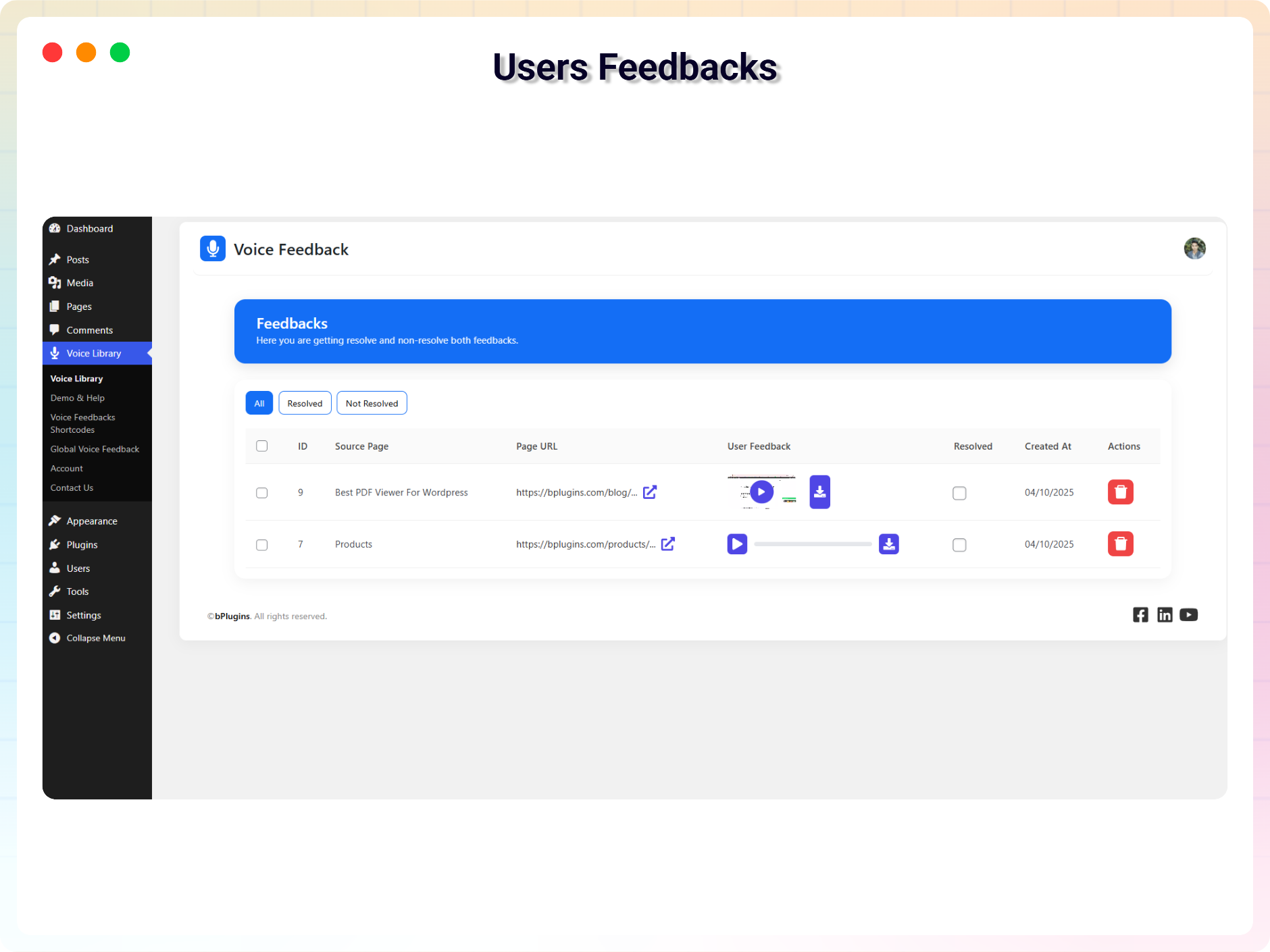
Every recording in one place. Play it, mark it resolved, or delete it — no downloading, no external service.
Most people never fill in a feedback form. Typing is the reason.
Someone spots a broken page, has a question, or wants to tell you something useful — and then they see an empty text box and close the tab. On a phone it is worse.
Voice Feedback replaces that text box with a record button. Your visitor taps it, says what they think in ten seconds, listens back, and sends. No account, no name, no email address unless you ask for one. The recording appears in your WordPress admin with a play button next to it.
Voice Feedback | Pricing | Support
Why voice gets more responses than a text box
- Speaking is about three times faster than typing, and far faster than typing on a phone.
- People say more when they talk. A text box gets “doesn’t work”. A recording gets “I clicked the download button on the pricing page and nothing happened”.
- You hear the tone. Frustration, confusion and enthusiasm do not survive a one-line text field.
- Anyone can use it — including visitors who find typing slow or difficult, and older users who avoid forms entirely.
What people use it for
- Customer feedback — ask what is missing, and actually get an answer.
- Bug reports — a visitor describes what they clicked, in their own words, instead of writing a ticket.
- Voice testimonials — a spoken testimonial is harder to fake and easier to believe than a paragraph of text.
- Course and training feedback — students record their thoughts rather than filling in a survey.
- Client updates — let a client send a quick voice note instead of an email.
- Audio comments on blog posts, as an alternative to a comment form.
How it works
- A record button appears on your site — as a floating drawer, a block, or a shortcode.
- The visitor records. They can play it back and re-record before sending, so nothing embarrassing gets submitted by accident.
- The recording is saved to your site and listed in Voice Library, with a player, a resolved marker, and a delete button.
Where the record button can appear
- Floating drawer — shows site-wide, on by default, one toggle to switch it off.
- Gutenberg block — drop a Voice Feedback block into any post or page.
- Shortcode — generate one from the admin and place it anywhere, including page builders.
Features (free)
- Voice recording with playback and re-record — no account needed to submit.
- Voice Library — every recording in one admin screen, with playback, resolve and delete.
- Spam protection — Cloudflare Turnstile CAPTCHA and rate limiting, free, no add-on.
- Email gate (optional) — ask for a name and email before recording, if you want to reply.
- Full styling control — colours, typography, padding and button text, so it matches your theme.
- Responsive — designed for phones, where most voice feedback is actually recorded.
- No personal data collected by default. It records a voice message, nothing else.
Voice Feedback Pro
- Email notifications — get an email the moment feedback arrives, with the audio attached. Customise the subject and body.
- Screen recording — the visitor records their screen along with their voice, so you see exactly what they saw.
- Display triggers — show the form after a scroll depth, at the bottom of the page, after X seconds, or when a section comes into view.
- Hide on scroll up — keep the page clean while people are reading.
- Position control — place the floating button wherever you want.
- Advanced customisation — full colour, background, typography and responsive control.
Coming next
- Contact form integration with a voice field
- Integration with project and task management tools
Other plugins by bPlugins
- HTML5 Audio Player – audio player plugin for WordPress.
- PDF Poster – a fully featured PDF viewer plugin.
- StreamCast – a fully featured radio player plugin.
- 3D Viewer – display interactive 3D models on the web.
Help translate this plugin
Voice Feedback is used on sites around the world. If you speak another language, you can help — no coding needed:
https://translate.wordpress.org/projects/wp-plugins/voice-feedback/
New to translating? Start here: https://make.wordpress.org/polyglots/handbook/translating/first-steps/
Source Code
You can find the source code, report bugs, and contribute to the development of this plugin on our GitHub repository:
Voice Feedback on GitHub
External Services
This plugin connects to the following external services. Connections are made only from the plugin’s admin dashboard pages and are not triggered for your site’s visitors on the front end.
bPlugins API
- Service: bPlugins product API –
https://api.bplugins.com - What it does: When you open the plugin’s dashboard, the plugin requests product information (such as the plugin’s own details and other plugins by bPlugins) so it can display product cards, version information, and upgrade options.
- What data is sent: A request is made to the bPlugins API endpoint with the product identifier (e.g.
https://api.bplugins.com/wp-json/bpl/v1/products/{id}). No personal data or site content is sent as part of this request. - When: Only while an administrator is viewing the plugin’s dashboard in wp-admin.
- Terms of Service: https://bplugins.com/terms-of-service/
- Privacy Policy: https://bplugins.com/privacy-policy/
WordPress.org Plugins API
- Service: WordPress.org Plugins Info API –
https://api.wordpress.org - What it does: The dashboard queries the public WordPress.org Plugins API to list other plugins published by the author (titles, icons, ratings, active installs, etc.).
- What data is sent: A public, read-only query request (e.g.
https://api.wordpress.org/plugins/info/1.2/?action=query_plugins&request[author]=bplugins). No personal data is sent. - When: Only while an administrator is viewing the plugin’s dashboard in wp-admin.
- Terms of Service: https://wordpress.org/about/privacy/
- Privacy Policy: https://wordpress.org/about/privacy/
Cloudflare Turnstile
- Service: Cloudflare Turnstile –
https://challenges.cloudflare.com - What it does: When you enable spam protection, the visitor’s browser loads the Turnstile widget and Cloudflare verifies that the submission is not automated.
- What data is sent: The visitor’s IP address and browser signals are sent to Cloudflare by the widget, and the resulting token is verified server-side against
https://challenges.cloudflare.com/turnstile/v0/siteverify. This only happens when spam protection is switched on. - When: On the front end, only when a visitor submits voice feedback and Turnstile is enabled.
- Terms of Service: https://www.cloudflare.com/website-terms/
- Privacy Policy: https://www.cloudflare.com/privacypolicy/
Third-Party Libraries
This plugin bundles the following third-party JavaScript/PHP libraries.
Freemius SDK
- Source: https://freemius.com/
- GitHub: https://github.com/Freemius/wordpress-sdk
- License: GPLv3 – https://github.com/Freemius/wordpress-sdk/blob/master/LICENSE.txt
- Purpose: Provides opt-in usage tracking and analytics to help improve the plugin.
bpl-tools
- Source / GitHub: https://github.com/bPlugins/bpl-tools
- License: GPL-2.0-or-later – https://www.gnu.org/licenses/gpl-2.0.html
- Purpose: Shared utility library providing admin dashboard components and common Gutenberg editor controls.
- External Services: The library may connect to bPlugins, WordPress.org, and Freemius services for product data and checkout functionality. See full details: https://github.com/bPlugins/bpl-tools#external-requests–why-they-are-made