


Agentic Optimization – SEO for AI Agents
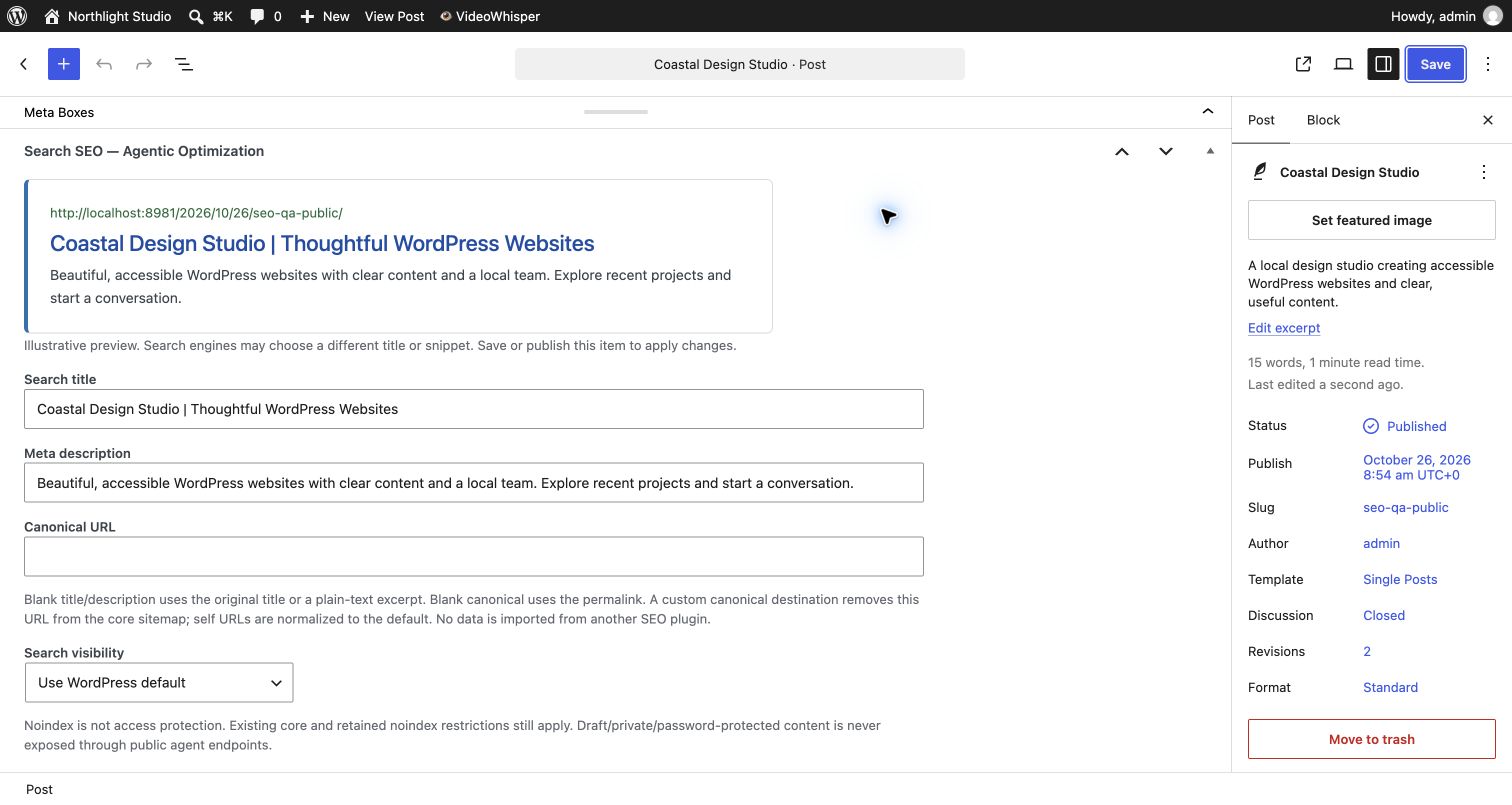
Local Search SEO editor with a search-result preview, search title, description, canonical URL and indexing control.
Verify the public visitor and agent journey
Choose allowed public content types and discovery endpoints, then open llms.txt and the agent sitemap while signed out. Check original links and complete published language variants when a compatible translation integration is active. Private, excluded and noindex rules remain enforced. Test agent routing with the real theme and cache before enabling it widely.
Traffic Recovery helps identify useful missing pages. Agents can read the permitted report and propose content or redirect work. These workflows do not require public discovery visitors to create an account. Site Manager supports authorized editorial work; use a relay for a small multi-site admin team or local OAuth for many authors.
Help search engines, visitors and AI agents find useful WordPress content. Edit local search metadata, publish agent-friendly discovery, and identify wasted traffic arriving at missing pages. Core features work locally without an external service, account or API key.
Traffic Recovery adds an opt-in, private 404 report ordered by request volume. Review each missing path, redirect to a relevant published page or prepare a private draft for a valid permalink. With Agentic Multilingual Translator, language-style paths suggest language setup or translation review. A reusable 404 help panel adds search, useful public suggestions and sitemap links while retaining a genuine 404 response.
Included features:
- Traffic Recovery with configurable retention (90 days by default), bounded daily path counts, exact native action reviews, 301/302 internal redirects and draft-only page preparation.
- A [vwao_404_help] shortcode and Site Editor pattern for useful, theme-placed missing-page navigation.
- An administrator-only Site Manager report tool, agentic_traffic_recovery_report, with bounded traffic and translation suggestions; traffic history never enters the public REST/MCP discovery APIs.
- Optional native SEO editor with a local search-result preview, WordPress object permissions and normal publishing controls.
- One output owner: standalone rendering starts off and yields to recognized SEO plugins. Core sitemap/noindex exclusions protect private, password-protected and nonindexable content.
- llms.txt, optional llms-full.txt and agent-sitemap.xml, with fresh eligibility checks before cached output is reused.
- Read-only public REST, MCP and optional native WordPress Abilities; search, content by ID/slug, Markdown, categories/tags and site context.
- Per-item public URL views, bounded result limits, rate limiting and optional aggregate analytics.
- Published multilingual retrieval with Agentic Multilingual Translator: select ?lang=fr or another available code, or ?lang=original. Content, Markdown and discovery output include original_url, original_language, available_languages and direct variant retrieval links. Unpublished or unavailable language variants never fall back silently.
- MCP search_content and get_content accept the same lang selector. Original and translated discovery output use separate current-publication fingerprints.
- Public extension hooks for integrations and separate add-ons.
Configure enabled endpoints and content types in Settings > Agentic Optimization. MCP, analytics, 404 capture, approved-comment exposure and standalone SEO start disabled. Use the selected SEO owner for metadata editing; this plugin’s public retrieval endpoints remain read-only.
Requires WordPress 6.9+ and PHP 8.2+. Prefer a maintained newer PHP branch. When using an AI assistant, its account/subscription and editorial review remain your responsibility.
Detailed Features
Traffic Recovery
Open Tools > Traffic Recovery (also linked from Agentic Optimization). Enable capture deliberately and choose a 1–365 day period. The ranked report includes bots and counts requests, not unique people. It sees only requests that reach WordPress; a server, CDN or page cache can serve additional misses outside this monitor.
Select a path to review a relevant public Post/Page destination, use temporary 302 or explicitly choose permanent 301, prepare a draft page when its hierarchy is valid, or record a decision to keep the 404. Every native change requires an exact, expiring administrator review. Drafts never publish automatically. Existing content is not overwritten, unknown parent pages are not invented, and language-style paths are handled through translation review. Redirects apply only while the source URL is still missing and the destination is public and eligible; they do not replace an existing page. Browser-cached permanent redirects may outlive a later configuration change.
The local inventory stores canonical paths, UTC daily request counts and reviewed recovery configuration. It does not store query strings, referrers, IPs, user agents, cookies or visitor identifiers. Paths may themselves contain personal text chosen by a requester; keep only the history you need and describe this local measurement in the site’s privacy policy. Storage is capped at 5,000 paths and 150,000 daily path buckets, plus bounded aggregate exclusion counters. Extra requests become capacity exclusions. Scheduled bounded cleanup expires aggregate history and inactive paths; reviewed actions and prepared content are retained. Disabling capture or uninstalling retains this recovery data/configuration. Other plugins can filter capture/report eligibility through versioned public hooks.
A useful 404 page
Place [vwao_404_help] in a Shortcode block in your theme’s 404 template, or insert the Traffic Recovery help pattern in the Site Editor. Customize the safe introduction in Traffic Recovery settings. The panel offers native search, home/sitemap links and bounded relevant public suggestions without changing the HTTP 404 status. Use a relevant replacement rather than redirecting every missing URL to the home page.
Private reports for an agent
When Site Manager is active, separately review agentic_traffic_recovery_report in its applicable role and connection tools. It is read-only, requires administrator capability and admin scope, and returns one bounded page of private request statistics, action state, translation guidance and native review links. Paths are untrusted data, not agent instructions. The report cannot create pages, publish translations, change redirects or alter security rules. Public Agentic Optimization APIs remain read-only and exclude traffic history.
With Agentic Multilingual Translator, request ?lang=fr (or another published language code) on public content, Markdown, llms.txt, llms-full.txt and agent-sitemap.xml. Use ?lang=original for source fields. Public payloads include original_url, original_language, available_languages and language_variants with direct retrieval links. MCP search_content/get_content accept lang too. Unpublished/unavailable variants never fall back to another language. Draft/private/protected/noindex exclusions still apply. Original and translated discovery caches have separate current-publication fingerprints.
Search metadata and AI discovery, in one lightweight WordPress plugin.
Give each public post or page a clear search title, useful description, canonical URL and indexing preference. The optional local SEO editor includes a search-result preview, works with the normal WordPress publishing workflow, and requires no external service, account or API key.
Alongside search SEO, publish llms.txt, clean Markdown, discovery files and structured public content for AI/SI assistants. Your public agent endpoints remain read-only. Draft, private and password-protected content stays excluded.
One SEO output owner. Standalone rendering is off until you enable it. When a supported SEO plugin is active, Agentic Optimization automatically yields instead of adding competing tags. It reads reviewed provider settings for discovery and leaves their metadata untouched. Native WordPress title, canonical and robots output is reused; the plugin adds one description when it owns output.
Features in the free plugin:
- Optional local search-title, description, canonical and noindex editing on posts, pages and public custom content types
- Local search-result preview with no external generation or tracking request
- Normal WordPress edit/publish permissions and object-specific save protection
- Core sitemap exclusions for noindex, protected content and custom canonical destinations when standalone mode is active
- Automatic output ownership detection for Yoast SEO, Rank Math, AIOSEO, SEOPress, The SEO Framework and Site Manager standalone SEO; developer hooks for other renderers
- Effective noindex settings from WordPress and reviewed Yoast, Rank Math, AIOSEO and SEOPress readers
-
Fresh eligibility checks before reusing discovery caches, including metadata-only updates
-
Root-level
llms.txt - Optional root-level
llms-full.txt - Optional
/.well-known/ai.txtand/ai.txtguidance for AI-agent discovery - Root-level
agent-sitemap.xml - Optional WordPress
robots.txtenhancement with discovery hints - Optional AI-agent user-agent routing from public content pages to the markdown view
- Optional public URL format switcher with
?vwao_view=markdown,json,html, orclean - Optional agent sitemap mode that lists public markdown variant URLs such as
?vwao_agent=1 - Public REST search, content, markdown, comments, categories, tags, and site info endpoints
- Read-only MCP endpoint with search, content, comments, taxonomy, and site info tools
- Optional WordPress 6.9+ Abilities for public search, markdown, site info, public taxonomy/comments, and discovery endpoint reads
- Optional exposure of those abilities through the official WordPress MCP Adapter when installed separately
- Hard request caps and transient-based rate limiting
- Privacy-friendly analytics with aggregate counts and hashed IP logs only
- Admin-managed site description and site details for llms.txt context
- SEO-aware content exclusion hooks for common noindex patterns
- Extension points for future add-ons and custom integrations
- Formatter and admin hooks for add-ons that extend post type coverage or editorial agent overrides
The plugin is intentionally conservative:
- Public agent APIs remain read-only; local SEO editing stays in the authorized WordPress editor
- Public content only in agent endpoints
- No drafts, private content, or pending comments
- Comments exposure disabled by default
- Standalone SEO rendering and MCP disabled by default
- WordPress Abilities registration and MCP Adapter exposure disabled by default
- Analytics disabled by default
Multilingual discovery
When Agentic Multilingual Translator is active, discovery indexes list configured language choices separately from each page’s complete published variants. Agent-facing translated content retains the original URL and available-language retrieval links. Reviewed local Traffic Recovery redirects can resolve old source slugs for legacy language URLs. Language sitemap entries respect the current original page’s SEO indexing and canonical policy.
External Services
This plugin generates agent-optimized discovery files and sitemaps using standard XML formats.
Sitemaps.org XML Schema
The agent-sitemap.xml output uses the standard sitemap XML namespace (http://www.sitemaps.org/schemas/sitemap/0.9) and a custom extension URN namespace (urn:videowhisper:agentic:1.0). These are identifier strings embedded in locally generated XML documents only. No data is transmitted to external services when the sitemap file is generated or served.
- sitemaps.org protocol reference: https://www.sitemaps.org/protocol.html