


VERIFIED Crypto Checkout – Card to USDC WooCommerce Payment Gateway
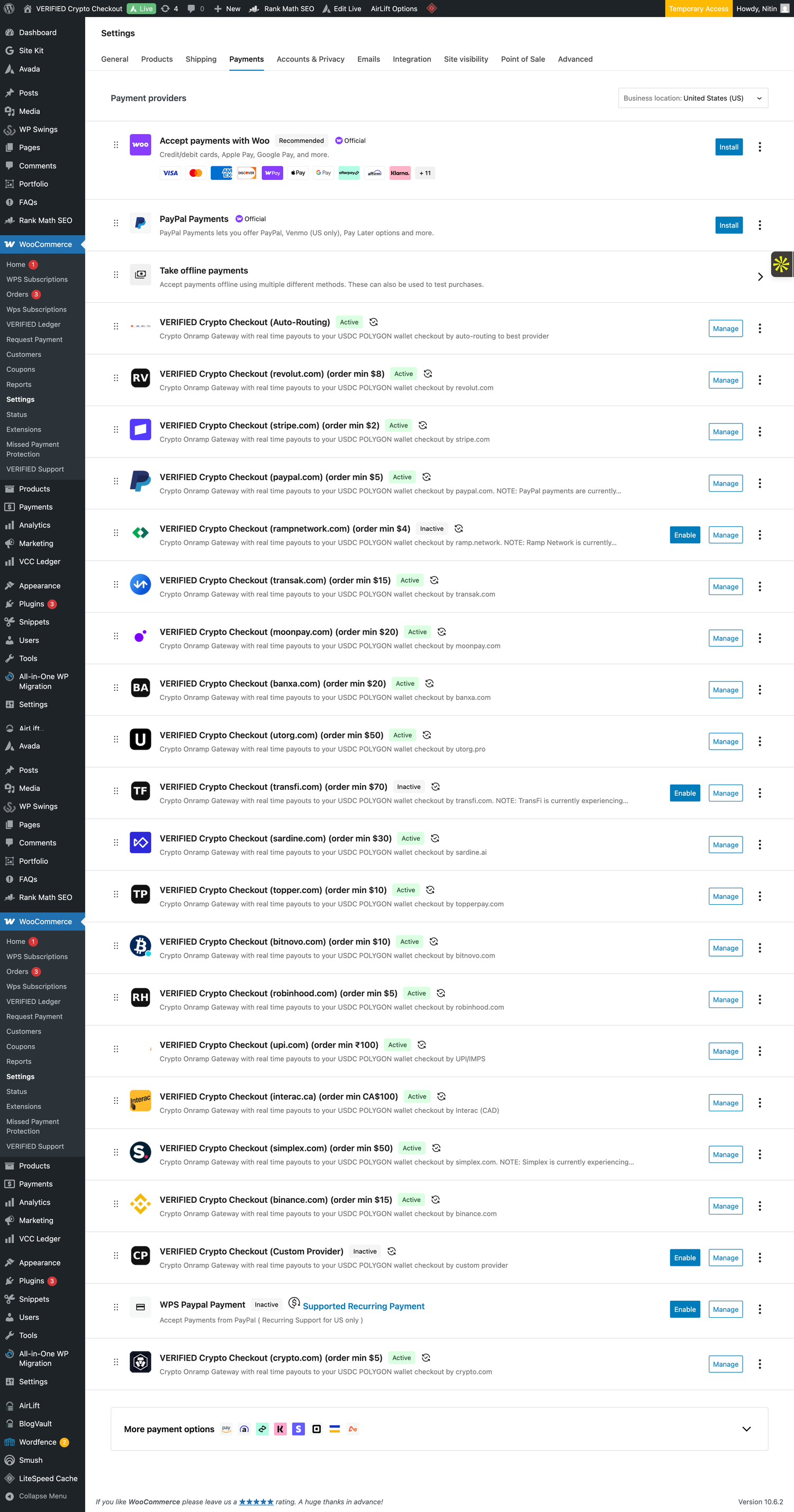
VERIFIED gateways in WooCommerce payment settings.
VERIFIED Crypto Checkout is WooCommerce-native card-to-crypto routing and settlement infrastructure. It connects WooCommerce orders to independent provider-hosted checkout pages and is designed to deliver settlement to a merchant-controlled wallet, with USDC on Polygon as the intended settlement route.
WooCommerce remains the system of record for the order. The hosted provider controls customer verification, payment-method availability, risk checks, transaction approval, conversion, and settlement execution. VERIFIED creates and tracks the checkout session, coordinates the order status, and provides reconciliation tools. VERIFIED does not process card data or custody merchant funds.
This model can provide a checkout continuity layer when traditional merchant-account underwriting is unavailable or unreliable. It is not a bypass, a guarantee of approval, or a way to avoid provider rules. Customer and transaction eligibility remain subject to each provider’s terms, KYC/AML controls, regional support, and applicable law.
Read the canonical product overview or visit the documentation hub.
Key Features
- WooCommerce Classic Checkout, Blocks Checkout, Store API fee handling, and HPOS compatibility
- Card, debit card, Apple Pay, Google Pay, and selected regional payment methods where supported by the routed provider
- Auto-Routing across available hosted providers, plus merchant-selectable single-provider gateways
- Intended USDC settlement to a merchant-controlled Polygon wallet; no VERIFIED custodial balance
- Settlement guard that holds orders when on-chain proof or the expected value cannot be verified
- Coin-aware verification for supported stablecoin and native-asset settlement outcomes
- Branded hosted waiting room and thank-you page, enabled by default, with minimal, standard, and optional full-receipt views
- Order Payment Requests with expiring, no-login Pay Now links and per-order request history
- Standalone payment links and branded invoice emails from WooCommerce admin
- In-person QR payments for counter sales, events, pop-ups, phone orders, and manual orders
- Automated abandoned-checkout recovery for eligible first-time customers
- Optional recovery incentives: fixed discount, percentage discount, or shipping credit
- Smart Recovery with up to two backup provider links and configurable large-order guidance
- Recovery reporting for emails sent, recovered orders, recovered revenue, and suppression reasons
- Email-based subscription renewals without stored-card rebilling
- Customer provider preference controls for supported subscription workflows
- Checkout notices explaining hosted redirection, possible identity verification, payment guidance, privacy boundaries, and confirmation behavior
- VERIFIED Ledger with filters, retry visibility, transaction hashes, and block-explorer links
- CSV and Excel ledger exports that respect status, event-type, and date-range filters
- Missed Payment Protection for pending and recently cancelled orders when a webhook is late or missing
- Merchant-absorbed or customer-paid 4% VERIFIED infrastructure fee configuration
- Customizable gateway titles, descriptions, icons, recovery email design, and checkout-notice colors
How Card-to-Crypto Checkout Works
- A customer selects VERIFIED at WooCommerce checkout or opens a payment link, invoice, renewal link, recovery link, or QR payment request.
- WooCommerce creates or identifies the order and remains the merchant’s operational record.
- VERIFIED creates a session and routes the customer to an independent hosted provider.
- The provider handles any required identity verification, payment authentication, eligibility checks, and payment execution.
- If approved, the provider converts the payment and sends settlement toward the wallet configured by the merchant.
- VERIFIED validates the returned amount and available on-chain evidence. An order without sufficient settlement proof is held for review rather than made shippable.
- Confirmed transaction details are written back to WooCommerce for order management and reconciliation.
Learn more about the hosted checkout architecture.
Routing and Provider Availability
Auto-Routing selects from available provider options based on the upstream route. Merchants can also expose individual gateways. The codebase includes integrations for providers and payment methods such as Coinbase, Ramp Network, Transak, Revolut, Stripe, Banxa, Simplex, Robinhood, Binance, PayPal, Crypto.com, Klarna, iDEAL, Blockchain.com, Particle, Interac, and UPI.
Provider availability is dynamic. Supported countries, payment methods, minimums, KYC requirements, fees, limits, and approval decisions vary by provider and may change. The plugin identifies discontinued or impaired routes in wp-admin; merchants should keep at least one active route enabled and review provider notices before accepting live orders.
Operational Workflows
Use existing orders to send expiring Pay Now links or display in-person QR codes. Use WooCommerce > Request Payment for standalone links and branded invoices. Automated Recovery follows up on eligible first-time abandoned sessions with merchant-controlled timing, incentives, backup providers, and reporting. Supported subscription plugins use scheduled, customer-authorized renewal links instead of silent stored-card rebilling.
Read about payment links, QR payments, Smart Recovery, and subscription workflows.
Settlement, Fees, and Risk
The intended settlement route is USDC on Polygon to the merchant’s configured wallet. Some upstream flows may return another supported asset or network outcome; the plugin’s settlement verifier evaluates the actual on-chain result and either completes the order when adequately proven or holds it for merchant review. Merchants must verify wallet compatibility and protect their private keys.
VERIFIED charges a 4% infrastructure fee on successfully confirmed transactions. The merchant can absorb it or add it as a customer-paid WooCommerce fee. Hosted providers charge separate provider-side conversion, payment, and possible network fees. Fees, net settlement, and timing vary by route; VERIFIED does not control provider pricing or guarantee settlement time. See the fees transparency guide and risk disclosure.
On-chain settlement does not create a traditional card-acquiring chargeback process against a WooCommerce merchant account. It does not eliminate customer disputes, fraud, provider action before settlement, blockchain risk, stablecoin risk, wallet risk, or legal obligations.
When This Model Fits
VERIFIED may fit merchants that want WooCommerce order control, hosted card-to-crypto execution, wallet settlement, multiple provider routes, or a continuity option when conventional acquiring is unavailable. It may not fit businesses that require fiat bank settlement, embedded card fields, silent stored-card rebilling, guaranteed approval, fixed provider availability, or freedom from customer identity verification.
Third-Party Services
This plugin depends on external services. These services are contacted when a merchant configures the plugin, creates a checkout or payment request, generates a QR code, checks settlement, or synchronizes transaction records.
VERIFIED Checkout Infrastructure
The plugin uses https://pay.verifiedcryptocheckout.com to create and route hosted checkout sessions and the VERIFIED service endpoint to synchronize limited financial and reconciliation metadata. Depending on the feature and privacy setting, transmitted data can include merchant site URL, order amount and currency, customer billing email, merchant wallet address, callback/status URLs, gateway/provider choice, fee values, transaction hash, and technical reconciliation identifiers. Optional Full Receipt mode also makes the selected order and billing details available to the hosted thank-you page.
Service: https://pay.verifiedcryptocheckout.com
Terms: https://verifiedcryptocheckout.com/terms/
Privacy: https://verifiedcryptocheckout.com/privacy/
Fees: https://verifiedcryptocheckout.com/fees/
Risk: https://verifiedcryptocheckout.com/risk/
QR Code Generation
Payment Request and In-Person QR features use QuickChart to render the QR image. The tokenized payment-link URL is sent to QuickChart only when the QR code is generated.
Service: https://quickchart.io
Privacy: https://quickchart.io/privacy/
Blockchain Verification and Pricing
Settlement Guard and Missed Payment Protection query public Polygon or Ethereum RPC endpoints to verify public on-chain records. Requests can include public wallet addresses, transaction hashes, token-contract addresses, block ranges, and JSON-RPC method data. Endpoints used by the current code include Polygon RPC (https://polygon-rpc.com), PublicNode (https://www.publicnode.com), Cloudflare Ethereum Gateway (https://cloudflare-eth.com), and LlamaRPC (https://llamarpc.com). An optional PolygonScan API key enables higher-volume Polygon lookups. CoinGecko is queried for the public market price of supported native assets when a non-stablecoin settlement must be valued; no WooCommerce customer record is sent in that pricing request.
Policies: Polygon (https://polygon.technology/privacy-policy), PublicNode (https://www.publicnode.com/privacy), Cloudflare (https://www.cloudflare.com/privacypolicy/), and CoinGecko (https://www.coingecko.com/en/privacy). Transaction links open PolygonScan or Etherscan only when an administrator or customer follows the displayed block-explorer link.
Hosted Payment Providers
The selected or routed provider receives the information entered on its hosted page and may collect payment credentials, identity documents, biometric/liveness data, contact information, device data, and other compliance information under its own terms. Provider identity is shown during the hosted flow. Providers are independent; references do not imply affiliation or endorsement. Availability and the provider roster change over time.
Provider privacy resources include Coinbase (https://www.coinbase.com/legal/privacy), Crypto.com (https://crypto.com/privacy/en), Stripe (https://stripe.com/privacy), PayPal (https://www.paypal.com/us/legalhub/paypal/privacy-full), Revolut (https://www.revolut.com/legal/privacy/), Transak (https://transak.com/privacy-policy), Ramp Network (https://rampnetwork.com/privacy-policy), Banxa (https://banxa.com/privacy-policy), Simplex (https://www.simplex.com/privacy-policy), Binance (https://www.binance.com/en/privacy), Robinhood (https://robinhood.com/us/en/about/legal/), Sardine (https://www.sardine.ai/legal/privacy-policy), Topper (https://topperpay.com/privacy), TransFi (https://www.transfi.com/privacy-policy), Unlimit (https://www.unlimit.com/privacy-policy/), Klarna (https://www.klarna.com/us/privacy/), iDEAL (https://www.ideal.nl/en/security-privacy/privacy-statement/), Blockchain.com (https://www.blockchain.com/legal/privacy), Guardarian (https://guardarian.com/privacy-policy), Particle (https://particle.network/privacy), Interac (https://www.interac.ca/en/privacy-policy/), and UPI/NPCI (https://www.npci.org.in/privacy-policy/). Review the provider named on the hosted page before submitting data.
Privacy and Data Handling
The plugin does not store card numbers or CVV values in WordPress. WooCommerce continues to store the order and customer information required by the merchant’s normal ecommerce workflow. VERIFIED stores local order metadata, tokens, gateway settings, recovery history, and ledger/reconciliation records needed for enabled features. Merchants are responsible for their site privacy notice, data-retention choices, wallet security, and applicable law.