


Trustie – Google Reviews, Testimonials & WooCommerce Product Reviews
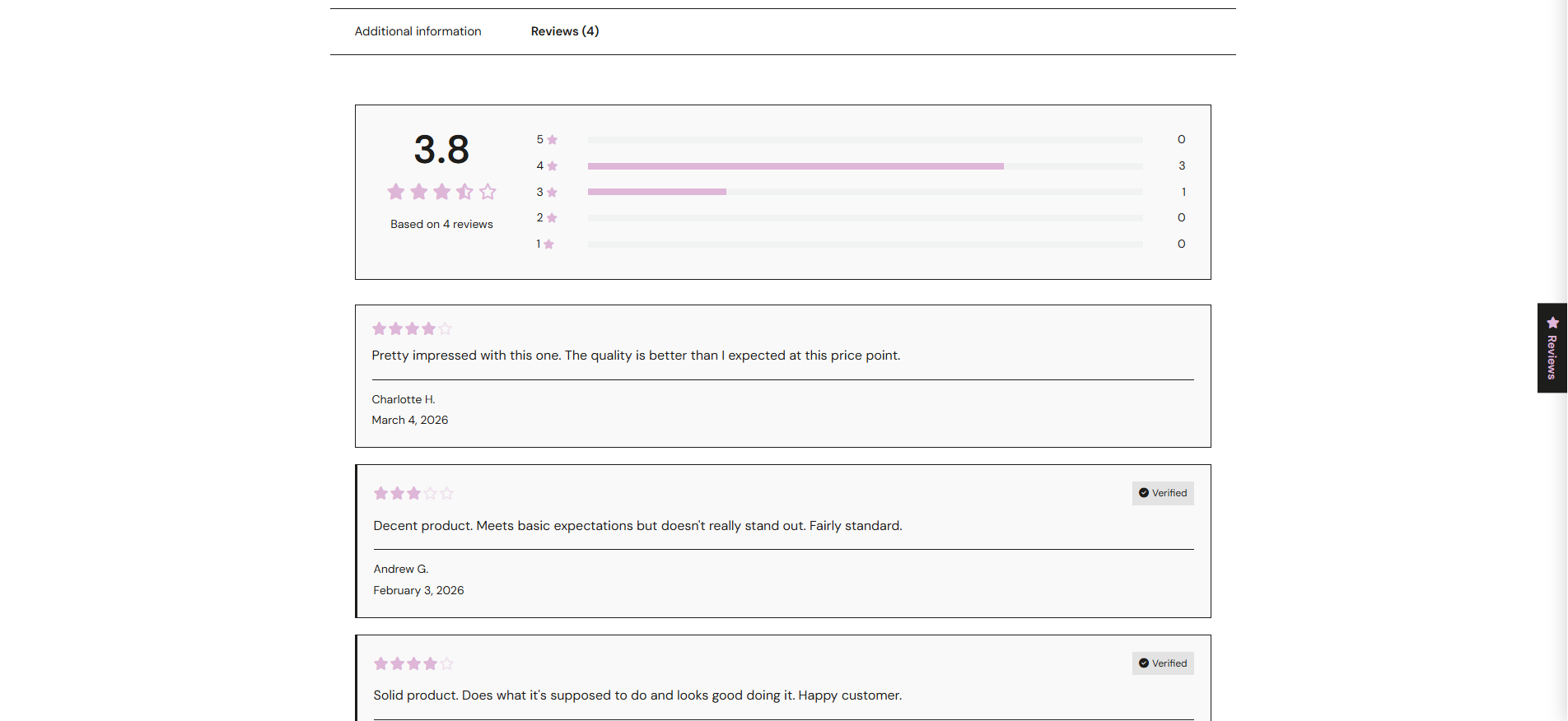
Google reviews display with aggregate rating
Most businesses collect praise in three separate places: Google, the inbox, and the product page. Trustie brings all three onto your own site, in your own branding, stored in your own database.
It works with WooCommerce. It works without it.
Three kinds of review, one plugin
- Google Business reviews: your real Google reviews on your own site, with star ratings, reviewer names and a “View on Google” link. Add your Google API key and Place ID, drop in a shortcode, done. JSON-LD schema travels with them, so search engines can pick them up for rich results.
- Testimonials you collect yourself: a proper submission form, displayed as a grid, list, masonry or slider. Auto-approve above a star rating you choose, or moderate every one by hand.
- WooCommerce product reviews: better-looking review cards, star-rating summaries, rating breakdowns, and an automatic review request email after purchase.
Most review plugins specialise in one of those three. Trustie does all of them, so your social proof isn’t scattered across plugins that don’t know about each other.
Your reviews stay in your database
Not ours. Not a third party’s. Product reviews stay in the wp_comments table where WooCommerce already puts them. Testimonials are an ordinary WordPress post type.
And it doesn’t have to be our post type. If your theme or your previous plugin already registered somewhere for testimonials to live, point Trustie at it instead: pick the post type, tell Trustie which meta keys hold the name, company, role and rating, and it displays what’s already there. Nothing copied, nothing migrated, nothing rewritten. Switch Trustie off again and your posts sit exactly where they were.
There’s no external service in the middle, no account to create, and nothing to be locked out of. If you ever want to export the lot and walk away, you can.
No WooCommerce? No problem
Google reviews, testimonials, the floating widget and the reviews page all work on any WordPress site: service businesses, portfolios, bakeries, accountants, anywhere with happy customers. When WooCommerce is installed, Trustie leans in and handles product reviews too.
What’s in the free plugin
All of it, really. Testimonials, Google reviews, product reviews, import tools, the floating widget, the reviews page and the visual Designer are all included. If you never need more, brilliant.
- A floating reviews widget: a slide-out panel showing your latest reviews on every page. The polite version of those pop-ups that chase you around the internet.
- A dedicated reviews page: a
/reviews/page with tabs, filtering and pagination. Works automatically, with or without WooCommerce. - Star ratings anywhere: shortcodes for average ratings on any page, plus lightweight “loop stars” built for archive pages, so category listings stay quick.
- Turn old comments into reviews: if you switched WooCommerce reviews on after already having product comments, one click converts them into star-rated reviews with a default rating you pick. Tidy up individual ratings afterwards.
- Catalogue-wide rating sync: recalculates average ratings and review counts across every product. Handy after imports, migrations, or general database fiddling.
The Designer: reviews that look like they belong on your site
Most review widgets announce themselves. You can spot the bolted-on third-party embed from across the room, because it arrived with its own idea of what a card should look like.
Trustie starts from your site instead. On first run it reads your theme’s fonts and colours and offers them back to you, so the default already looks like the rest of the page. From there, four tabs:
- Colours: your detected theme palette sits at the top, one click to copy. Set primary and secondary colours, button text, accent, and the two that matter most for reviews: filled star colour and empty star colour.
- Interface: corner rounding (square, subtle, medium, rounded), drop shadows (none, on hover, always), and a switch for hover animations. This is how you match a sharp, flat theme or a soft, shadowed one without writing CSS.
- Branding: your logo with width and position, plus business name, tagline, email, phone and address. These feed your emails, your documents and your structured data, so you enter them once.
- Emails. Style the review request email itself: header as standard, banner or minimal; footer as standard, minimal or detailed; colours, footer text, and whether the order items table shows.
And you can see it while you do it. Live previews render your actual review card, testimonial card, buttons, typography and the review request email as you change the settings. No save-and-go-look.
Every setting is applied through CSS variables, so it lands everywhere at once (shortcodes, the widget, the reviews page) and your theme can still override it if you want it to.
Review request emails that know when to stay quiet
When WooCommerce is installed, Trustie emails customers after a purchase asking for a review, because they’re not going to remember on their own. The email is cancelled automatically if the order is refunded, cancelled, returned or failed, if the customer already reviewed something on it, or if they’ve unsubscribed.
Tested with the page builders people actually use
Elementor, Divi, Bricks and Oxygen are all tested. If you use a different builder and something looks off, please tell us. We’d much rather hear it from you than find out from a one-star review (ouch).
Moving from another plugin? We’ll meet you halfway
- Testimonials: auto-detects and imports from Strong Testimonials, Easy Testimonials and Starter Templates. Keep the originals or clear them out once you’re settled, your call.
- Or don’t move them at all: if your testimonials already live in a post type your theme or old plugin registered, map Trustie to it and leave them where they are. Settings > Testimonials > Storage.
- Old product comments: one click, pick a default rating, done.
Built to be accessible
Trustie is tested against WCAG 2.1 AA guidelines and we keep improving: keyboard navigation, visible focus indicators, screen reader announcements for form submissions and content loading, and descriptive labels on interactive controls. If something doesn’t work the way it should for you, tell us. Accessibility is a commitment, not a checkbox.
Shortcodes
Without WooCommerce
[trustie_google_reviews]: your Google Business reviews with aggregate rating and schema. Needs a Google API key and Place ID in Settings > Google Reviews.[trustie_testimonials]: testimonials in grid, list, or masonry.[trustie_testimonial_form]: the submission form.[trustie_testimonial_slider]: auto-advancing carousel.[trustie_testimonial_grid]: grid layout wrapper (convenience shortcut).
With WooCommerce
[trustie_reviews]: reviews for a specific product, with optional form and summary.[trustie_all_reviews]: all reviews, from all products, in a grid.[trustie_reviews_page]: full reviews page with pagination.[trustie_review_form]: standalone review submission form.[trustie_rating]: average star rating for a product.[trustie_rating_badge]: compact stars-plus-count badge.[trustie_loop_stars]: lightweight stars optimised for archive loops.
Every shortcode takes optional attributes for customisation. See the full shortcode reference for details.
Plays nicely with the rest of the family
If you add Tracksies HQ, Helpie, Packsie, Perkie, Squizzie or Pipesie alongside Trustie, the admin menus merge automatically into one shared “Tracksies” parent in the WordPress sidebar, not six. No setup; Trustie spots the siblings and adjusts.
The free plugin is meant to be enough
It isn’t a trial and it isn’t crippled. Most sites will never need anything else.
But there are five specific situations where you’d outgrow it, and it seems only fair to say what they are before you install rather than after:
- You have more than five Google reviews and you want all of them. Free uses a Places API key, and Google caps that at five individual reviews (the aggregate rating still counts every one). Trustie Pro connects to your Google Business Profile with a single sign-in and syncs the lot, with no Google Cloud console and no API key to create.
- You sell something regulated. Supplements, therapeutic goods, anything where a cheerful “this cured my arthritis” must not auto-publish. Pro lets you mark a form as regulated: reviewers get guidance about what can and can’t be published, and every review on that form is held for manual approval.
- You want photos on your reviews. Customers attach images, which are resized and compressed automatically and open in an accessible lightbox.
- One follow-up email isn’t enough. Free sends a single review request after purchase. Pro runs a sequence, with the same smart cancellation rules applied throughout.
- You need to ask more than the standard questions. Pro has a drag-and-drop form builder, different forms for different product categories, and custom fields shoppers can filter the reviews by.
If none of those are you, stay on Free. That’s the plugin working as intended.
The rest of the family
- Tracksies HQ. The operational layer for WooCommerce stores: customer intelligence, order management, tags, branded email templates, returns workflow, packing workflow.
Visit tracksies.com if that sounds like your sort of thing.
Privacy and external services, in brief
Trustie connects to two external services. Full detail is in the External Services section below.
- Google Places API: used only when you’ve added your own API key and Place ID, and only to fetch your own Google reviews. No visitor data is sent to Google.
- Appsero: diagnostic telemetry is switched off in the plugin and Trustie does not offer a way to turn it on. The only thing that sends is the deactivation prompt, and only if you pick a reason. No customer data, no review content, no personal information and no email addresses are ever sent.
Trustie is a Tracksies plugin made by A Lined Design, a WordPress studio in Hobart, Tasmania. Every one of them started as something a client site needed, and they all still run on the sites we build. The full range lives at tracksies.com. For more about the studio, or custom site work, see alineddesign.com.
Privacy Policy
Trustie stores your reviews and testimonials in your own WordPress database. No review content, customer name, or email address is ever sent anywhere by this plugin.
Two external connections are described in full in the External Services section below: the Google Places API, which runs on your own API key and only when you configure it, and Appsero, whose diagnostic telemetry is switched off and which Trustie does not offer a way to turn on.
External Services
This plugin connects to the following external services:
Google Places API
Trustie uses the Google Places API to retrieve your Google Business reviews for display on your site.
- What data is sent: Your Google API key and Place ID (both configured by you in plugin settings).
- When: When a page containing the
[trustie_google_reviews]shortcode is loaded, or when you test the connection from Settings > Google Reviews. Results are cached for 24 hours to minimize requests. - No visitor data is sent to Google. Only your business credentials are used to fetch your own reviews.
- Google Terms of Service
- Google Privacy Policy
Appsero
Trustie uses the Appsero SDK. Its diagnostic reporting is switched off in Trustie.
- Nothing is collected while Trustie is running. Diagnostic reporting is switched off in the plugin and Trustie does not offer a way to switch it on, so no periodic data is sent at any point.
- The one thing that sends is the deactivation prompt. If you deactivate Trustie and pick a reason, that reason is sent together with basic environment information: your WordPress and PHP versions, server details, your active theme, how many plugins you have active and inactive (counts only, never their names), and Trustie’s own version. Your site address is sent as a one-way hash, so installs can be counted without being identified.
- Closing that prompt without picking a reason sends nothing.
- What is never sent: no customer data, no review or testimonial content, no personal information, and no email addresses.
- Appsero Terms of Service
- Appsero Privacy Policy