


Tabilo – Table Builder Block
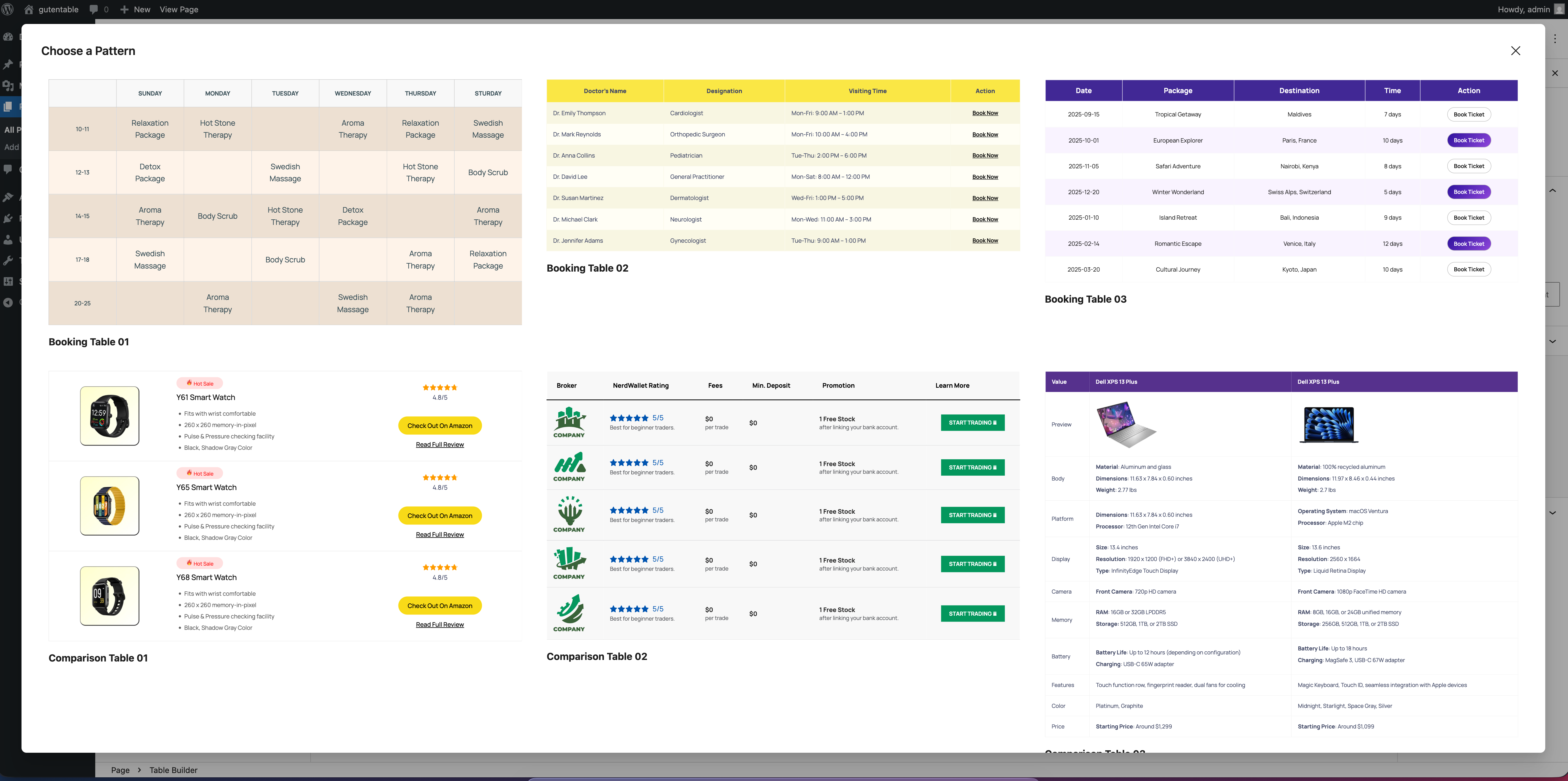
Build flexible tables visually inside the WordPress block editor.
Tabilo is a flexible, native table builder block for the WordPress block editor (Gutenberg). Create beautiful pricing tables, comparison tables, data tables, booking tables and more — right inside the editor, with a live preview and zero shortcodes.
Unlike traditional WordPress table plugins that lock you into plain text cells, Tabilo lets you insert any Gutenberg block inside a table cell — headings, paragraphs, images, buttons, lists, icons, star ratings, and even other blocks. If you can build it with blocks, you can put it in a Tabilo table.
Start fast with 40+ pre-designed table patterns, then customize colors, borders, spacing, and typography visually — no code required.
Already have the data? Import a CSV or Excel file, or paste a Google Sheets link and pull it straight in. Tabilo works out what each column holds, so a column of picture addresses becomes real images and a column of scores becomes star ratings — not a wall of text. And if the data keeps changing, switch on live sync and the published table refreshes itself in the background.
Why choose Tabilo?
- Any content, any cell – insert any block into table cells for unlimited layouts.
- Made for the block editor – a true native block, not an iframe or shortcode.
- Beginner friendly – build a table visually with columns, rows, header and footer toggles.
- Bring your own data – import a spreadsheet or a Google Sheet, and keep the table in sync with it.
- Designer ready – fine-grained control over colors, borders, radius, padding and spacing.
- Lightweight & fast – no jQuery, no bloat, clean semantic HTML output.
- Translation ready – fully internationalized and RTL friendly.
Key Features
- Flexible content – add any Gutenberg block (text, images, buttons, icons, ratings…) inside cells.
- Visual table builder – set columns and rows, then edit directly in the editor.
- Import from CSV & Excel – drop in a spreadsheet and the table is built for you, with a preview first.
- Import from a web address – paste a Google Sheets link or a direct link to a .csv, .tsv or .xlsx file and fetch the data straight into a table.
- Live sync – keep a table connected to its source and let it refresh itself hourly, every six hours or daily, so published tables stay current without re-importing.
- Smart columns – a column of picture addresses becomes real images, a column of links becomes clickable links, and a column of scores becomes star ratings. Detected for you, and changeable per column before you import.
- Header & footer sections – optional table header and footer with independent styling.
- Sticky header – keep column names visible while visitors scroll long tables, with a top offset control.
- Fixed or auto layout – switch between fixed-width and content-based column sizing.
- Responsive tables – horizontal-scroll mode with an optional scroll hint, or Stacked Card mode that turns each row into a labelled card on small screens.
- Per-column colors – give any header or footer column its own text and background color.
- Block styles – Default, Striped, and Separated styles out of the box.
- Full styling controls – table, row, cell, header and footer colors, backgrounds, per-side borders, border radius, padding, border spacing and font sizes.
- 40+ ready-made patterns – pricing, comparison, data and booking table designs to start in one click.
- Bonus native blocks – a Star Rating block and an SVG Icon block (icon library + custom SVG) to enrich your tables.
- Own block category – all Tabilo blocks are grouped under a dedicated “Tabilo” category in the inserter.
Included Blocks
- Table Builder – the core flexible table block.
- Table Row & Table Cell – structural blocks with their own color and border controls.
- Star Rating – display ratings with an optional numeric value.
- Icon – insert SVGs from the built-in library or paste your own custom SVG.
Ready-Made Table Patterns
Kickstart your layout with professionally designed patterns:
- Pricing tables – 19 designs for plans, subscriptions and hosting.
- Comparison tables – 14 designs for products, phones, laptops and features.
- Data tables – 7 designs for sports standings, food menus, listings and more.
- Booking tables – 3 designs for schedules and reservations.
Perfect For
- Pricing and subscription tables
- Product and feature comparison tables
- Specification and data tables
- Pros and cons tables
- Booking, schedule and menu tables
- Product catalogues built from a spreadsheet, pictures and all
- Stock levels, price lists and any data that changes on its own
- Any content that needs a clean, structured, tabular layout
External services
Tabilo can build a table from a spreadsheet at a web address you paste in. When you do that, and only then, your site makes a request from your own server to the address you entered and shows you the data it returns. Nothing is sent to the plugin author at any point, and no information about you, your site or your visitors is transmitted.
Google Sheets
When the address you paste is a Google Sheets link, the plugin rewrites it into Google’s own CSV export address on docs.google.com and requests that instead. This happens only when you paste a Google Sheets link and press Fetch Data, or when a table you have set to live sync refreshes itself.
What is sent: the sheet address you pasted, and nothing else.
This service is provided by Google. Terms of service: https://policies.google.com/terms — Privacy policy: https://policies.google.com/privacy
Other addresses
For any other address, the plugin requests exactly the address you entered — nothing is rewritten.
Live sync
If you switch a table to live sync, your site repeats that same request on the schedule you choose (hourly, every six hours, or daily) using WordPress’s built-in scheduler. The request is made in the background: your visitors never wait for it, and a page view never triggers an outbound request of its own. You can turn sync off or disconnect the source at any time from the block’s Data Source panel.
Picture addresses inside your data
When an imported column holds picture addresses, your site makes one short request per column to ask the host what kind of file it serves, so the column can be recognised as images. If you switch on Copy pictures into the media library, your site then downloads those pictures and stores them as attachments. Left off — the default — the pictures are simply displayed from wherever they already live, and your visitors’ browsers load them from that host.
Limits
Requests are restricted to http and https addresses, to two megabytes per data file and five megabytes per picture, and to addresses outside your own private network. Fetched data is only read and displayed; it is never executed, and nothing is written to your server unless you explicitly ask for pictures to be copied into the media library.