

SyncNet Patch Radar
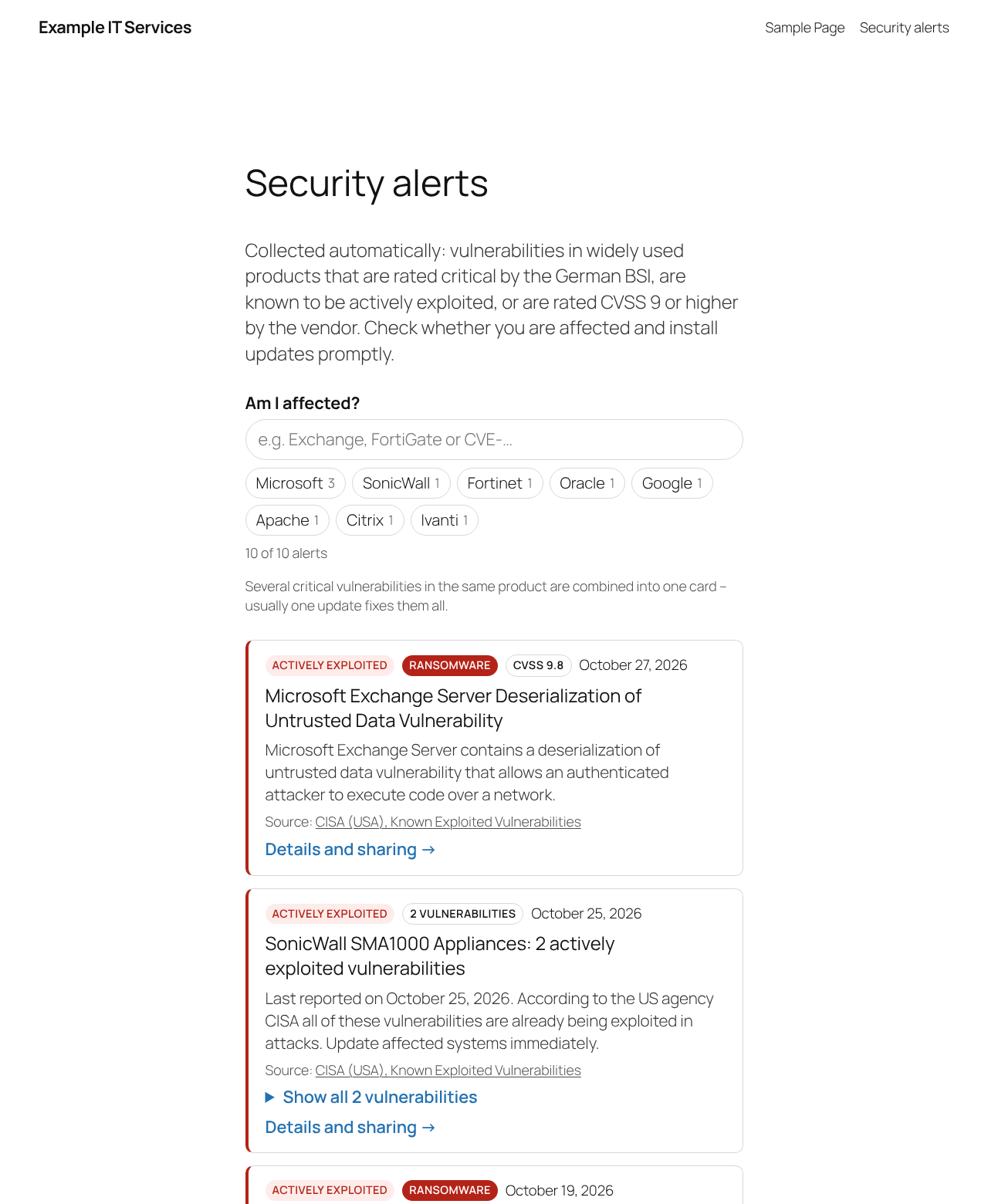
List with search, vendor filters and grouped products
SyncNet Patch Radar collects security alerts automatically and shows only what really matters: critical vulnerabilities in widely used products such as Windows, Exchange, NetScaler, FortiGate, Cisco, VMware, Java, Chrome or PHP.
An alert is shown when it
- is rated critical by the German Federal Office for Information Security (BSI / CERT-Bund), or
- is listed by the US agency CISA as actively exploited (Known Exploited Vulnerabilities), or
- is rated CVSS 9.0 or higher (adjustable), exploitable over the network without authentication, and was reported by the vendor itself (NVD),
and concerns one of the products in your list (fully editable).
Features
- Clean list with search (“Am I affected?”) and vendor filters
- Several critical vulnerabilities in the same product are combined into one card (“Google Chrome: 12 critical vulnerabilities”) – one update usually fixes them all
- Every alert and product group has its own page to share (LinkedIn, WhatsApp, Teams, email, copy link, native share on phones) – shared links always point to your site
- RSS feed for all alerts and one feed per vendor
- You choose where the subscription box and the share buttons appear: above, below or both
- Source and link to the original record on every card
- Optional small red dot on your menu item for the alerts page while a fresh, actively exploited vulnerability is listed (off by default)
- Optional one-line “latest critical alert” for your front page and a compact box for any page
- Optional call to action (“Not sure whether you are affected? Contact us”)
- Check tool in the settings: enter a CVE ID and see which condition is met
- No tracking, no cookies, no external scripts or fonts – visitors never connect to third parties
- Nothing is fetched until you switch fetching on in the settings
- Translation ready
Shortcodes
[syncnet_patch_radar]– the list (a draft page with it is created on activation)[syncnet_patch_radar_latest]– one discreet line with the newest alert[syncnet_patch_radar_box count="3"]– compact cards with a link to the list
Disclaimer
The list is compiled automatically from public sources. It is no substitute for your own vulnerability management and comes without any guarantee of completeness or correctness.
External services
This plugin relies on the following third-party services. Nothing is sent on activation. Your server only connects to them after an administrator has ticked “Fetch alerts” in Settings SyncNet Patch Radar and saved; it can be switched off there at any time.
Vulnerability data (retrieved by your server)
Once fetching is switched on, your server downloads public vulnerability data hourly via WP-Cron, after saving the settings and when you click “Fetch now” – only from the sources you have selected. The requests contain no data about your visitors, users or site; the user agent only names the plugin and its version. Requests to the NVD contain your NVD API key if you have entered one.
- BSI / CERT-Bund Warn- und Informationsdienst (WID), Federal Office for Information Security, Germany. Used to show security advisories rated “critical”. Endpoint:
https://wid.cert-bund.de/content/public/securityAdvisory/rss(only if the BSI source is selected). Service: https://wid.cert-bund.de/ – Privacy policy: https://www.bsi.bund.de/EN/Service/Datenschutz/datenschutz_node.html - CISA Known Exploited Vulnerabilities Catalog, Cybersecurity and Infrastructure Security Agency, USA. Used to show vulnerabilities known to be exploited. Endpoint:
https://www.cisa.gov/sites/default/files/feeds/known_exploited_vulnerabilities.json(only if the CISA source is selected). Privacy policy: https://www.cisa.gov/privacy-policy - NIST National Vulnerability Database (NVD) API 2.0, USA. Used to show critical vulnerabilities reported by the vendor, and by the CVE check tool on the settings page (only when you click “Check”). Endpoint:
https://services.nvd.nist.gov/rest/json/cves/2.0(only if the NVD source is selected). Terms of use: https://nvd.nist.gov/developers/terms-of-use – Privacy policy: https://www.nist.gov/privacy-policy
This product uses data from the NVD API but is not endorsed or certified by the NVD.
Share buttons (opened by the visitor)
Alert pages show share buttons. They are plain links; nothing is loaded from these services when the page is displayed. Only when a visitor clicks a button does their browser open the respective service, sending the title and address of the alert page so it can be shared:
- LinkedIn (LinkedIn Corporation / LinkedIn Ireland) –
https://www.linkedin.com/sharing/share-offsite/. User agreement: https://www.linkedin.com/legal/user-agreement – Privacy policy: https://www.linkedin.com/legal/privacy-policy - WhatsApp (WhatsApp LLC / WhatsApp Ireland) –
https://api.whatsapp.com/send. Terms of service: https://www.whatsapp.com/legal/terms-of-service – Privacy policy: https://www.whatsapp.com/legal/privacy-policy - Microsoft Teams (Microsoft Corporation) –
https://teams.microsoft.com/share. Services agreement: https://www.microsoft.com/servicesagreement – Privacy statement: https://privacy.microsoft.com/privacystatement
E-mail and “copy link” use the visitor’s own mail program and clipboard; no service is contacted.