

saidweekly
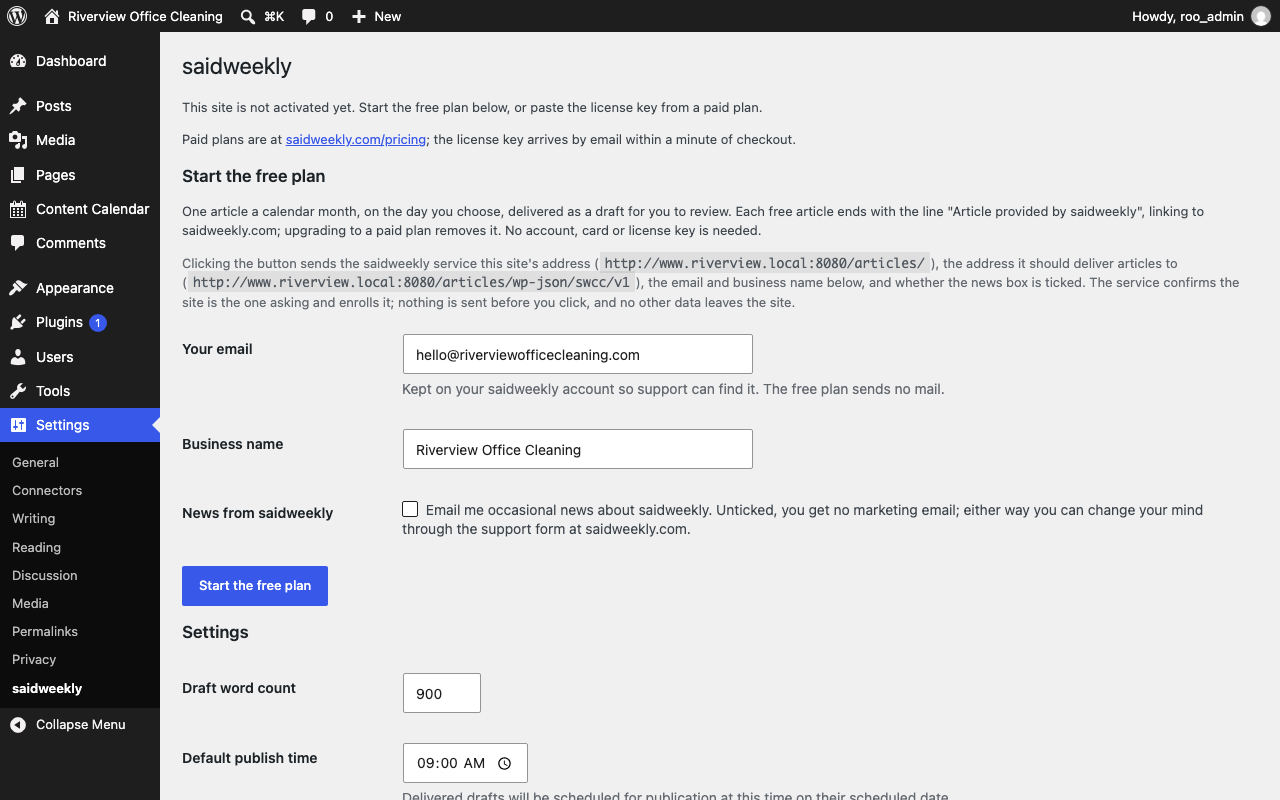
Settings → saidweekly on a new install. Start the free plan with no account, card or license key, or paste a paid plan's key. The screen says what is sent before you click.
saidweekly plans an editorial calendar for your business and turns it into finished articles, delivered to your WordPress site on the days you choose.
The calendar lives inside WordPress. Add and edit topics, lock the ones you want kept, import and export spreadsheets, and decide whether articles arrive as drafts or publish on their own. The research, planning, writing and featured images come from the saidweekly service.
The free plan needs no account, card or license key. Open Settings saidweekly, click Start the free plan, and the site is enrolled. The free plan writes one article a calendar month. Each article ends with the line “Article provided by saidweekly”, linking to saidweekly.com; a button under Settings saidweekly removes it.
Paid plans (https://saidweekly.com/pricing) are annual, cover one website, and write one article a week, three a week, or one every day. Paste the license key into the same settings screen to activate.
How the calendar is planned
saidweekly researches your business, your area and what your site already covers, using live web search and a read of your own pages. It then proposes a topic for each open date in the next 90 days, each with its reasoning and sources. The calendar is extended every month. On paid plans the research is refreshed every quarter and the whole calendar can be regenerated twice a year; the free plan can regenerate once a year.
The calendar is yours to change. Edit or lock any topic, add your own, or import a list from a spreadsheet. Nothing you wrote, edited or locked is ever changed by the plugin.
How articles arrive
Pick the days your articles fall on. Seven days before each date, the saidweekly service writes the article, chooses a featured image and delivers it to your site as a draft. Each draft includes:
- The article body, written for your business from the details you enter under Branding
- An SEO title and meta description (the description also becomes the post excerpt)
- A featured image with a filename and alt text, stored as WebP unless you turn that off
- Your category and a short list of post tags
- A call to action linking wherever you choose
- The scheduled date from its topic, so clicking Publish schedules the post instead of publishing it immediately
What you control
- Publishing. Articles arrive as drafts. Automatic publishing stays off until you switch it on and confirm. It applies only to articles written after that, and never publishes anything past its date.
- Topics. Titles, keywords, categories and dates are yours to set, and any topic can be locked.
- Pausing. Pause the whole site at any time. An article whose topic changed after it was written is held for your review.
- Status. The calendar shows where every topic stands: Planned, Queued, Drafted, Scheduled, Published or Private.
- Warnings. If the calendar runs low, the site administrator is emailed.
What leaves your site
Nothing is sent anywhere until you start the free plan or activate a paid plan under Settings saidweekly. After that, the plugin talks only to the saidweekly service and downloads featured images from Pexels. Exactly what is sent, and when, is listed under External services below.
The service writes with Anthropic’s Claude models, researches with Anthropic’s web search, and chooses images from Pexels. Your site never holds a key for any of these providers and never calls them directly. The service is operated by Martin Miller Software Consulting LLC under its terms of service (https://saidweekly.com/terms) and privacy policy (https://saidweekly.com/privacy).
Requirements
- PHP 8.0 or later
- A site reachable over HTTPS, so the saidweekly service can confirm it and deliver articles to it
- For a paid plan, a license key from saidweekly.com
External services
This plugin is the WordPress half of a hosted service. On its own it provides the editorial calendar; everything else comes from the two external services described here. Neither is contacted until you start the free plan or activate a paid plan under Settings saidweekly.
The saidweekly service
Operated by Martin Miller Software Consulting LLC, doing business as saidweekly. Terms of service: https://saidweekly.com/terms. Privacy policy: https://saidweekly.com/privacy.
The service researches your business, plans the editorial calendar, writes the articles and chooses the featured images. Data is sent at these times, and only these:
- When you start the free plan: this site’s address, the address articles should be delivered to, and the email address and business name shown on that screen. If you tick the box asking for occasional news about saidweekly (unticked by default), that answer is sent too. It controls marketing email only, never service notices.
- When you activate a paid plan: your license key, the site address and the delivery address. The key is used once and never stored on your site.
- Twice a day: the service checks in and your site replies with the identifiers of the jobs that are due. Nothing else.
- When an article is written: the topic (title, keyword, notes, word count), your Branding details, the identifiers of recently used photographs, the stored research summary and your recent article titles. The service holds these in memory while it writes and keeps none of it afterwards.
- When a calendar is planned: your Branding details and the public addresses of your own pages, which the service reads. What it finds is stored on your site, with every source.
- When the Settings page opens: a request for your plan and credit balance.
- Billing buttons on the Settings page open the service’s payment provider, Stripe, in your browser.
The service uses Anthropic’s Claude models and web search to write and research, and the Pexels API to choose photographs. Your site never holds a key for these providers and never calls them directly. The service’s privacy policy covers what it shares with them.
Pexels
Terms of service: https://www.pexels.com/terms-of-service/. Privacy policy: https://www.pexels.com/privacy-policy/. License: https://www.pexels.com/license/.
When the service delivers an article, it names a photograph on images.pexels.com that it has already chosen. Your site downloads that one file, once, into your media library as the featured image, the same way WordPress’s own media sideloading works, and serves it from your site from then on. Nothing is hot-linked, and no page on your site loads anything from Pexels. The request carries no data about you or your site beyond an ordinary HTTP request for the file. If the download fails, the article still arrives, without a featured image.