


Publishio – Build & Publish Pages & Posts with AI Using Your Own Block Patterns
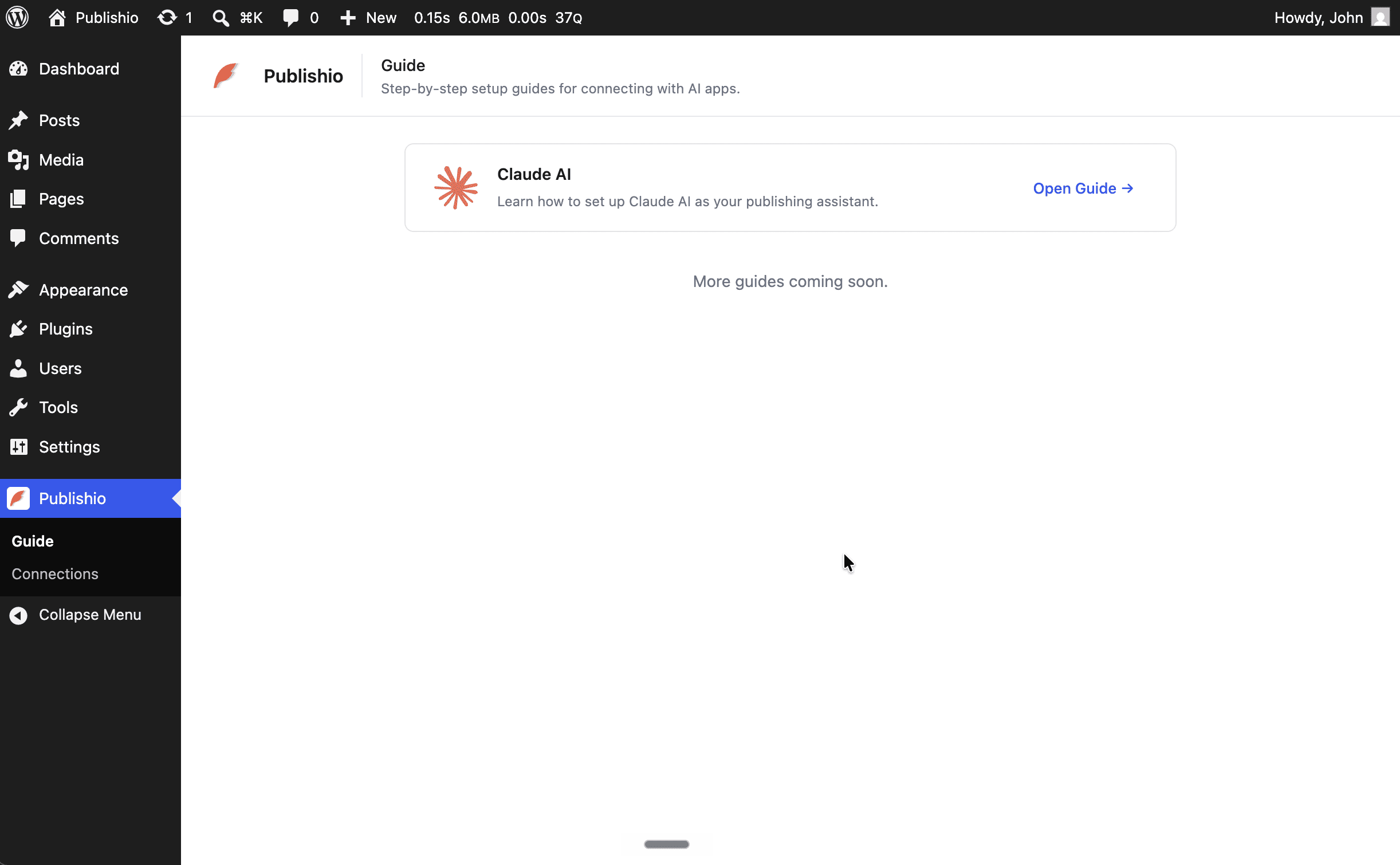
The Publishio Guide page in the WordPress dashboard — lists available AI setup guides.
Publishio connects any AI assistant — ChatGPT, Claude, or any tool that supports the Model Context Protocol (MCP) — directly to your WordPress site, so you can create and publish pages and posts just by chatting.
Publishio is not an AI itself. It is the bridge between the AI you already use and your WordPress site. The key difference from generic AI content tools is that Publishio builds everything from your site’s own block patterns — the patterns your designers already created. Your layout, spacing, colours, and brand stay exactly as intended, because the AI assembles pages from your approved building blocks rather than inventing new markup.
That means editors and content teams can spin up landing pages, blog posts, and campaign pages in minutes, in plain language, without touching the designer’s work and without breaking the design system.
Features
- Pattern Auto-Discovery: Automatically discovers all patterns registered on your site — from your theme, plugins, and core.
- Structured Content Generation: AI builds pages using proper block structures, fully Block Editor-compatible content, avoiding messy HTML insertion.
- In-Chat Previews: Shows live previews of each section directly within the AI chat interface before AI publishes them.
- Platform Agnostic: Works with major AI platforms like Claude and ChatGPT via Model Context Protocol (MCP).
- SEO & Metadata: Automatically adds metadata and SEO details (compatible with Yoast).
- Theme Agnostic: Works with any Block-based/FSE theme.
AI Skill
This plugin includes a skill file that teaches AI assistants how to generate WordPress content correctly — using your site’s existing patterns, building pages incrementally, and following your design system rather than inventing markup.
The skill is served automatically to any connected AI assistant via MCP. Editors and content creators don’t need to configure anything — just connect your AI platform and start prompting.
To use the skill in Claude (claude.ai):
- Download the skill file
- Open Claude and go to Customize Skills Upload Skill
- Upload the downloaded file
- Start prompting Claude to build WordPress pages using your theme’s patterns
Requirements
WordPress
- WordPress 6.9 or higher
Themes
- Tested this plugin with Twenty Twenty-Five and Ollie.
- Compatible with any theme. For best results, ensure patterns have descriptive names and descriptions.
Why your theme’s patterns need proper names and descriptions
This plugin acts as a bridge between your WordPress theme and AI assistants. Here’s how it works:
- Pattern discovery — the plugin scans all patterns registered by your active theme via
WP_Block_Patterns_Registry. - Metadata sent to AI — each pattern’s
title,description,categories, andkeywordsare sent to the AI as structured data. The actual block markup is fetched separately, on demand. - AI selects a pattern — the AI reads the pattern metadata and decides which pattern best fits the user’s request.
- Content is filled — the AI hydrates the selected pattern with new content (headings, paragraphs, images, buttons).
- Preview and approve — the generated page is previewed in the AI chat before insertion.
When a pattern has no description (or a generic one), the AI has only the title to work with for matching. A title like “Hero Section” doesn’t tell the AI whether it’s a full-width hero, a split hero with an image, a centered hero with a CTA, or a hero with a background video. The AI must then fetch the full content of every pattern that matches a keyword — adding expensive round trips — just to understand what each one looks like.
What the AI sees:
- Patterns with rich metadata the AI matches confidently in one round trip.
- Patterns with no metadata the AI either skips them or fetches every candidate’s full content to reverse-engineer their purpose.
Bottom line: The more descriptive your pattern names and descriptions, the better the AI’s output. Theme authors should treat pattern metadata as documentation for AI — not just a label for the block inserter.
Documentation
- Connection Guide — Open the Publishio page in your WordPress dashboard for the Claude setup guide.
- Development Guide — Setup, commands, testing, and contribution.
- Contributing
- Code of Conduct
- Security
Source Code
The source code is available on GitHub.