


PHP Vitals
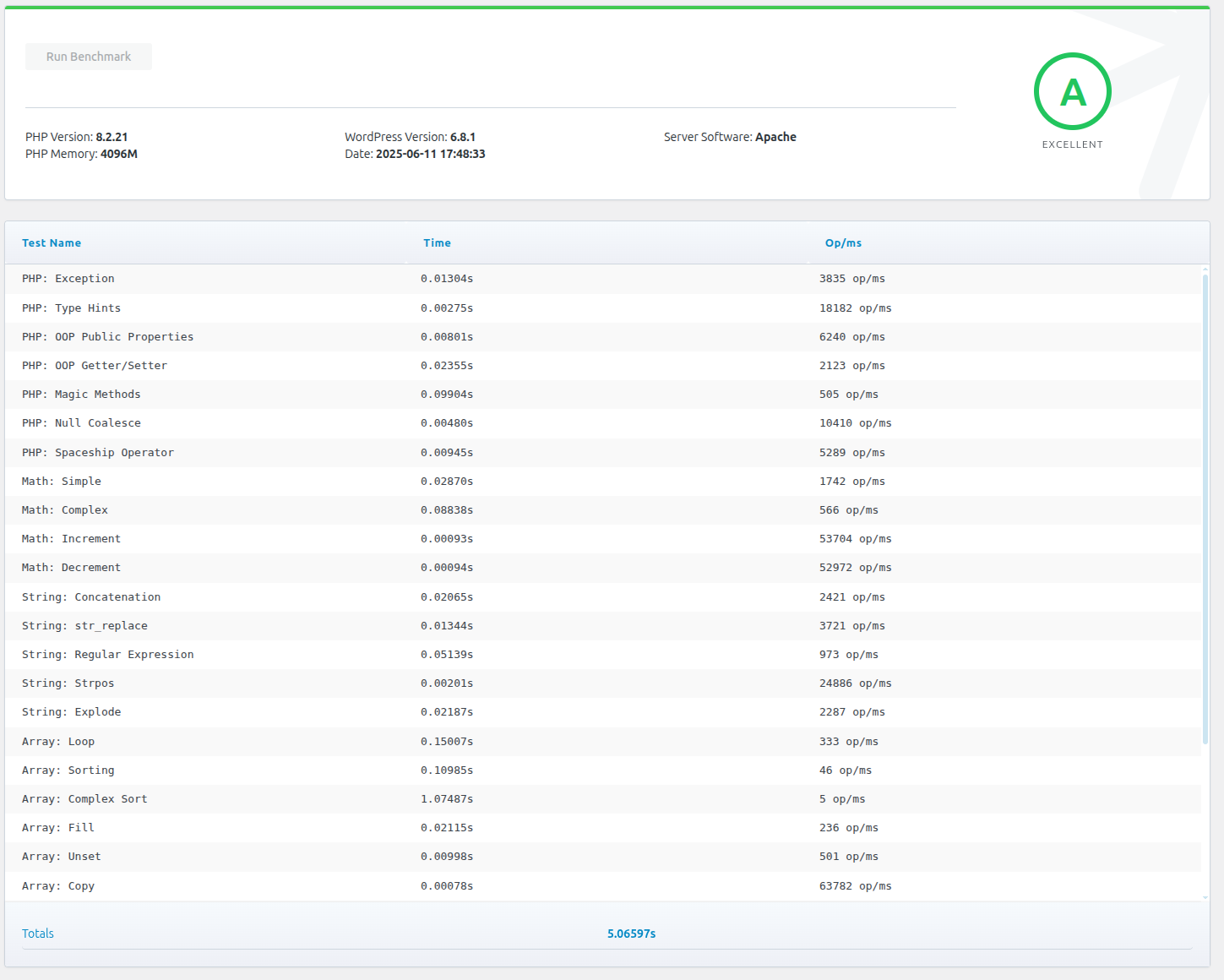
Speedtest results in the WordPress Dashboard.
How fast is your web host? Dozens of PHP speed tests, 1 overall grade: The easy way to compare hosting performance.
Bringing Transparency to Your Web Host’s PHP Performance
The faster your websites run, the better. Better SEO, better UX, better returns on your effort. But in any PHP-based system (including WordPress, Drupal, Joomla, Magento, and many others) there’s an important performance factor that’s hard for you to see and mostly beyond your control. It’s your web hosting. How fast does PHP run on the infrastructure that your web host provides?
PHP Vitals gives you a simple way to find out.
A Free, Quick and Easy Speed Test
In a minute or two, PHP Vitals analyses exactly how well your server performs on dozens of different tests of PHP performance. When you run PHP Vitals you’ll see an overall grade, and you can see where your web host belongs on the PHP Vitals leaderboard.
You can’t see your server hardware. You don’t know how many others are sharing your resources. You don’t know if your hosting is rate-limited, over-provisioned, or dependent on ancient CPUs. PHP Vitals lifts the lid on what you’re really getting for your money.
What Gets Tested
PHP Vitals focuses on base PHP functions. Base categories are:
– php_features
– math
– string
– array
– crypto
– file
– serialization
Specific operations that are tested include:
– PHP Class (getter/setter).
– Public properties and methods.
– Simple math operations.
– Complex math operations.
– String concatenations.
– Regular expressions (regex).
– Functions: explode, strpos.
– Operations: Array sorting, set, unset, copy, and others.
– Password hashing.
– MD5 hashing.
– SHA256 hashing.
There are no MySQL or database benchmarks included.
Features
PHP Vitals suite of PHP performance benchmarking tests usually takes only 1-2 minutes to run. The tests give you live performance data.
Each time you run PHP Vitals you’ll see a breakdown of individual test data and an overall grade (A+ to F). A visual grade scale shows where you sit on the scale, with a plain-language comparison such as “faster than X% of servers.” Test data is objective, for example the time taken for each test. Grades are based on the overall time taken. The subjective grading scale is likely to change over time (e.g. an A in 2025 is unlikely to still be an A in 2027).
Benchmark test names, categories, and iteration counts are fetched from phpvitals.com when you run a test; all test code executes locally on your server.
Every completed run is saved to a local benchmark history on your site (last 15 runs), whether or not you share results. Leaderboard sharing is optional: if enabled, completed benchmarks may also be submitted to phpvitals.com so developers can compare hosting performance worldwide. No personal data is collected.
After each run, you can copy a detailed php.ini optimization prompt (benchmark results, PHP configuration, and slowest tests) and open ChatGPT, Claude, Perplexity, or Gemini in a new tab. Nothing is sent to any AI service automatically—you paste and send only what you choose.
Optional hosting type and monthly cost settings help group your results with comparable servers on the leaderboard.
PHP Vitals data is presented through a responsive admin interface under Tools PHP Vitals.
Usage on WordPress
PHP Vitals is very straightforward. Install the plugin, open Tools PHP Vitals in your WordPress admin dashboard, and click “Run Benchmark”.
External services
This plugin connects to PHP Vitals for:
- Benchmark test metadata (names, categories, iteration counts) from
/api/tests— test code runs locally in the plugin - Grade thresholds from
/api/grades - Hosting type/cost labels from
/api/options - AI advisor prompt template from
/api/advisor-prompt(fallback bundled in the plugin if unreachable) - Optional leaderboard submission to
/api/benchmarkwhen sharing is enabled
When leaderboard sharing is enabled, each completed benchmark may submit:
- Overall run time and grade
- PHP and WordPress versions
- Server software and PHP memory limit
- Hosting type and monthly cost (if configured)
- Per-test timing output from the run
No personal account data or site content is collected.
This service is provided by PHP Vitals: Privacy Policy, Terms of Use