


OneVoicer
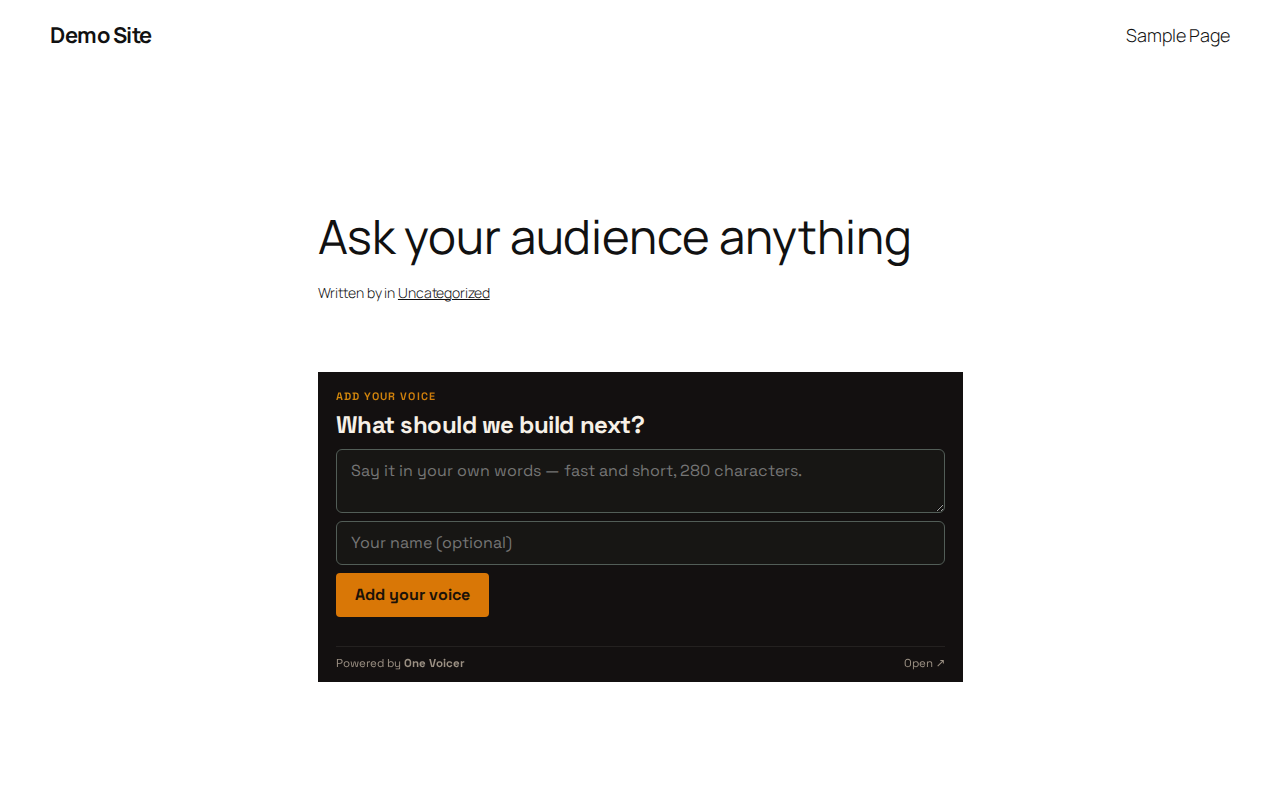
The live embed on a page: question, answer box, and the blended one voice.
OneVoicer turns a crowd of answers into one clear answer. You ask a question. People answer in their own words, from their phone or right on the page, with no app and no account. OneVoicer’s AI reads every reply and blends them into a single answer, the “one voice” of your crowd, and keeps re-blending as new voices arrive. It is a different animal from a poll: instead of bar charts over the options you thought of in advance, you get a readable answer built from what people actually said.
On OneVoicer you create a voicer: one question with its own share link and QR code. This plugin puts that voicer on your WordPress site. Add the OneVoicer block to a page or post, paste the share link, and publish. What your visitors see depends on the voicer:
- The live embed. Your question and an answer box, right on the page. A visitor types a short answer, sends it, and sees the blended one voice, which keeps updating as other voices land. Available when embedding is enabled on the voicer (part of the OneVoicer Creator plan) and your site’s domain is on its allowed list.
- The QR card. A compact branded card with an optional heading, a scannable QR code, and a tap-friendly link to the voicer’s public answer page. Works with every OneVoicer plan, including the free Starter plan.
The block never leaves a blank space: it renders the live embed when the voicer allows it on your site, and the QR card otherwise. In the editor it previews exactly what visitors will get, and if the live embed is not available yet it explains why and what to change.
Use it for a feedback box on your site, a running question on a community page, or a public pulse on a blog post. It is the same voicer as everywhere else: voices collected on your site appear in the OneVoicer app, feed the same blend, and land in the same history.
Full setup guide with screenshots: onevoicer.com/docs/wordpress-plugin
This plugin connects to a hosted service. It renders content from onevoicer.com and checks a pasted link against onevoicer.com to decide what to render. Creating a voicer requires a free account at onevoicer.com.
External services
The plugin communicates only with OneVoicer (onevoicer.com), in exactly two ways:
- Link check (server-side). When a share link is pasted in the editor, and periodically when a page renders, your site’s server sends a HEAD request to the voicer’s public embed URL at app.onevoicer.com to learn whether the live embed may render here. The only data transmitted is the share token that is part of the pasted link itself. The result is cached for five minutes.
- The live embed (visitor’s browser). When the live embed renders, the visitor’s browser loads the voicer’s public page from app.onevoicer.com in an iframe, like any embedded content, and an answer a visitor chooses to submit is sent to OneVoicer.
Nothing else is transmitted: no account data, no site data, no visitor analytics. The QR code is drawn locally in the visitor’s browser by the bundled qrcode-generator library (MIT licensed), not by an external service.
This service is provided by One Voicer: terms of service, privacy policy.
Source code
The JavaScript in build/ is compiled with @wordpress/scripts. The human-readable source ships alongside it in the plugin’s src/ directory, and the plugin is developed in the open at github.com/epreisz/onevoicer-wp-plugin — to rebuild, run npm install && npm run build there.
One third-party library is bundled (into build/view.js): qrcode-generator version 1.5.2, MIT licensed, by Kazuhiko Arase — source at github.com/kazuhikoarase/qrcode-generator (npm). It draws the QR card’s code locally in the visitor’s browser.