

MCP Content Manager Lite
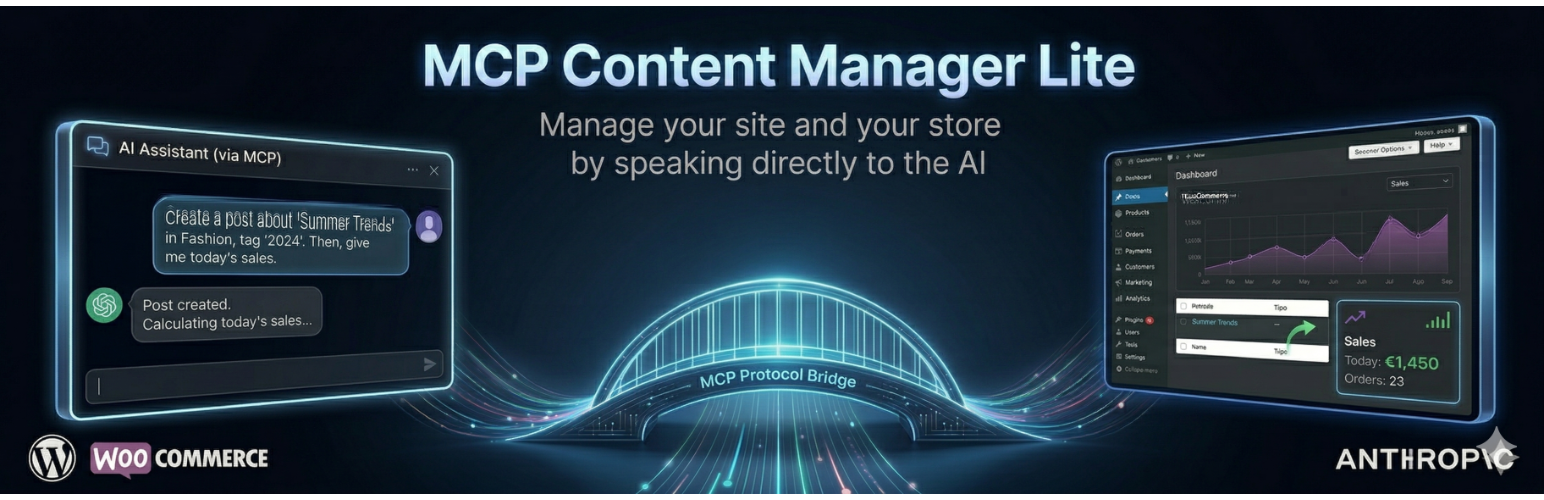
MCP Content Manager Lite turns your WordPress site into a first-class Model Context Protocol (MCP) server so AI assistants like Claude, ChatGPT, GitHub Copilot, Cursor, Windsurf, Continue, JetBrains AI Assistant or Cowork can manage your content using natural language.
It is not a wrapper around the REST API. The plugin auto-discovers every CPT, taxonomy, ACF group, custom field and registered meta on your site and exposes them as MCP abilities, so your AI client instantly understands the structure of your specific install — without configuration files, without code, without YAML.
Why MCP Content Manager Lite over other MCP plugins
Most WordPress MCP plugins ship 10–20 hardcoded tools that wrap a fixed list of REST endpoints. MCP Content Manager Lite ships 60+ abilities out of the box, plus trust, onboarding and observability features that the rest of the ecosystem treats as paid extras:
- Auto-discovery, not hardcoded tools. Your AI client sees your real schema — CPTs from CPT UI, ACF, JetEngine, Pods, Toolset; taxonomies; statuses; shortcodes; permalink structure — generated at runtime. No YAML files to maintain.
- OAuth 2.1 with PKCE built in. No application passwords. The plugin runs its own OAuth 2.1 server with Dynamic Client Registration so Claude, ChatGPT, Cursor and Copilot connect with one click.
- Granular per-client allowlists. Each OAuth client has its own
allowed_abilitieslist, editable visually. Give Claude full access, give a webhook integration onlyread-postandlist-recent-posts. - AI image generation with Google Gemini. Generate up to three images per call, save them to the Media Library, set as featured image. Imagen, multiple aspect ratios, 2K/4K and image editing remain Premium.
- Rate limiting per client_id, Activity Log with 30-day retention, MCP annotations on every ability and a public /health endpoint for uptime monitoring.
- Get Started wizard + Connect tab with copy/paste config for Claude Desktop, ChatGPT, Cursor, Windsurf, Continue and JetBrains AI.
- Universal SEO read across Yoast, Rank Math, AIOSEO, The SEO Framework, SureRank, SEOPress, Slim SEO and Squirrly. One ability, eight plugins.
- Universal multilingual read across Polylang, WPML and TranslatePress.
- WooCommerce read-only when WooCommerce is active.
- Spanish translation bundled. Coexistence with Premium with no conflicts.
No code. No configuration. Install, activate, run the wizard, paste the URL into your MCP client.
Everything Included in Lite (60+ abilities)
Auto-discovery and schema introspection. list-post-types, list-taxonomies, list-post-statuses, list-shortcodes, get-permalink-structure, list-blocks-registered, list-block-patterns, list-fse-templates. ACF groups, JetEngine fields and registered meta detected automatically.
Universal content CRUD. Create, read, update, search and delete posts, pages and any custom post type. Full Gutenberg block markup with a built-in block reference so the AI generates clean blocks. Search filters by status, author, date range, taxonomy, meta. Custom fields and ACF fields read/write. Featured image from URL or Media Library. Bulk-friendly endpoints for agentic workflows.
Site stats and content shortcuts. get-site-stats, get-media-stats, list-recent-posts, list-pending-comments, list-scheduled-posts, list-trashed-posts, list-post-revisions.
Taxonomies. List, create, update and delete terms in any taxonomy with full hierarchy support.
Comments. List, read, create, reply, approve, mark as spam, send to trash and delete. Bulk moderation friendly.
Media library. List attachments with mime/size filtering, upload from local files or remote URL, set featured image, attach to posts.
Users (read-only). Browse users by role with detailed profile view.
Menus, widgets and sidebars (read-only). list-nav-menus, list-widgets, list-sidebars.
WooCommerce read-only (conditional). When WooCommerce is active, four abilities appear: wc-get-store-info, wc-list-products, wc-list-recent-orders (with email/name redaction by default) and wc-list-coupons.
SEO read (universal, 8 plugins). seo-read-meta with adapters for Yoast, Rank Math, AIOSEO, The SEO Framework, SureRank, SEOPress, Slim SEO and Squirrly. Title, description, canonical, robots, OpenGraph and Twitter where the source plugin exposes them.
Multilingual read (universal, 3 plugins). i18n-list-languages, i18n-list-translations-for-post, i18n-get-post-in-language, i18n-list-string-translations. Adapters for Polylang, WPML and TranslatePress.
WordPress options (read-only, security whitelist). Site title, URL, admin email, timezone, date/time format, language, posts per page, permalink structure, reading and writing settings.
Theme customizations (read-only). Custom logo, site icon, colors, header text, background.
System diagnostics. Complete environment report (WordPress, PHP, database, theme, active plugins, server, memory, SSL, REST base, security indicators), list-cron-events, list-user-roles.
Plugin management. List every installed plugin and activate or deactivate them.
Recovery and debug. site-health summary, clear-recovery for recovery-mode flags, debug logging toggle without editing wp-config.php.
AI image generation (Gemini). When a Google Gemini API key is configured in Settings: generate-image (1–3 images per prompt, saved to Media Library, optional post attachment) and set-featured-from-prompt (generate and assign as featured image in one call). Imagen, multiple aspect ratios, 2K/4K and image editing remain Premium.
OAuth 2.1 server. Authorization Code flow with PKCE, Dynamic Client Registration (RFC 7591), per-client allowed_abilities allowlist with a visual editor, token revocation, refresh tokens, scope management.
Trust, observability and rate limiting. Activity Log (30-day retention, daily cron purge, paginated admin viewer). Hourly and daily rate limits per client_id (filterable). MCP annotations on every ability. Public /wp-json/mcpcomal/v1/health endpoint for uptime monitoring.
Onboarding and connection. Get Started wizard (environment check, OAuth client creation, AI client picker, live connection test). Connect tab with copy/paste config exporter for Claude Desktop, ChatGPT, Cursor, Windsurf, Continue, JetBrains AI and a curl debug snippet. Prompts gallery (30+ curated prompts). “Detected on this site” badges in Status. Navigable Premium catalog inside the Go Premium tab. Spanish translation bundled.
Example Requests You Can Make
Just talk to your AI assistant naturally:
- “Create a draft blog post titled ‘Summer Travel Guide’ with an introduction and three headings.”
- “Show me all draft posts from the last month and publish the ones tagged ‘ready’.”
- “Find posts in the ‘Tutorials’ category without a featured image.”
- “Create a new category called ‘Case Studies’ under ‘Resources’.”
- “Approve all pending comments from the last 24 hours.”
- “Upload this image from a URL and set it as the featured image for post 42.”
- “Generate a hero image of a sunset over the ocean and set it as the featured image of post 123.” (Gemini)
- “What languages does this site have configured in Polylang? Fetch the Spanish version of the ‘About’ page.”
- “Read the SEO meta of the homepage and list the meta description of every post in the ‘Services’ category.”
- “Show me the last 20 paid WooCommerce orders and which coupons are active.”
- “Show me a complete system diagnostics report and which plugins are currently active.”
- “What content types does this site have? Show me the custom fields registered for the ‘product’ post type.”
Compatible MCP Clients
The plugin works with any MCP client that supports remote servers and OAuth 2.1. Confirmed clients:
- Claude Desktop, Claude Code, Cowork (Anthropic) — full native OAuth 2.1.
- ChatGPT (OpenAI) — full native OAuth 2.1 with Dynamic Client Registration.
- GitHub Copilot in VS Code — native OAuth (VS Code 1.101+).
- Cursor AI — OAuth (some servers may need the mcp-remote bridge).
- Windsurf (Codeium) — OAuth for remote MCP servers.
- Continue — full native OAuth 2.1 in VS Code and IntelliJ.
- Augment Code — native OAuth with one-click approval.
- JetBrains AI Assistant — MCP support in JetBrains IDEs (2025.2+).
Any application that implements the Model Context Protocol with remote server support should work. There are 500+ MCP clients today and the protocol is the same everywhere.
Who Is This For?
- Content creators who want to draft, schedule and update posts using natural language.
- Site administrators who want quick diagnostics, log inspection and bulk content oversight.
- Agencies managing dozens of WordPress sites from a single AI assistant.
- WooCommerce store owners who want to inspect their catalog, orders and coupons via chat.
- Multilingual site owners running Polylang, WPML or TranslatePress.
- Developers building agentic workflows on top of WordPress.
Requirements
- WordPress 6.9 or later (AI Mode requires WordPress 7.0+ — see FAQ).
- PHP 8.3 or later.
- The WordPress MCP Adapter plugin (the Lite plugin can also load the bundled adapter automatically if no other source provides it).
- An MCP-compatible client.
Need More? Get Premium
The Premium version turns your WordPress site into a full agentic workstation: 575 abilities across 17 categories, with everything Lite has, plus:
- WooCommerce write (8 modules): products with variations and attributes, orders edit, refunds, customers CRUD, sales analytics, shipping zones, webhooks, store settings and subscriptions across 5 platforms (WooCommerce Subscriptions, Yith, Sumo, ASWC, WBTE).
- SEO suite: universal write across the same 8 plugins as Lite + a content auditor with scoring and bulk fixes.
- Security and recovery: 23 hardening measures with audit scoring, hacked-site cleanup (core integrity, malware scan, DB injection detection, rogue admin detection, salt regeneration), maintenance mode and Time Machine backups with one-click rollback.
- Performance: adapter for 7 cache plugins (WP Rocket, W3TC, WP Super Cache, LiteSpeed, SG Optimizer, Hummingbird, FlyingPress) and a profiler with 0–100 scoring and 20 built-in optimizations.
- WP-CLI bridge with per-command permissions, default 16-command blocklist and timeout/shell-metachar protection.
- Plugin and theme installation from WordPress.org or ZIP URL, with a 14-phase site-creation guide.
- Users, roles and multisite: users CRUD, roles and capabilities CRUD with escalation prevention, network-wide site CRUD and cross-site ability execution.
- Full Site Editing write: navigation, theme.json global styles, fonts, templates and widgets.
- Custom fields write across ACF, Meta Box, Pods and JetEngine (full repeater and flexible content support).
- Multilingual write with site-wide AI translation queueing across Polylang, WPML and TranslatePress.
- AI image generation extended: Google Gemini and Imagen with 10 aspect ratios, 1K/2K/4K, PNG/JPEG and image editing.
- File manager, htaccess manager and wp-config safe write.
- Action logger with diff and HMAC-signed confirmations on 30+ destructive abilities — nothing destructive runs without explicit cryptographic consent.
- Advanced diagnostics: hook inspector, REST route discovery, shortcode registry, Action Scheduler, SSL/DNS analysis and a coding-guidelines validator.
Get MCP Content Manager Premium
External Services
This plugin connects to the following external services:
WordPress.org API
The system diagnostics feature tests whether your server can make outgoing HTTP requests (both GET and POST) by connecting to the WordPress.org core version check API. This is used only when the user explicitly requests a system diagnostics report. The data sent is the WordPress version number. No personal data is transmitted.
- Service: WordPress.org
- Terms of Use
- Privacy Policy
OAuth 2.1 Authentication
This plugin implements an OAuth 2.1 server so that MCP clients (Claude, ChatGPT, Copilot, Cursor, etc.) can authenticate with your site. The OAuth flow happens entirely between the MCP client application and your own WordPress site. No data is sent to any third-party service by the plugin during authentication. The MCP client connects directly to your site’s REST API endpoints.
Google Gemini (optional, only when image generation is configured)
If — and only if — you configure a Google Gemini API key in Settings > MCP Content Manager Lite > Settings, the generate-image and set-featured-from-prompt abilities call Google’s Gemini API at generativelanguage.googleapis.com. The data sent is: the prompt provided by the AI client, the model id you have configured (default gemini-2.0-flash-exp) and the API key. The response (a base64-encoded image) is saved to the Media Library and the prompt is stored as attachment meta. No data is sent to Google when the API key is empty or the abilities are not invoked.