


Hajik Form Guard
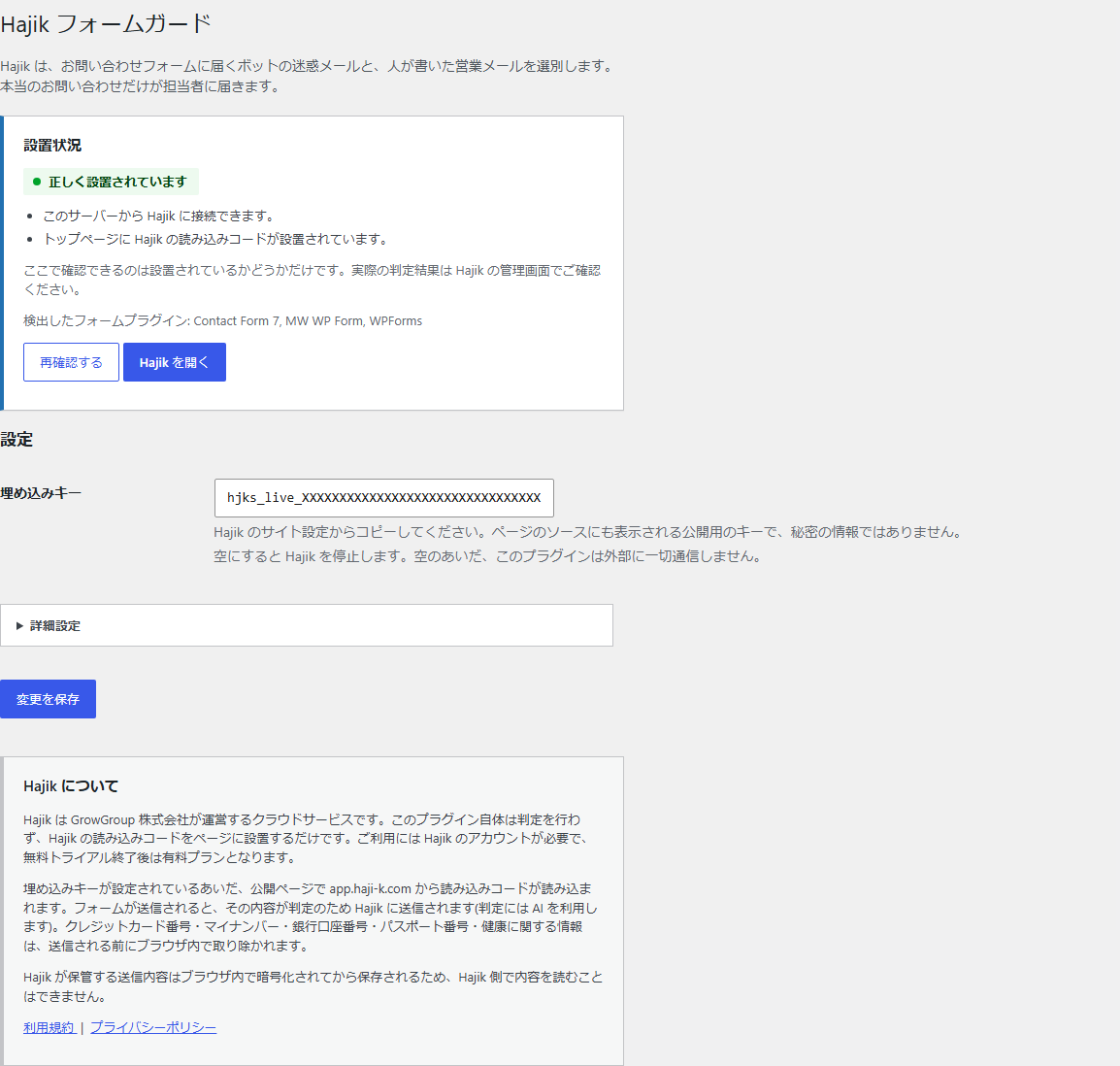
The settings screen once an embed key is configured, showing the installation check and the detected form plugins.
Contact forms attract two very different kinds of unwanted mail: bot spam, and sales emails written by real people. Traditional spam filters and CAPTCHAs handle the first and let the second straight through, so someone still has to read every message to find the enquiries that matter.
Hajik classifies both. An AI model reads what the message actually says, in Japanese, and separates genuine enquiries from sales outreach and spam, so your team only deals with the real ones.
What makes it different
- Built for Japanese-language forms. The AI classifier is designed around Japanese business writing and Japanese sales-email conventions, not translated from an English-first product.
- Filters sales emails, not just spam. Bot spam is the easy half. Hajik also identifies human-written cold outreach, which CAPTCHAs and keyword filters cannot see.
- Errs towards letting mail through. Missing a sales email is an inconvenience. Blocking a real customer is not. When Hajik is unsure, it treats the message as genuine and lets a person make the final call.
- No CAPTCHA for your visitors. Nothing to click, nothing to squint at.
- Your forms are not modified. The plugin never touches a form’s action, method, nonce or hidden fields.
What this plugin does
This plugin adds the Hajik SDK tag to your site and gives you one screen to manage it. It contains no filtering logic of its own — all classification happens on the Hajik service.
About the Hajik cloud service
Hajik is a cloud service operated by GrowGroup Inc. (haji-k.com). This plugin is a thin client for that service: the classification runs entirely on Hajik’s servers.
A Hajik account is required. There is a 14-day free trial with no credit card required, after which paid plans apply. The plugin itself is free and contains no locked features.
This is a service-integration plugin under section 6 of the WordPress.org plugin guidelines, “Software as a Service is permitted”:
https://developer.wordpress.org/plugins/wordpress-org/detailed-plugin-guidelines/#6-software-as-a-service-is-permitted
Privacy
Sensitive categories — credit card numbers, national ID numbers, bank account numbers, passport numbers and health information — are removed in the visitor’s browser before anything leaves the page.
Form content is then sent to Hajik to be classified, which involves an AI service. Submissions that Hajik stores afterwards are encrypted in the browser before being saved, so Hajik cannot read them.
External services
This plugin relies on the Hajik service, operated by GrowGroup Inc. It connects to one external host. If no embed key is configured, the plugin outputs nothing and no request to that host is made.
app.haji-k.com
- What it is: the host that serves the Hajik SDK and receives classification requests.
- When it is contacted: while an embed key is configured, every public page render enqueues
https://app.haji-k.com/v1/hajik.js?key=<your embed key>. The settings screen additionally requests that same file once to confirm it is reachable, and requests your own front page to confirm the tag is present. - What the plugin sends: your public embed key (an identifier beginning with
hjks_live_, which also appears in your page source and is not a secret), passed as a query parameter on the script URL. - What the visitor’s browser sends: standard browser identifiers (IP address, User-Agent, Referer, language headers) when loading the script. When a visitor submits a form, the SDK sends the submitted form content to Hajik to be classified, after removing sensitive categories in the browser. Classification involves an AI subprocessor; the privacy policy linked below covers this.
- What is never sent: WordPress administrator credentials, password hashes, WordPress secret keys or salts, authentication cookies, post content, or data belonging to other plugins.
- Service provider: GrowGroup Inc.
- Terms of service: https://haji-k.com/legal/terms
- Privacy policy: https://haji-k.com/legal/privacy