


DebugPay Toolkit for Payfast
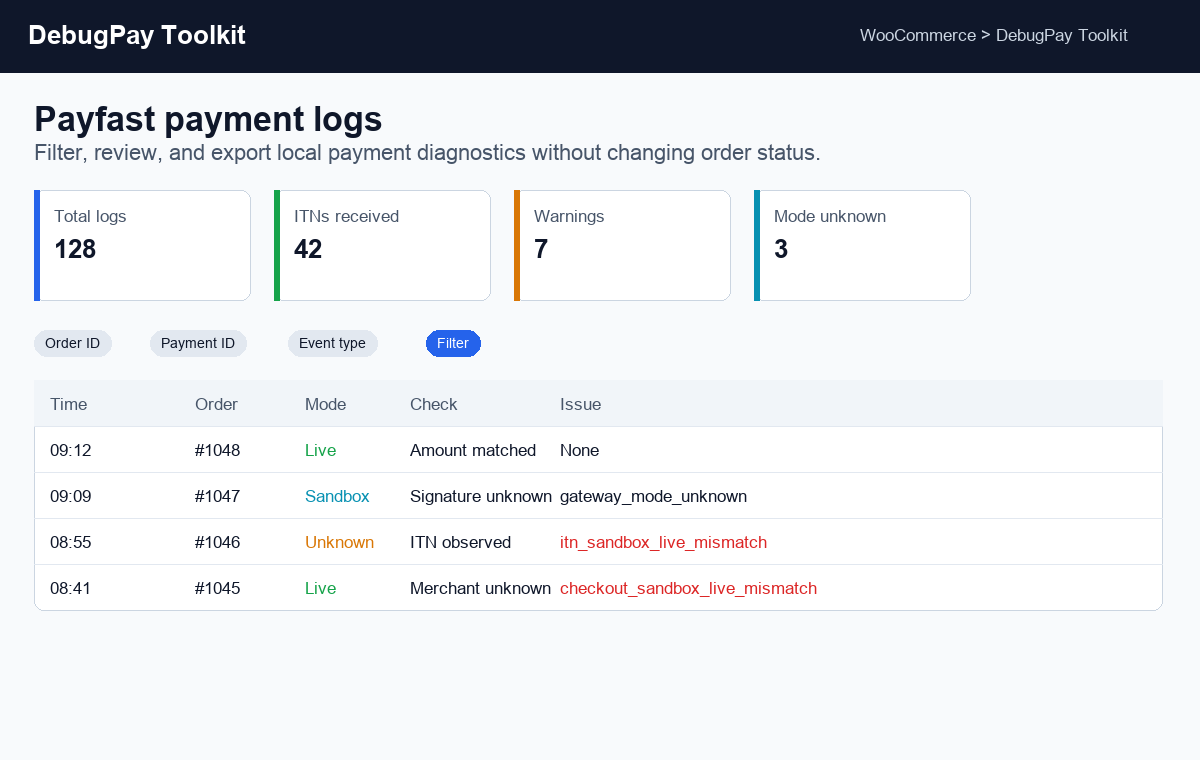
DebugPay Toolkit logs screen with Payfast payment diagnostics, filters, pagination, and issue labels.
DebugPay Toolkit for Payfast helps WooCommerce store owners, developers, and support teams investigate Payfast payment issues without acting as a payment gateway.
Use it when Payfast payment activity appears successful but a WooCommerce order stays pending, failed, cancelled, on-hold, or unpaid. The plugin creates local payment logs, order debug panels, and reports for comparing order activity, callback delivery, ITN observations, sandbox/live mode signals, and common mismatch symptoms.
The plugin records WooCommerce order creation events for Payfast-related orders, order status changes, likely Payfast ITN/callback metadata on recognized WooCommerce callback routes, and environment diagnostics. It does not change order statuses automatically.
This plugin does not include, register, enable, or replace a payment gateway. For full logging, your site must already have an active Payfast-compatible WooCommerce gateway that creates Payfast orders and receives Payfast callbacks. If no compatible gateway is detected, the admin screen shows setup diagnostics and a non-affiliated checklist.
DebugPay Toolkit for Payfast is an independent diagnostic tool and is not affiliated with, endorsed by, or sponsored by Payfast, WooCommerce, Woo, Automattic, or WordPress.
Key Features
- Custom database table for local diagnostic logs.
- WooCommerce > DebugPay Toolkit admin page.
- Summary cards, AJAX filters, AJAX pagination, log detail view, CSV export, and clear logs action.
- Settings for logging, retention, maximum logs, customer data masking, and uninstall cleanup.
- WooCommerce order admin payment debug panel.
- Human-readable copyable debug reports.
- Payfast Health Check with setup status, last activity, ITN/callback observation, issue counts, and recommended actions.
- Payfast Callback Readiness Check for SSL, permalinks, gateway detection, mode labels, and ITN history.
- Payfast Test Run Assistant for reviewing a manually tested WooCommerce order by order ID.
- Payfast Support Pack for sanitized order, health, and log context.
- Sanitized diagnostic report export for developers and support teams.
- Built-in issue guide for common Payfast payment gateway and WooCommerce order update problems.
- Issue classification for common payment/order mismatch scenarios.
- Site diagnostics for WooCommerce, Payfast gateway detection, SSL, permalinks, WP debug, and log table status.
- Setup guidance when no Payfast-compatible WooCommerce gateway is detected.
- Sandbox/live diagnostics that label activity as Sandbox, Live, or Unknown when safe signals are available.
- WordPress.org Live Preview blueprint for a quick browser-based demo environment.
What This Plugin Does Not Do
- It does not create, register, enable, or replace a Payfast payment gateway.
- It does not process payments or collect card or bank details.
- It does not automatically mark orders paid, cancel orders, or retry callbacks.
- It does not store Payfast passphrases, API secrets, passwords, or sensitive tokens.
- It does not claim official affiliation with Payfast, WooCommerce, Woo, Automattic, or WordPress.
Privacy
This plugin does not phone home, track usage, or load remote assets. It stores diagnostic data locally in your WordPress database.
The plugin avoids storing passwords, secrets, passphrases, API keys, sensitive tokens, and card or bank details. Diagnostic log rows include event details, order/payment identifiers, request IP address, and user agent. Customer email and billing phone are masked in generated reports by default.
Sandbox/live diagnostics are read-only. The plugin may inspect safe gateway settings, endpoint hostnames, and callback context to label activity as Sandbox, Live, or Unknown. It does not modify gateway mode and does not read or store Payfast passphrases, API secrets, or sensitive credentials.