
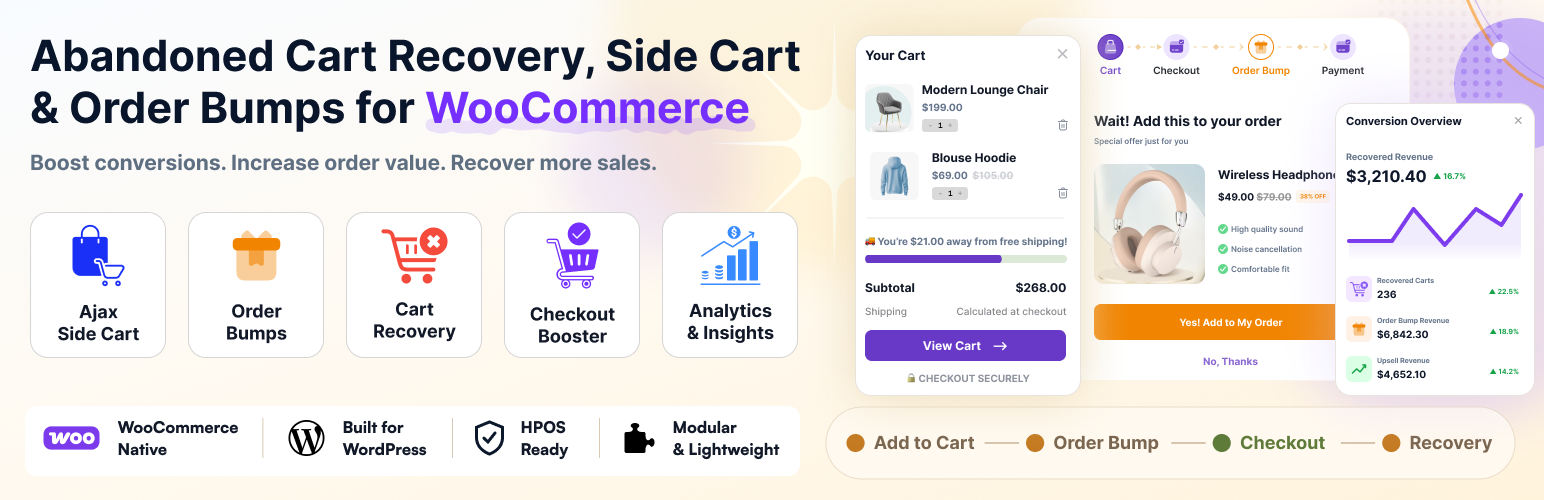

CartLane – Abandoned Cart Recovery, Side Cart & Order Bumps for WooCommerce
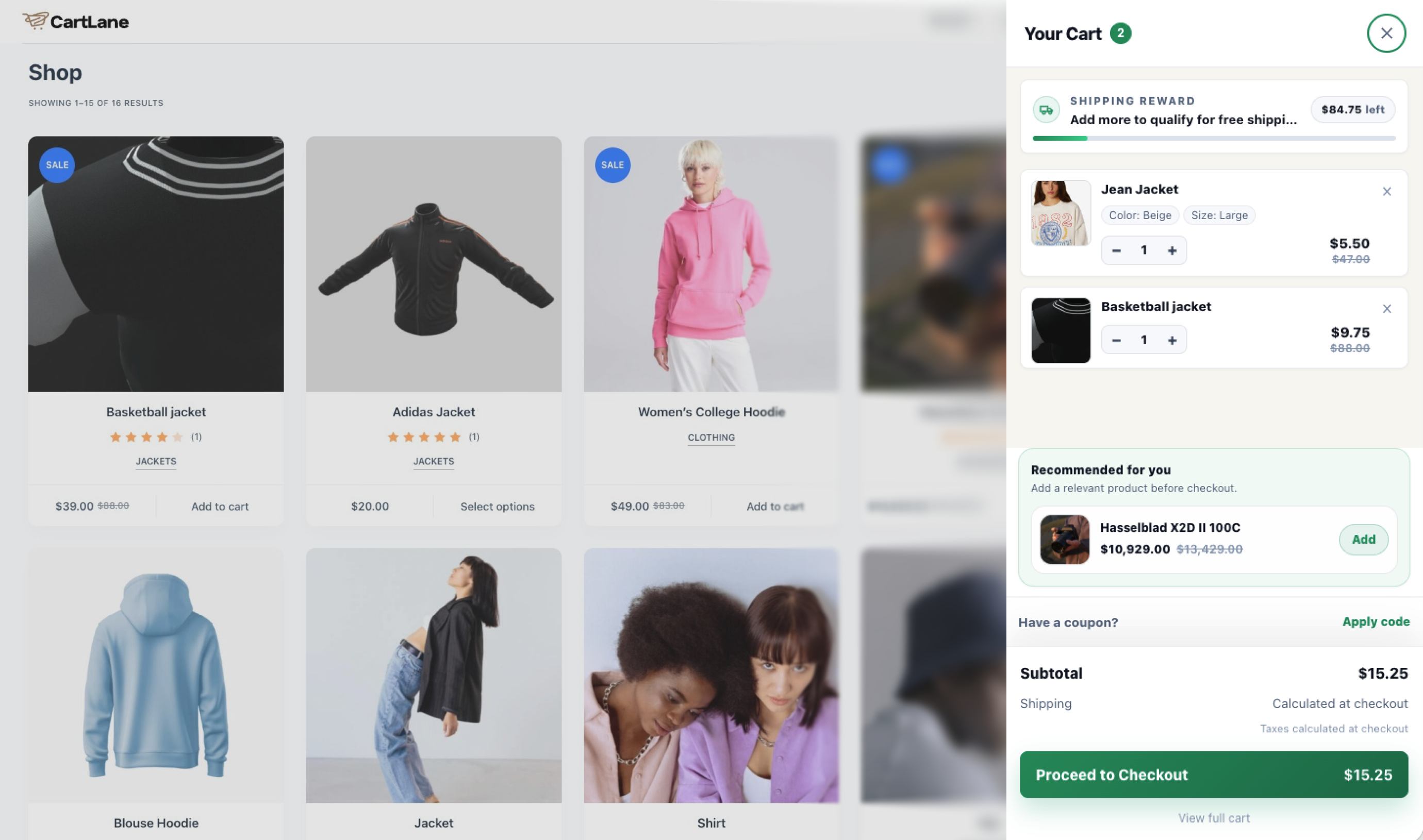
AJAX Side Cart on a WooCommerce shop page with quantity controls, product recommendations, coupon access, free-shipping progress, and live totals.
Recover Abandoned WooCommerce Revenue Without Another SaaS Subscription
CartLane helps WooCommerce stores recover shoppers who leave checkout, bring them back to the cart they left behind, and measure recovered revenue inside WordPress.
Start with abandoned-cart recovery, then enable the conversion tools your store needs: a fast AJAX side cart, checkout enhancements, one free order bump, and built-in revenue and conversion analytics. You do not need to stack separate plugins for each workflow.
Turn Abandoned Checkouts Into Recoverable Opportunities
When an eligible shopper provides an email address but leaves before completing checkout, CartLane can retain the cart session and run your configured recovery workflow.
- Capture eligible guest and registered-customer cart sessions
- Configure a recovery email sequence and timing
- Bring shoppers back with secure restore-cart links
- Preview recovery emails and send test emails before going live
- Resend recovery messages manually when needed
- Track abandoned, recovered, and recovery-attributed revenue
- Respect unsubscribe requests and scheduled data cleanup
Recovery email delivery depends on your WordPress email configuration. For reliable production delivery, use a properly configured transactional email or SMTP provider.
Why Store Owners Choose CartLane
CartLane keeps the cart, checkout, recovery, and conversion workflows together in one WooCommerce-focused experience.
- Recover shoppers who leave after entering their email address
- Reduce cart friction with a fast slide-out AJAX cart
- Increase average order value with relevant checkout offers
- Reinforce trust and urgency around checkout
- See revenue, order-bump, abandonment, recovery, and conversion signals in one place
- Keep built-in Free analytics data in your WordPress database without requiring a separate analytics SaaS account
- Load CartLane storefront assets conditionally so disabled or unrelated modules do not add unnecessary CartLane frontend payload
What You Get in CartLane Free
- Automated abandoned-cart recovery workflows
- Secure restore-cart links for recovery emails
- Recovery email preview and test-email workflow
- AJAX side cart with quantity controls, coupon support, and live totals
- Free-shipping progress messaging
- Checkout trust signals and urgency controls
- One active checkout order bump
- WooCommerce revenue and conversion analytics
- Recent privacy-safe analytics activity
- HPOS compatibility
- Conditional frontend asset loading
No coding is required. Enable the modules you need, configure them from the CartLane dashboard, and keep the rest switched off.
For setup guides and feature documentation, visit the CartLane documentation.
AJAX Side Cart for WooCommerce
Give customers a faster way to review and update their cart without leaving the page they are browsing.
- Slide-out AJAX cart drawer
- Increase, decrease, or remove cart items without a full page reload
- Apply and remove coupon codes inside the drawer
- Live subtotal, discount, shipping, and total updates
- Free-shipping goal and progress messaging
- Responsive layout for desktop, tablet, and mobile
- Accessible controls, labels, and keyboard behavior
- Store-page visibility controls
Checkout Optimization
Reduce friction and add confidence-building elements around the WooCommerce checkout.
- Checkout behavior and presentation controls
- Trust badge rows
- Countdown and urgency messaging
- Configurable accent presets
- Cleaner customer-facing checkout presentation
- Compatibility with supported classic and block-based WooCommerce flows
WooCommerce Order Bumps
Present a complementary offer during checkout and let customers add it to their order with one click.
- One active order bump in CartLane Free
- AJAX add-to-order interaction
- Product, category, and cart-condition targeting
- Classic, Highlight, and Minimal templates
- Configurable content order, colors, labels, and timer behavior
- Offer impression, acceptance, paid-conversion, and revenue reporting
Analytics and Conversion Activity
Use the built-in reporting tools to understand what is happening across your store.
- Store revenue and order summaries
- Average order value and conversion signals
- Order-bump performance
- Abandoned-cart and recovered-revenue reporting
- Recent privacy-safe conversion activity
- 7, 30, and 90-day reporting periods
- Bounded analytics queries and versioned report caching
Advanced revenue intelligence, complete event history, customer segmentation, investigation tools, advanced filters, and exports are available through CartLane Pro.
CartLane stores its operational and analytics records in your WordPress database. The free plugin does not require an external analytics SaaS account.
Built for Performance
CartLane is designed to load only what each experience needs.
- Vanilla JavaScript storefront runtime with no CartLane jQuery dependency
- Conditional CSS and JavaScript loading
- Route-based admin bundles
- Modern React-powered WordPress admin application
- Enforced production bundle budgets
- Dedicated database tables for CartLane workflows
- High-Performance Order Storage compatibility
Actual performance depends on your theme, hosting, WooCommerce configuration, product catalog, and other active plugins.
CartLane Pro
CartLane Pro extends the free plugin inside the same CartLane interface. Depending on the installed Pro version and active entitlement, Pro modules include:
- Visual funnel workflows
- Post-purchase upsells
- A/B testing
- Dynamic pricing and BOGO campaigns
- Role-based and quantity-based pricing
- Unlimited active order bumps
- Extended reporting ranges
- Advanced revenue intelligence and forecasting
- Customer segmentation and event investigation
- Advanced filters, complete history, and exports
- Advanced recommendations and revenue workflows
CartLane Pro requires the free CartLane plugin. Free features continue to work without a Pro license.
Compatibility
CartLane is built for WooCommerce and follows standard WordPress integration patterns.
- WordPress 6.3 or newer
- PHP 8.0 or newer
- WooCommerce 7.0 or newer
- Tested with WooCommerce up to the version declared above
- WooCommerce High-Performance Order Storage
- Common WordPress themes and page builders that preserve standard WooCommerce hooks
- Standard WooCommerce payment flows
Because themes, checkout customizations, and payment extensions can alter WooCommerce markup and behavior, test conversion features on a staging site before enabling them on a live store.
Privacy and Store Data
CartLane Free processes cart, checkout, order, recovery, and analytics data on your WordPress site to provide its features. Depending on the modules you enable, this may include customer contact details entered during checkout, cart contents, order references, campaign activity, visit/session identifiers, and recovery events.
Store owners are responsible for configuring appropriate privacy disclosures, consent flows, retention settings, and email practices for their jurisdiction and business.
Developer Information
CartLane includes a namespaced REST API and WordPress hooks used by its admin and storefront modules. Human-readable source archives and build instructions for released Free versions are available from the public source page linked near the end of this readme.
Development / Source Code
CartLane distributes compiled production assets in the installable plugin package.
The matching human-readable source code and build instructions for each release are published at:
View CartLane source code and build instructions
For every CartLane release, the source page publishes a versioned source archive, its SHA-256 checksum, matching build instructions, and historical source versions.
The public source archive includes the React, JavaScript, CSS, PHP, dependency lockfiles, and build configuration used to generate the distributed production assets. Rebuild the production assets from an extracted archive with:
npm ci

npm run build:assets
CartLane Pro source, licensing-server source, private planning, credentials, and deployment configuration are not included in the public Free-source archive.