


BackupRidge
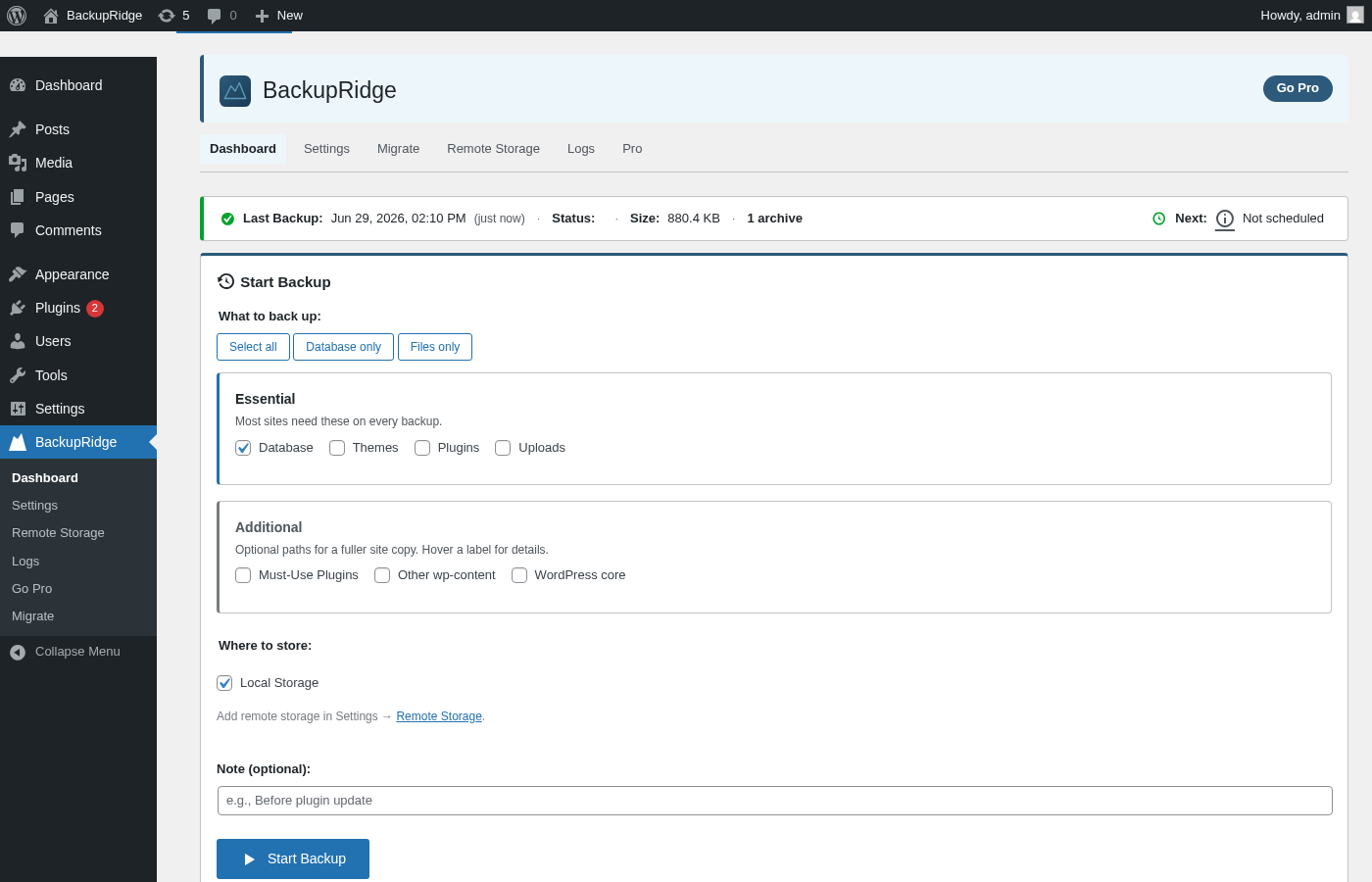
Dashboard — backup status, history, and one-click start, stop, continue, and retry.
BackupRidge is the WordPress backup plugin engineered to finish — even on cheap shared hosting. Most backup plugins assume a fast server, then quietly die when a 30-second PHP limit or a missed WP-Cron event cuts them off. BackupRidge saves a checkpoint at every step and resumes across requests, a watchdog revives stalled jobs, and pacing adapts to your host’s measured speed — so a full-site backup completes on hosting where other plugins give up.
Back up your database and files on a schedule, send the archives off-site, restore the whole site or only the pieces you need, and migrate a site to a new domain or host — from a dashboard that reports what actually happened, per destination, with real logs.
Back up to storage you control
Every backup can upload to one or more destinations:
- Amazon S3 backup — including any S3-compatible service
- Cloudflare R2 backup
- FTP backup and SFTP backup to your own server
- Local backup on the web server, protected from direct web access
- Google Drive backup, Dropbox backup, OneDrive backup, and Backblaze B2 backup with BackupRidge Pro
Your archives live in accounts you own. There is no vendor cloud in the middle, and nothing about restore depends on our servers.
Built for hosts that kill long requests
- Resumable everything — database export, file archiving, and uploads all checkpoint and continue across requests, so strict execution limits pause a backup instead of killing it.
- Backup watchdog — a cron-based watchdog detects stalled jobs (missed cron, loopback failures, hard process kills) and resumes them automatically.
- Host-aware tuning — the plugin measures your server’s real disk and upload throughput and sizes its work slices, archive parts, and pacing to match.
- Backup intensity control — pace backup I/O so a running backup doesn’t slow down your live visitors.
- Split archives — large sites are split into right-sized numbered parts that upload reliably and download individually.
Honest by design
- Restore is not a paywall. Restore, including component selection and migration receive, ships in this plugin at no cost — and archives are self-describing, so they restore on a brand-new install too.
- Per-destination truth. If a backup reaches two destinations and fails a third, the job says exactly that — no false green checkmarks.
- Real logs. Every job writes a readable log you can view and download, plus a one-click diagnostics bundle for support.
- We publish our restore tests. Every release goes through an automated backup wipe restore drill; results are public at backupridge.com/restore-log.
Free Features
- Resumable backups — Long-running backups save progress and resume from the last checkpoint so they finish on any host, including shared hosting with 30-second limits.
- Database backup — MySQL/MariaDB export via mysqldump (when available) or native PHP streaming with optional table filtering and row-level resumption.
- File backup — Back up wp-content (and optionally the full WordPress root) with exclusion patterns, compression, and optional archive splitting for large sites.
- Local storage — Store completed backups on the server filesystem. Optional subfolder under uploads (base:
wp-content/uploads/backupridge). - Remote storage — Add multiple destinations and upload completed backups to Amazon S3, Cloudflare R2, FTP, or SFTP.
- Scheduled backups — Run backups automatically on a daily, weekly, or custom schedule via WP-Cron, with a REST endpoint available for triggering from an external system cron.
- Restore — Restore from a local backup, remote storage, or an uploaded archive, with component-level selection (database, themes, plugins, uploads, core) so you only restore what you need.
- Site migration (receive) — Bring another WordPress site into this one: upload its backup archive via Import Backup on the Dashboard (split/multi-part archives supported) and restore it — old domain URLs are replaced with this site’s URL automatically. The Migrate admin page handles live site-to-site transfer (receiving a push sent from BackupRidge Pro, plus history).
- Import All-in-One WP Migration (
.wpress) archives — Upload an existing AIOWM export via Import Backup (orwp backupridge import) and restore it directly, with no size limit — unlike AIOWM’s own free-tier 512 MB import cap. Database table prefixes and site URLs are remapped automatically during restore. - WP-CLI discover/import —
wp backupridge discoverscans for archives already placed underwp-content/uploads/backupridge/backups/(e.g. copied over viascp) and registers them in Backup History;wp backupridge import <path>does the same for a single archive file anywhere on disk. Both are the scriptable equivalent of the Dashboard’s “Discover local backups” / “Import Backup” buttons — useful for disaster-recovery runbooks that rebuild a site entirely from the command line. - WP-CLI remote orphan scan/delete —
wp backupridge remote-orphans scan <provider-id>lists archives on a remote storage destination that this site’s Backup History no longer tracks, classified by likely cause;wp backupridge remote-orphans delete <provider-id> <group-key>removes one such group after confirmation (--yesto skip). The scriptable equivalent of the Dashboard’s remote orphan scan, for agencies managing storage across many sites from the command line. - Dashboard — View backup status, history, progress, and logs. Start, stop, continue, or retry backups from the admin UI.
- Backup watchdog — A cron-based watchdog recovers backups that stall due to missed cron events or loopback failures.
- Custom backup filenames — Choose a filename prefix (BackupRidge, site URL, or site name) with automatic date/time stamping.
- Multi-part downloads — Download each archive part from the dashboard, or use Download All to queue sequential direct downloads (reliable on shared hosting).
- Log viewer — Browse and download per-job log files directly from the admin UI.
- Email notifications — Optional email after a successful and/or failed backup (you choose), sent to a configurable address that defaults to the site admin email if left blank; the address and which outcomes to notify are in Settings Notifications.
- Webhook notifications — Optional HTTP POST after a successful and/or failed backup (you choose): generic JSON, Slack incoming webhook, or Discord webhook format; URL, format, and which outcomes to notify are in Settings.
- Update-screen warning — See a notice on WordPress update screens when no backup has been created in the last 24 hours.
Pro Features
- More cloud providers + OAuth — Connect Google Drive, Dropbox, OneDrive, and Backblaze B2 with easy OAuth sign-in—no manual API keys required.
- Incremental backups — Only back up files that changed since the last run, reducing time and storage.
- Archive encryption — AES-256-GCM authenticated encryption for backup archives before upload (legacy AES-256-CBC archives are still decryptable for restore). The encryption key can be downloaded from Settings Encryption and imported on another site — save a copy before you need it, since the key lives only on this site and encrypted backups cannot be recovered without it.
- Advanced scheduling — Multiple independent schedules with time-of-day, day-of-week, 5-field cron expression support, and per-schedule settings overrides.
- Backup verification — SHA-256 integrity checks on every archive part after backup completes.
- System cron integration — Managed system cron setup and WP-CLI commands for triggering and automating backups, instead of relying on WP-Cron.
- Custom filename templates — Build filenames from placeholders (
{type},{seq}, and more) instead of a fixed prefix. - Tiered (GFS) retention — Grandfather-Father-Son backup retention: keep a shrinking set of daily, weekly, monthly, and yearly backups instead of only the most recent N, with per-schedule overrides and a live preview of exactly what a policy would keep and delete before you save it.
- Advanced webhooks — Multiple webhook endpoints, each with its own URL, custom JSON/text payload templates, optional HMAC-SHA256 request signing and custom headers, automatic retries, and a phase-transition event fired as a job moves through the backup pipeline.
- Concurrent backups — Run more than one backup job at a time instead of queueing them one after another.
Requirements
PHP 8.0 or higher, WordPress 6.7 or higher. The backup directory (default wp-content/uploads/backupridge) must be writable by the web server.
Support
Without a license: please open a thread in BackupRidge’s support forum — the Support tab on this plugin’s directory page. We read every thread.
Pro license holders get a priority support channel: use the Support link in the plugin footer (Dashboard, Settings, Log Viewer, etc.) or go directly to backupridge.com/contact. When your license is active, the in-plugin link automatically carries your license key and plan so your ticket is prioritised at intake.
Whichever channel you use, attaching diagnostics up front avoids back-and-forth over “what PHP version / what host / is cron working?”:
- Log Viewer (BackupRidge Logs) — copy or download the log for a specific backup job as plain text.
- Support Bundle (also in the Log Viewer) — a one-click report combining your host environment, host capabilities, WP-Cron status, and a redacted summary of your settings. Copy it to your clipboard or download it as a
.txtfile and attach it to your ticket.
External services
BackupRidge can upload backup archives to third-party cloud storage services configured by the user. No data is sent to any external service unless the user explicitly configures a storage provider.
Links to backupridge.com and stavatech.no are informational website links and do not receive backup data from the plugin.
Amazon S3
Used to store backup archives via the S3 API. Signed requests with user-provided credentials and backup files are transmitted when the user configures S3 storage.
* AWS Customer Agreement
* AWS Privacy Notice
Cloudflare R2
Used to store backup archives via S3-compatible API calls. Signed requests with user-provided credentials and backup files are transmitted when the user configures R2 storage.
* Cloudflare Terms
* Cloudflare Privacy Policy
FTP
Used to upload backup archives to a host, port, and credentials supplied by the site administrator. Data is transmitted only when the user configures FTP storage.
This connection targets a user-selected server endpoint (self-hosted or third-party chosen by the site owner), so no single provider Terms or Privacy policy applies.
SFTP
Used to upload backup archives over SSH file transfer to a host, port, and credentials (or key) supplied by the site administrator. Data is transmitted only when the user configures SFTP storage.
This connection targets a user-selected server endpoint (self-hosted or third-party chosen by the site owner), so no single provider Terms or Privacy policy applies.
Google Drive (BackupRidge Pro only)
Not included in the WordPress.org download. When installed separately, BackupRidge Pro can upload backups via the Google Drive API using OAuth and user-granted access. Backup file data and metadata needed for the upload are sent to Google when the user configures this provider and runs a backup. Setup requires enabling the Google Drive API on your Google Cloud project (not only OAuth credentials). See https://backupridge.com/docs/cloud-storage#google-drive
Dropbox (BackupRidge Pro only)
Not included in the WordPress.org download. When installed separately, BackupRidge Pro can upload backups via the Dropbox API using OAuth. Backup file data is sent to Dropbox when the user configures this provider and runs a backup. Setup requires enabling file permissions on your Dropbox app and clicking Submit in the Permissions tab before OAuth. See https://backupridge.com/docs/cloud-storage#dropbox
Microsoft OneDrive (BackupRidge Pro only)
Not included in the WordPress.org download. When installed separately, BackupRidge Pro can upload backups via Microsoft Graph / OneDrive using OAuth. Backup file data is sent to Microsoft when the user configures this provider and runs a backup. Setup requires an Azure app registration with a redirect URI of wp-admin/admin.php (no query string) and account types matching your Microsoft sign-in. See https://backupridge.com/docs/cloud-storage#onedrive
Backblaze B2 (BackupRidge Pro only)
Not included in the WordPress.org download. When installed separately, BackupRidge Pro can upload backups to Backblaze B2 via the Backblaze B2 Native API. It calls https://api.backblazeb2.com to authorize the session with the user-provided Key ID and Application Key, then uploads the backup archive parts. Backup file data is sent to Backblaze only when the user configures this provider and runs a backup.
HTTP webhooks (backup status)
When webhooks are enabled in Settings, the plugin can send an HTTP POST to the URL you provide after a backup succeeds and/or after it fails, depending on the checkboxes you set. Choices: generic JSON (job id, status, size, duration, timestamp), Slack incoming webhook (JSON with a text field), or Discord webhook (JSON with a content field). Data is sent only to your URL; the receiving service’s terms apply if you use Slack or Discord.
REST / cron trigger (this plugin)
Optional: a REST URL with a secret key can be called by system cron so the site can run backup segments without WP-Cron or loopback. Requests go only to the same WordPress site; no third party receives data unless the site owner configures something else.
Preferred authentication: send the key in the X-BackupRidge-Cron-Key request header. Legacy ?key= query authentication remains supported for compatibility, but query strings can be logged by proxies and web servers.
Source Code
This plugin ships its full, human-readable source. Every minified script in assets/js/dist/ has its un-minified source in assets/js/src/, and the minified stylesheet assets/css/admin.min.css has its source in assets/css/admin.css, inside the same plugin package, so each compiled file can be reviewed and rebuilt. No source is removed during packaging.
Build tools and steps to regenerate the compiled assets:
- Requirements: Node.js 18+ and npm.
- Install dependencies:
npm install - Build JS and CSS (terser minifies each
assets/js/src/*.jsintoassets/js/dist/, and PostCSS/cssnano minifiesassets/css/admin.cssintoassets/css/admin.min.css):npm run build
PHP dependencies are managed with Composer (composer install). No third-party JavaScript libraries are bundled in a minified-only form; all shipped scripts are first-party and their sources are included as described above.