


AI Product Tools – Bulk Product Content Generator & AI Toolkit for WooCommerce
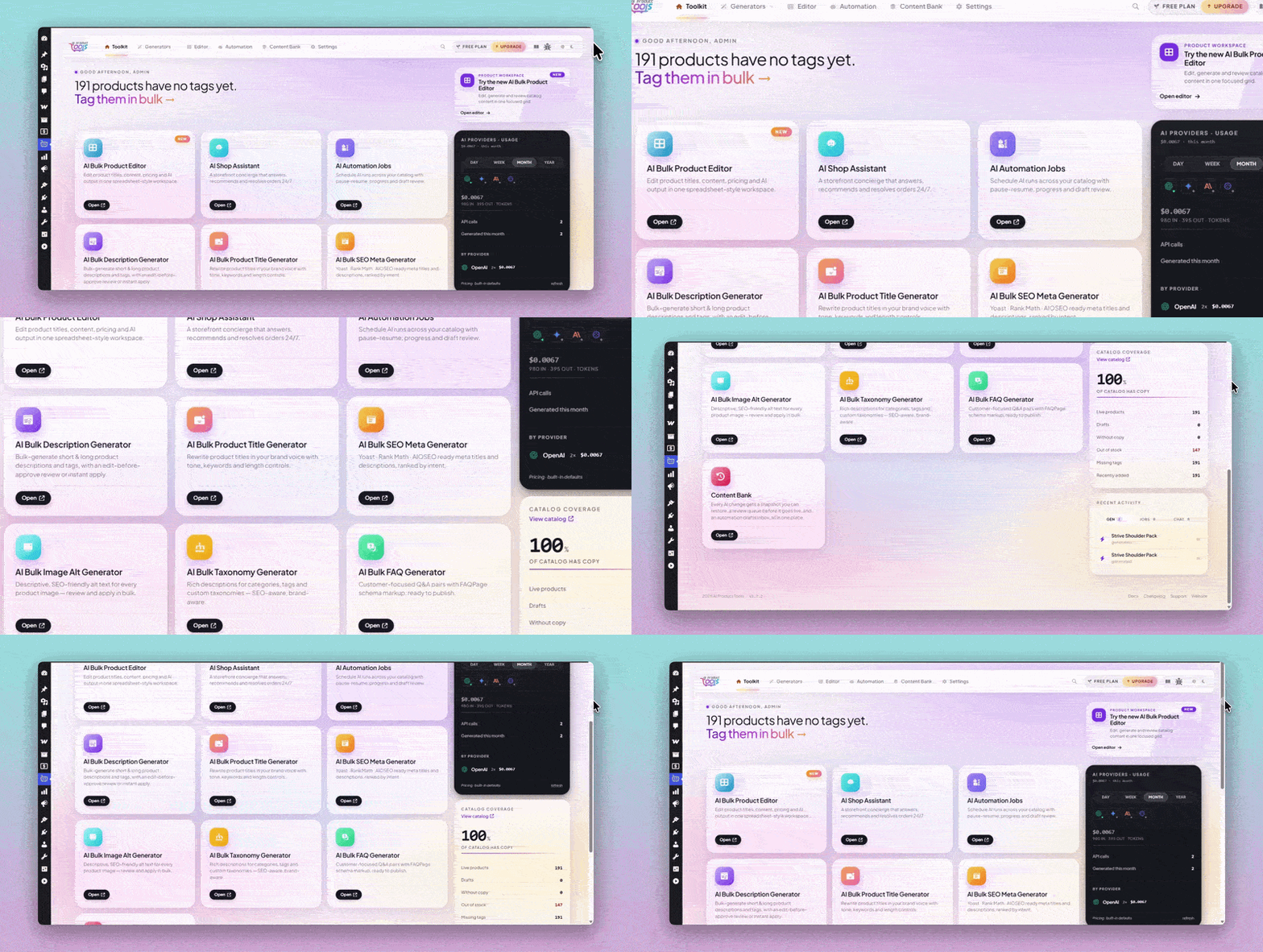
AI Toolkit Dashboard
AI Product Tools is a comprehensive AI suite designed to automate your WooCommerce operations and enhance customer experience. It combines high-volume bulk product content generation with a store-aware AI Shop Assistant, so one plugin covers both the content work in your admin and the product help your shoppers see.
You bring your own key. Connect OpenAI, Google Gemini, Anthropic Claude, or OpenRouter and you deal with that provider directly: your account, your billing, your rates. There are no credits to buy from us, no usage meter, and no markup. Switch provider or model whenever you like, test with a free OpenRouter model, and work at whatever volume your provider account allows.
🚀 What you can do
- Generate product descriptions, product titles, product tags, FAQs, SEO meta, and image alt text for many WooCommerce products at once.
- Edit hundreds of products in a spreadsheet-style grid without opening each one.
- Check and edit every AI result before it touches your live products.
- Roll back to what a product said before an AI change.
- Answer shopper questions on your storefront with an assistant that reads your real catalog.
- Schedule content work to run in the background instead of watching a progress bar.
⚡ Bulk Product Content Generators
Filter your products, generate, review the results, then apply them. Every generator lets you retry one failed product instead of restarting the run, and the review step is free for everyone.
Product descriptions. Short and long product descriptions, plus product tags, up to about 1,000 products per run. Plain text or HTML, keep or replace existing content, improve an existing description instead of rewriting it, 42 languages, 10 writing styles, custom prompts. Business adds a saved review queue, style matching from your own example descriptions, and mapping custom fields such as {custom1} into prompts, including Advanced Custom Fields.
Product titles. Up to 5,000 products per run, 1 to 5 variants each, with an optional slug update. Six tones are free: SEO-Focused, Professional, Casual, Luxury, Technical, and Persuasive. Three length presets: Short at 40 characters, Medium at 60, Long at 80. Business adds Improve Title mode for rewriting an existing title, focus keyword targeting, four more data sources, and extra prompt instructions.
Product SEO meta. Meta titles and meta descriptions with a live search result preview and a score, up to about 1,000 products per run. Six tones, your own focus keywords, two variants per product, titles within 60 characters and descriptions within 160. Writes to Yoast SEO, Rank Math, All in One SEO, SEOPress, The SEO Framework, and Squirrly SEO. Business adds up to five variants, AI suggested focus keywords, extra prompts, and custom length limits.
Product FAQs. Question and answer pairs from your product data, 1 to 10 per product, shown on the product page as an accordion or a flat list in the default theme, or placed anywhere with [aipt_faq] and [aipt_faq product_id="123"]. New FAQs are added alongside existing ones. Business adds replace mode, questions-only and answers-only modes, five other display themes with control over colors, typography, spacing, borders, icons and animations, custom CSS, and FAQ structured data for search engines.
Product image alt text. Vision models describe your featured images, gallery images, or both. Preview, edit, regenerate one result, or dismiss it before applying. Length is adjustable from 50 to 250 characters, default 125, and images up to 20 MB are supported. Business adds reusable templates, A/B variants, product attribute enrichment, and expanding older galleries.
Category and tag descriptions. Descriptions for WooCommerce product categories, tags, and public custom taxonomies, written in a split screen workspace with a rich text editor. Four purposes, four term data sources, six tones, three lengths, HTML or plain text, and append, overwrite, or skip behaviour. The AI reads up to 10 sample products per term. Business adds a custom purpose, two more data sources, and 5 to 20 samples per term. Bulk tag suggestions are also included on every plan.
🧮 AI Bulk Product Editor
A spreadsheet-style grid for editing many products at once, without opening each product page.
- Edit titles, descriptions, tags, FAQs, SEO fields, slugs, and image alt text in the cell.
- Compare an AI suggestion against your current text word by word, then accept or reject per cell.
- Undo and redo up to 100 steps, save up to 25 personal views, and stay protected against overwriting a colleague’s change.
- Generate AI content one row at a time.
- Generate or retry many selected rows in one action, with advanced per run settings. (Business)
🛍️ AI Shop Assistant
An assistant on your storefront that answers from your own catalog, not from generic web knowledge.
- Recommends up to 10 products per answer, with View Product buttons and live stock status.
- Answers store questions from knowledge pages you choose, such as shipping or returns.
- Detects the visitor’s language automatically, with a fallback you set, and works on mobile and in right to left languages.
- Add a WhatsApp button and a pre-chat consent step.
- Set the bot name, greeting, colors, typography, position, and launcher icon.
- Saves questions it could not answer to an admin queue, so nothing is lost.
- Add an Add to Cart button, choose response depth and behaviour modes, upload a custom icon or hero image, add custom CSS, pick extra themes and launcher animations, translate every label, and reply to queued questions yourself. (Business)
📦 Store index for the assistant
The assistant answers from a compressed, searchable copy of your catalog, built in batches so large stores stay responsive.
- On every plan the index covers seven fields: product title, short description, full description, categories, tags, price, and stock status.
- Build one index profile manually, filtered by stock status or date, covering up to 50,000 products per build with 10,000 as the default.
- Add SKU, stock quantity, and product attributes, run several profiles, filter by category and tag, and rebuild on a schedule. (Business)
🗓️ Scheduled Bulk Runs
Set up a content job and let it run in the background through WP-Cron, instead of keeping a browser tab open.
- Run one job at a time, covering one content type, started manually or at a time you choose.
- Filter products by price range, product IDs, description or keyword match, include and exclude lists, AND/OR logic, and whether the AI already processed them.
- Watch progress and estimated completion, read logs, retry failed products, and pause, resume, or stop at any point.
- Run several jobs at once, each covering several content types, on daily, weekly, or monthly schedules. (Business)
- Filter by category, tag, and stock status. (Business)
- Start a run when a product is published or changes, and use review policies, draft review, and automatic pausing after repeated errors. (Business)
On a Business licence this area is called Automation in the admin menu.
🗂️ Content Bank
One page with three tabs, covering everything the AI changes on your store.
Content History is available on every plan. Before any AI change is applied, the plugin stores the previous value, so you can always see what a product said before. You get a timeline with before and after views, and you choose how many versions to keep per field, from 1 to 10, with 5 as the default. The original is never removed. Products the AI has touched are marked, so you can filter your catalog by AI status and skip anything already processed.
Review Content holds results you generated but have not applied, across the description, title, FAQ, SEO meta, and image alt generators. On every plan you preview, edit, approve, and reject in the current browser session, and nothing is written to your site until you approve it.
Draft Content collects output from scheduled runs that is waiting for a decision, where you approve, reject, or bulk manage drafts. (Business)
- Restore an earlier version with one click, or in bulk, up to 50 selected items or 200 items for a whole product. Each restore is recorded, so you can undo an undo. (Business)
- Keep the review queue on your site so results survive a page reload. (Business)
🛠️ Dashboard, Prompt Studio, and integrations
- One dashboard for every tool, with recent activity, usage statistics, and provider connection status, plus a command palette on
Ctrl+KorCmd+K. - The Visual Prompt Builder walks you through prompt creation for all five generators, with a live preview, so you do not write instructions by hand.
- Set your brand voice and store context once, and every generator reuses it. Save and reuse your own prompt templates.
- Work from the single product edit screen and the scheduling screens, and page through large catalogs 10, 25, 50, or 100 products at a time.
- Open prompt editors for the Title, FAQ, SEO Meta, Taxonomy, and Image Alt generators, create your own prompt variables, use AI assisted prompt filling and polishing, and share or import community prompt templates. (Business)
- Works with WordPress AI Connectors on WordPress 7.0 for OpenAI, Google Gemini, and Anthropic Claude credentials. OpenRouter keys stay in the plugin.
- Registers abilities through the WordPress Abilities API, so MCP capable clients can call them.
💡 What is free and what Business adds
Creating content is free. Business is the operations layer for stores that run this work regularly.
Free on every site:
- Bulk generation for product descriptions, product titles, product tags, FAQs, SEO meta, image alt text, and category descriptions.
- Preview, edit, approve, or reject every result before it is saved.
- Content History, so you can see what a product looked like before each AI change.
- The AI Shop Assistant, with product recommendations and appearance settings.
- The AI Bulk Product Editor grid, with row by row generation.
- One scheduled bulk run, started manually or at a time you pick.
- All four AI providers, every model in the catalog, and your own OpenRouter model IDs.
Business Plan adds:
- A review queue saved on your site, so results survive a page reload.
- One click restore and bulk rollback from Content History.
- Draft review for scheduled runs.
- Recurring daily, weekly, and monthly schedules, several jobs at once, and category, tag, and stock filters.
- Add to Cart in the shop assistant, plus extra themes, custom CSS, and label translation.
- Generating for many selected rows at once in the Product Editor.
Customers on the earlier Pro plan keep their Pro features. Sites already running the plugin before version 2.7.2 keep their Review Content and Draft Content access.
🔒 External Services and Privacy
This plugin makes the external requests described below only after an administrator completes the relevant setup or opt-in, or when a configured feature is used. AI provider keys are encrypted in your database or managed by WordPress AI Connectors. Keys are never sent to AI Product Tools servers.
AI providers
OpenAI (api.openai.com), Google Gemini (generativelanguage.googleapis.com), Anthropic Claude (api.anthropic.com), and OpenRouter (openrouter.ai) provide AI generation, automation, chatbot, key validation, and model-catalog features. An administrator must select a provider and provide an account/API key, either in the plugin or, where supported, through WordPress AI Connectors. Requests occur only when configured features are used. The selected provider bills the user directly.
Generation, automation, and chatbot requests send the selected model, API key, prompts, and relevant product or store context: titles, descriptions, categories, tags, attributes, prices, stock, SEO inputs, prompt variables, chatbot messages, and store-index snippets. Image-alt generation also sends encoded image data. Key validation sends the key, and model catalogs may be fetched when needed. OpenRouter additionally receives the site URL and plugin name in request headers.
Policies: OpenAI API Terms, OpenAI Privacy, Gemini API Terms, Google Privacy, Anthropic API Terms, Anthropic Privacy, OpenRouter Terms, OpenRouter Privacy.
Licensing and plugin services
Freemius (freemius.com) provides paid licensing, plan checks, checkout, updates, and optional usage reporting through its SDK. An administrator starts or opts into the connection; free features do not require a licence. Freemius may receive site and administrator contact details, environment and plugin data, usage events, and, for plan validation, the install ID, plugin ID, signed headers, and licence metadata it already holds. It never receives product content, chatbot messages, or AI keys. Freemius Terms and Freemius Privacy.
AI Product Tools services (api.aiforwoo.com) include two features. The pricing feed obtains public provider prices for cost estimates, on a schedule or when requested. It sends the plugin version and site home URL, but no product data, chat content, or keys. The optional Business Community Prompt Library is contacted only when an administrator opens, submits, imports, or likes a prompt. It sends the site URL, timestamp, authentication signature, optional filters, and, where relevant, template name, description, generator type, language, tags, prompt data, or prompt ID. The site URL supports anonymous deduplication. AI Product Tools Terms and AI Product Tools Privacy.
Service availability and remote images
If enabled, chatbot provider status probes contact OpenAI (status.openai.com), Anthropic (status.claude.com), or Google (status.cloud.google.com) only after a chatbot provider error. They help determine whether service can resume and send no product data, chat content, settings, or keys. OpenRouter has no default probe. The provider policies above apply.
For administrator-started image-alt generation, an image stored on an external http or https host may be retrieved before it is sent to the selected AI provider. That host receives only request metadata needed to fetch the image, never keys or prompt text. Its own terms and privacy policy apply.