


AI Featured image
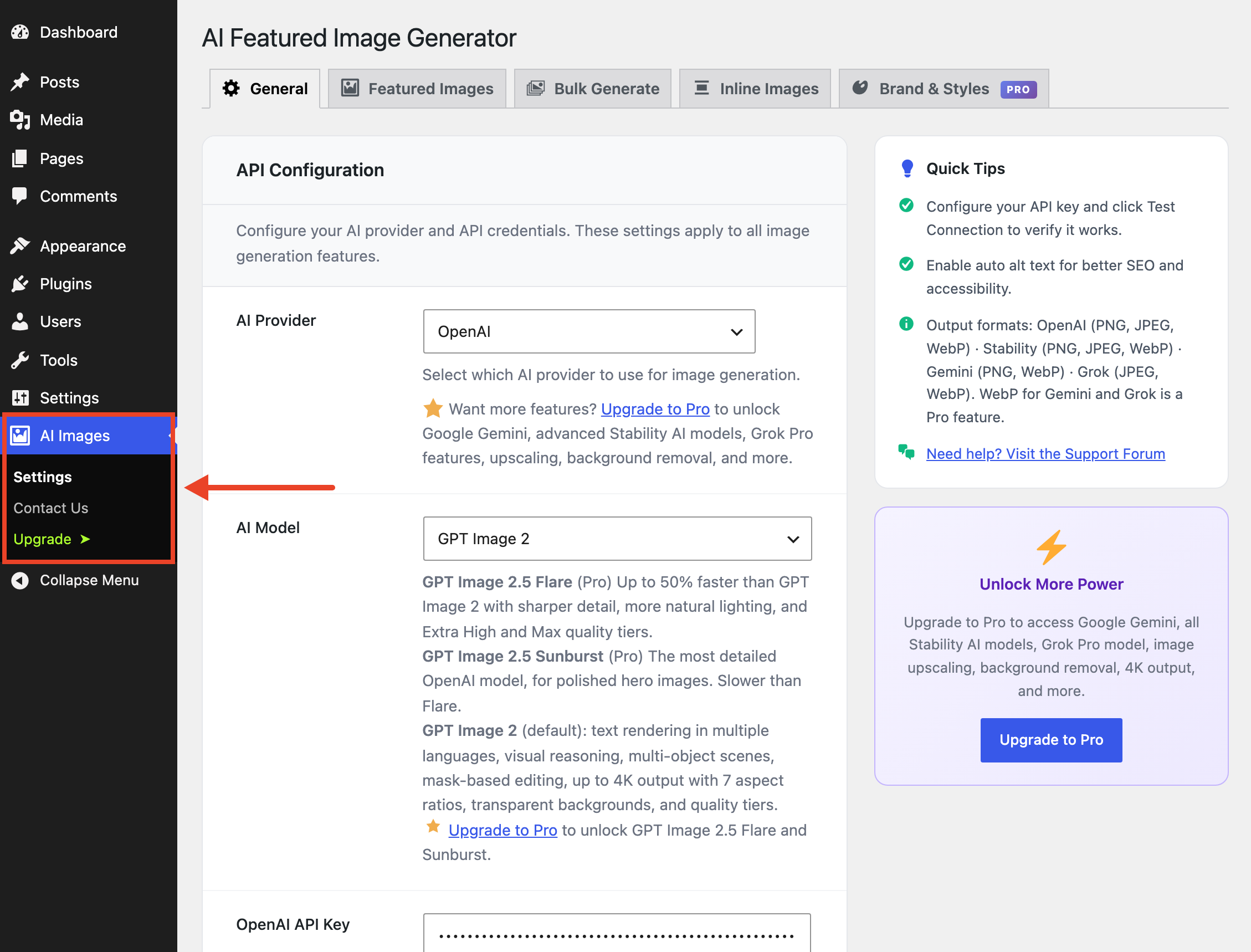
General settings: API configuration, AI provider, and AI model selection
AI Featured Image Generator creates AI-powered featured images right from the WordPress editor. Click “Generate Featured Image” on any post and the plugin builds a unique image from your post title, chosen style, and optional custom prompt, using OpenAI, Stability AI, or Grok/xAI on the free plan, or Google Gemini on Pro.
Every image gets alt text automatically and an SEO-friendly filename based on your post title. Generate one at a time in the editor, in bulk, straight from the Posts list, or inline in your content with the AI Image Generator block. Everything is managed from one settings hub.
Video Walkthrough
Free Features
- 3 free AI providers: OpenAI, Stability AI, and Grok/xAI (Google Gemini available on Pro)
- OpenAI models: GPT Image 2 (default): excels at text rendering in multiple languages, visual reasoning, multi-object scenes, transparent backgrounds, mask-based editing, and up to 4K output
- Stability AI: Stable Image Core with 16 native style presets (Photographic, Cinematic, Anime, Digital Art, Comic Book, Fantasy Art, and more)
- Grok/xAI: Grok Imagine Image: fast and affordable at $0.02 per image
- 21 style presets: Common (None, Realistic, Artistic, Cartoon, Minimalist), Creative (Sketch, Watercolor, 3D Render, Pixel Art, Cyberpunk, Fantasy, Anime, Technicolor), and Trending (Toy Figure, Miniature World, Claymation, Cinematic, Lo-Fi Cozy, Vintage Instant Photo, Magazine Collage, Paper Cut)
- Custom prompts: plus one-click Generate Prompt from Content, which crafts an AI-optimized prompt from your post title and body (OpenAI and Grok free; Gemini on Pro)
- 7 image sizes with GPT Image 2 and 2.5: square, portrait, landscape, widescreen 16:9, vertical 9:16, ultra-wide 3:1, and tall banner 1:3
- 3 aspect ratios for Stability AI and Grok: 1:1, 16:9, and 9:16
- Output control (OpenAI): WebP/PNG/JPEG format, compression slider (1–100), and Low/Medium/High generation quality (Extra High and Max on GPT Image 2.5, Pro)
- Text control: allow or block text, captions, and words in generated images
- Auto alt text: from the post title, the prompt, or a custom template with
{title},{prompt},{style}, and{site_name}placeholders. with an option to preserve manual edits on regeneration - Bulk Generate: up to 5 posts per batch, 50 images lifetime on the free plan
- Generate from Post List: an “AI Featured Image” column on the Posts/Pages list with a one-click Generate/Regenerate link, so there is no need to open the editor, and it doesn’t count against the free bulk limit
- Inline images: the AI Image Generator block adds AI images anywhere in your Gutenberg content, with its own settings tab
- Multisite compatible
Pro Features 🚀
- Google Gemini: Nano Banana (Gemini 2.5 Flash), Nano Banana 2 Preview (Gemini 3.1 Flash), and Nano Banana Pro (Gemini 3 Pro): up to 4K resolution and 10 aspect ratios
- GPT Image 2.5 (OpenAI): GPT Image 2.5 Flare (fast, recommended) and GPT Image 2.5 Sunburst (best detail), with Extra High and Max generation quality and a one-click “Retry with Sunburst” button in the post editor
- Image upscaling (Stability AI): Conservative (faithful 4x), Creative (AI-enhanced 4K), or Fast (quick 4x), right from the post editor
- Background removal (Stability AI): one click isolates the subject and saves a transparent PNG as your featured image
- Advanced Stability AI models: Stable Image Ultra, SD 3.5 Large / Large Turbo / Medium / Flash, SD 3 Large / Large Turbo / Medium, and SDXL 1.0
- Negative prompts (Stability AI): exclude unwanted elements, e.g. “blurry, watermark, text, low quality”
- Grok Imagine Image Pro: higher quality at $0.07 per image, plus 2K resolution
- More aspect ratios: 9 for Stability AI, 9 for Grok, 10 for Gemini
- More output formats: PNG/JPEG/WebP for Stability AI, and automatic WebP conversion for Gemini and Grok images
- Unlimited Bulk Generate: hundreds of posts at once with filters for post type, status, date range, and thumbnail status, plus real-time progress
- Custom post types: enable generation for any public post type
- Custom styles: create named styles with your own prompt descriptions, available in every style dropdown
- Brand Kit: save your brand colors, a style description, tone, and avoid-rules, plus an optional reference image (used by Google Gemini) and a logo watermark, applied automatically to every image you generate, with a per-image “Use Brand Kit” toggle to skip it
Want to unlock Google Gemini AI, image upscaling, background removal, unlimited bulk generation and more? Upgrade to Pro here.
Requirements
- WordPress 5.8 or higher
- PHP 7.4 or higher
- An API key for at least one provider:
- OpenAI (free plan)
- Stability AI (free plan)
- Grok/xAI (free plan)
- Google Gemini (Pro only)
External Services
This plugin connects to your chosen AI provider’s API to generate images. For every provider:
- Your post title and content (or your custom prompt, and for Stability AI any negative prompt) are sent to the provider’s API when you generate an image
- Your API key for that provider authenticates each request
- Requests are only sent when you trigger generation: from the post editor, the Posts list, Bulk Generate, or the AI Image Generator block
- “Generate Prompt from Content” sends your post title and body to the provider’s text API: gpt-4o-mini (OpenAI), grok-3-mini (Grok), or Gemini 2.5 Flash (Gemini, Pro)
OpenAI (Free & Pro): image generation and prompt generation.
Terms of Service | Privacy Policy | API Documentation
Stability AI (Free & Pro): image generation; for Pro users, upscaling and background removal also send your existing featured image file to Stability AI for processing.
Terms of Service | Privacy Policy | API Documentation
Grok / xAI (Free & Pro): image generation and prompt generation.
Terms of Service | Privacy Policy | API Documentation
Google Gemini (Pro only): image generation and prompt generation.
Terms of Service | Privacy Policy | API Documentation
Data usage: generated images are stored in your WordPress media library. No personal data is stored by the providers beyond what’s necessary for API processing. You are responsible for ensuring your content complies with the selected provider’s usage policies.