
Add as Preferred Source on Google
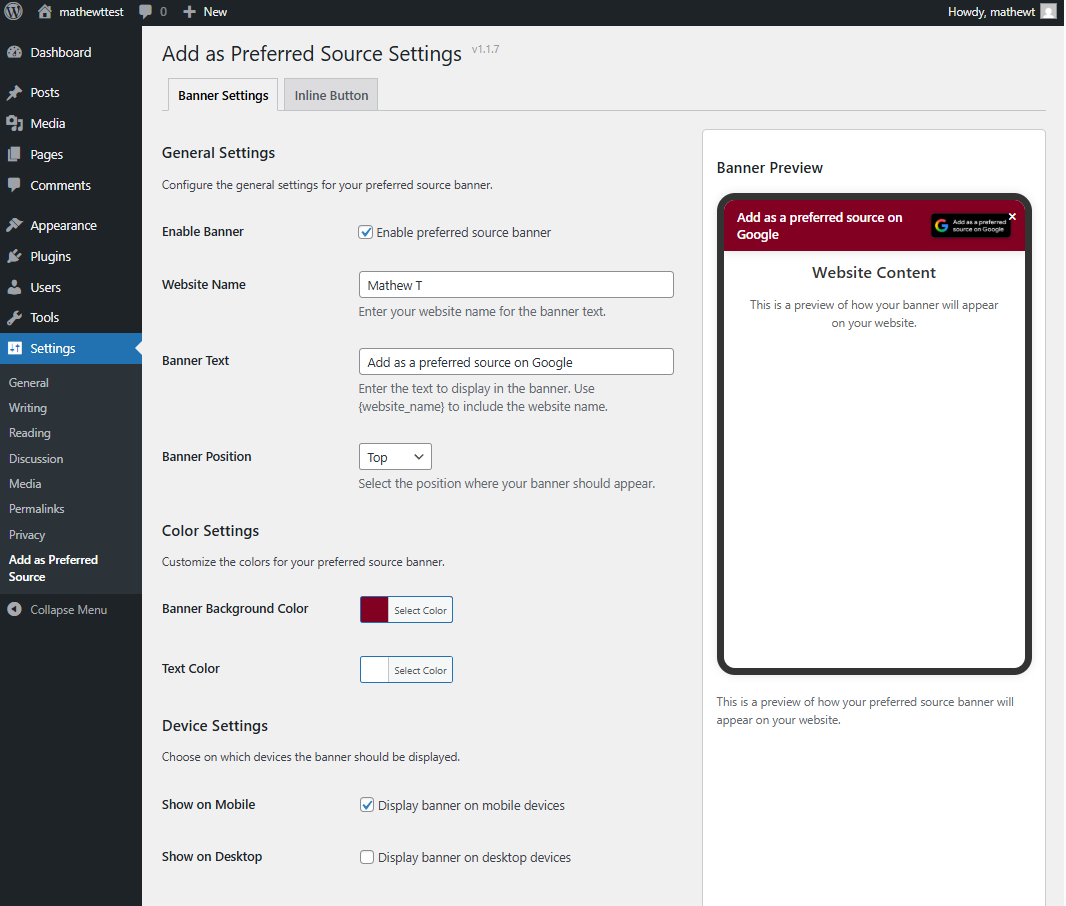
Plugin settings page with customization options and live preview
Add as Preferred Source on Google plugin displays a banner and inline button on your website that directs visitors to Google’s preferred sources feature. When clicked, the banner takes users to Google’s preferences page where they can add your site as a preferred source for their personalized search results.
What it does:
- Displays a customizable banner on your website
- Links to Google’s preferred sources feature
- Allows users to set your site as a preferred source in their Google Search settings
- Provides banner customization options (colors, text, position)
- Includes device-specific display controls for the banner (show it on mobile, desktop, or both)
- Controls exactly where the banner appears with Display Rules (all pages, posts only, pages only, or front page only)
- Excludes specific categories or individual posts/pages from showing the banner
- Triggers the banner immediately on page load, after the visitor scrolls a set percentage, or after a time delay
- Controls what happens after a visitor closes the banner – hide it for a configurable number of days, or show it again on every page view
- Tracks impressions, clicks, and dismissals with a built-in 30-day analytics dashboard
- Localized Google badge – the official badge ships in 17 languages, with an Auto mode that matches your site language
- Dark and Light badge themes – pick the badge variant that best fits your design
- Custom text badge – type your own button label for any language not in the built-in list; the badge renders with the Google logo in the same style as the official badges
- Inline badge style switcher – choose between the full card layout (title, subtitle, badge) or a clean simple style that shows only the badge
- Inline button with its own position (above content, below content, or both), post type targeting, color pickers, and customizable title and subtitle
- Automatically clears page caches from popular caching plugins when you save settings, so changes go live immediately
About Google Preferred Sources:
Google’s preferred sources is a feature that allows users to indicate which sources they want to see more of in their search results. This is a Google feature, not affiliated with this plugin. Users who add your site as a preferred source may see your content more frequently in their personalized search results.
DISCLAIMER: This plugin is not associated with Google and was created to help website owners make a banner and inline card for adding their sites to Google’s Preferred Source. The term “Google” is used solely to convey the plugin’s function, and we are not related to Google in any way.
Thank you for using the Add as Preferred Source plugin 🙂 If you like it, please leave a ★★★★★ rating to support us on WordPress.org to help us spread the word to the community.
Plugin Features:
- Custom domain override for the Google Preferred Source link
- Customizable banner text with website name variable
- Color customization for background and text
- Position control (top or bottom of page)
- Device-specific display for the banner (mobile, desktop, or both) – the inline button is not affected by these settings and appears on all devices
- Cookie-based dismissal with a configurable hide duration (1-365 days, default 7), or switch to showing the banner again on every page view
- Responsive design
- Translation ready
- Display Rules – show the banner everywhere, on posts only, pages only, or the front page only; exclude specific categories or individual post/page IDs
- Display Trigger – show immediately on page load, after the visitor scrolls a configurable percentage of the page (10-90%), or after a set time delay (1-60 seconds)
- Click-Through Analytics Dashboard – view 30-day impressions, clicks, dismissals, and click rate with a visual bar chart directly in the admin
- Badge Language – choose from 17 official badge languages (Danish, German, Spanish, Estonian, Finnish, French, Hindi, Hebrew, Japanese, Korean, Norwegian, Brazilian Portuguese, Russian, Swedish, Turkish, Ukrainian, and English), or leave it on “Auto” to match your site language
- Badge Theme – switch between the Dark (default) and Light versions of the official Google badge, with a live preview in the settings
- Custom Badge Text – type your own button label for any language not in the built-in list; the badge renders with the Google “G” logo matching the official badge style
- Inline Button – an in-content card with its own enable toggle, position (above content, below content, or both), post type targeting (posts, pages, and custom post types), background and text color pickers, and customizable title and subtitle
- Inline Badge Style – switch the inline button between “Default” (full card with title and subtitle) and “Simple” (badge image only, no card)
- Automatic Cache Clearing – saving settings purges page caches from popular caching plugins (WP Rocket, W3 Total Cache, WP Super Cache, LiteSpeed Cache, and more) so changes go live immediately
- Lightweight and Accessible – CSS and JavaScript load only on pages that actually show the banner or button, assets are minified, and the banner is fully keyboard accessible
Technical Requirements:
- WordPress 5.0 or higher
- PHP 7.2 or higher
- Modern web browser with JavaScript enabled
Configuration
After installation, go to Settings > Add as Preferred Source in your WordPress admin to configure the plugin.
Step 1: Basic Settings
-
Enable Banner: Check this box to activate the banner on your website. The banner will not appear until this is enabled.
-
Website Name: Enter your website or publication name. This defaults to your WordPress site title but can be customized. This name will replace the {website_name} placeholder in your banner text.
-
Custom Domain: Override the URL used in the Google Preferred Source link. Leave this empty to use your site’s domain automatically (recommended). Only set this if the link should point to a different URL – for example, if your WordPress site lives on a subdomain but your canonical domain is
https://example.com. -
Banner Text: Customize the message displayed to visitors. Default text is “Add as a preferred source on Google”. You can use the placeholder {website_name} anywhere in your text, and it will be automatically replaced with the website name you specified above.
- Example: “Add {website_name} as your preferred source on Google”
- Example: “Get more content from {website_name} – add us as a preferred source”
-
Badge Language: Choose which language to use for the Google badge image. “Auto” detects your site’s language automatically and falls back to English if the language is not available. 17 languages are included: Danish, German, Spanish, Estonian, Finnish, French, Hindi, Hebrew, Japanese, Korean, Norwegian, Brazilian Portuguese, Russian, Swedish, Turkish, Ukrainian, and English. If your language is not listed, select “Custom text (my language is not listed)” – this lets you type your own button label, and a badge will be generated with the Google logo and your text, styled to match the official badges.
-
Badge Theme: Choose between the Dark (default) and Light versions of the badge. Dark works best on light-colored banner backgrounds; Light works best on dark-colored backgrounds.
-
Banner Position: Choose where the banner appears on your website:
- Top: Banner appears at the top of the page, above all content
- Bottom: Banner appears at the bottom of the page (recommended for better user experience)
-
After Visitor Closes Banner: Decide what happens when a visitor clicks the close (x) button:
- Hide it for a number of days (uses a cookie): The banner stays hidden for the duration you set in the Hide Duration (days) field (1-365 days, default 7). This matches the behaviour of earlier versions and remains the default for sites updating from an older version.
- Show it again on every page view (ignores the cookie): Closing the banner only hides it for the current page. It appears again on the next page view, wherever your Display Rules allow it. This is the default for new installs.
Step 2: Appearance Customization
-
Banner Background Color: Click the color picker to choose a background color that matches your website design. Default is dark gray (#1a1a1a).
-
Text Color: Select the color for the banner text and close button. Ensure good contrast with your background color for readability. Default is white (#ffffff).
Step 3: Display Options
-
Show on Mobile: Check this box to display the banner on mobile devices (phones and tablets).
-
Show on Desktop: Check this box to display the banner on desktop computers and laptops.
You can enable both, or choose to show the banner only on specific device types based on your audience preferences.
Notes on device detection:
- These settings apply to the banner only. The inline button appears on all devices regardless of these checkboxes.
- Device detection is user-agent based (WordPress’s
wp_is_mobile()function), so tablets are treated as mobile devices. - On sites with full-page caching, a cached page may have been generated for a different device type, so the banner can occasionally appear or stay hidden on the “wrong” device until the cache refreshes.
Step 4: Save and Test
- Click Save Changes to apply your settings
- Visit your website to see the banner in action
- Click the banner to test the Google redirect functionality
- Use the close (x) button to test the dismissal feature
Testing Tips:
* Clear your browser cache and any server/plugin caches after making changes
* Test in incognito/private browsing mode to see the banner fresh
* Add a parameter to your URL (e.g., ?test=1) to bypass cache
* Check on different devices based on your display settings
* The banner will stay hidden after a user closes it for the number of days you set (7 by default), unless you choose the “every page view” option
Preview Feature:
The settings page includes a live preview that updates as you modify colors, text, and position. This helps you see how the banner will look before saving changes.
Step 5: Display Trigger
Control when the banner appears to a visitor:
- Immediately on page load – the banner shows as soon as the page finishes loading (default behaviour).
- After user scrolls – the banner only appears once the visitor has scrolled a set percentage of the page. You can choose any value between 10% and 90% in 5% increments. Useful for keeping the banner out of the way until the reader is engaged with your content.
- After a time delay – the banner waits a number of seconds (1-60) before appearing. This lets visitors settle in before the prompt is shown.
Step 6: Display Rules
Target exactly which pages show the banner:
- Everywhere – the banner appears on all pages and posts across your site (default).
- Posts only – restricts the banner to single post pages.
- Pages only – restricts the banner to static WordPress pages.
- Front page only – shows the banner exclusively on your site’s home/front page.
You can further refine visibility with two exclusion options:
- Exclude Categories – search for and select any categories whose posts should never show the banner. The picker supports live search so you can find categories quickly without loading a long list.
- Exclude Post/Page IDs – enter a comma-separated list of post or page IDs to suppress the banner on specific pieces of content.
Step 7: Analytics Dashboard
Open the Analytics tab on the settings page to view banner performance over the last 30 days:
- Impressions – how many times the banner was displayed to visitors.
- Clicks – how many visitors clicked through to the Google preferences page.
- Dismissals – how many visitors closed the banner without clicking.
- Click Rate – the percentage of impressions that resulted in a click (clicks / impressions).
A colour-coded bar chart shows the daily breakdown of all three metrics so you can spot trends at a glance. Data is stored locally in your WordPress database and requires no third-party services.
Note: the analytics dashboard only tracks the banner. Impressions and clicks on the inline button are not recorded yet – inline button tracking will be added in a future version.
Step 8: Inline Button
Open the Inline Button tab to configure the in-content card, which works independently of the banner:
- Enable Inline Button – turn the inline button on or off. It can run alongside the banner or on its own.
- Badge Style – choose “Default” (a card with title, subtitle, and badge) or “Simple” (the badge image only, with no card around it). Selecting Simple hides the card-specific fields below.
- Button Position – show the button above your content, below it, or in both places.
- Post Types – select which post types display the button: posts, pages, and any public custom post types registered on your site.
- Background Color / Text Color – use the color pickers to match the card to your site design.
- Inline Title – the main heading shown on the card.
- Inline Subtitle – the supporting text displayed below the title.
A live preview on the tab updates as you change these settings, just like the banner preview.