
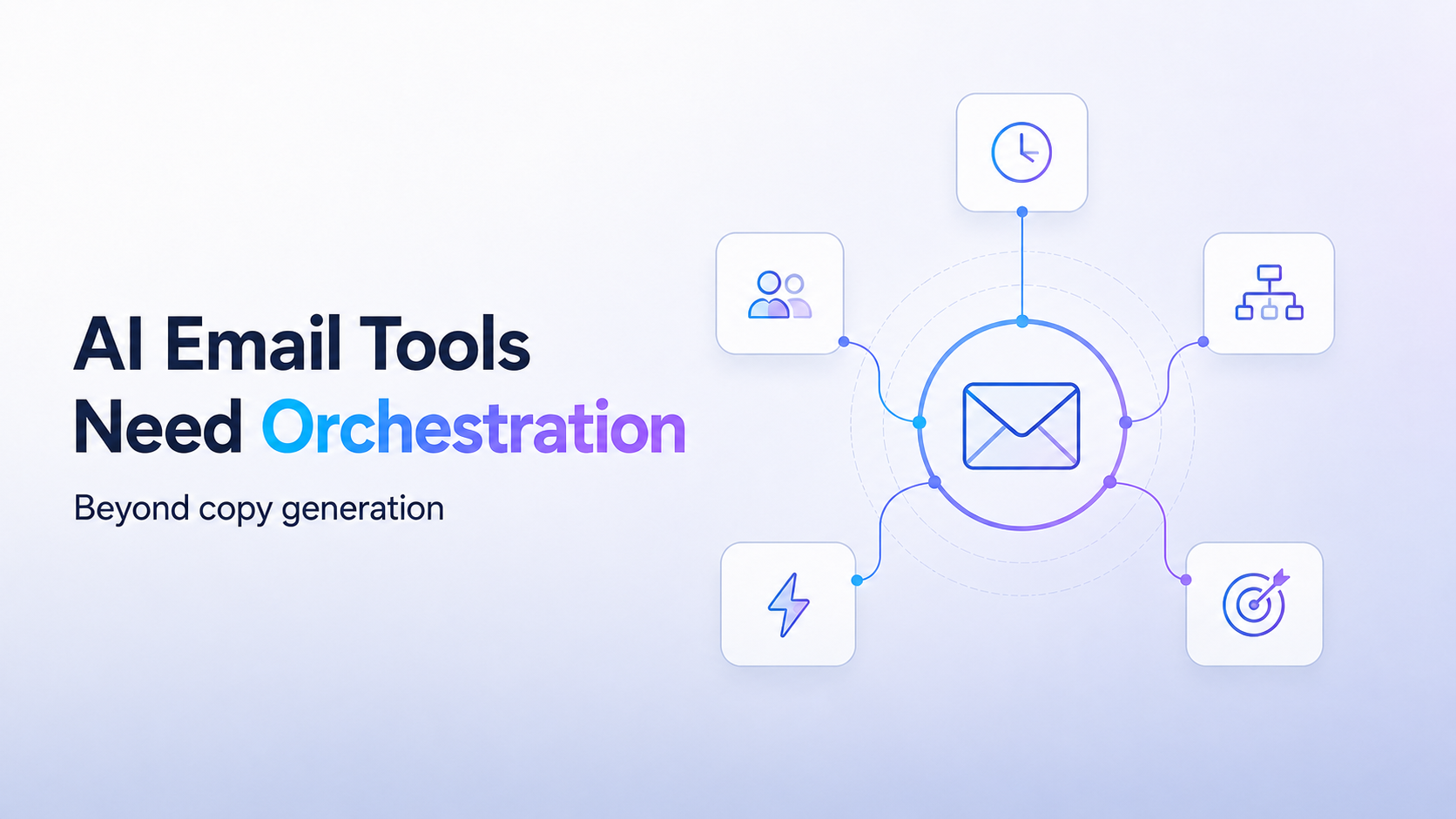
Most AI email marketing tools solve the easiest part of the problem: they help someone write another email.
That is useful, but it is not where growth usually breaks.
Companies, creators, ecommerce brands, agencies, course sellers, SaaS teams, communities, and marketplace operators rarely struggle because nobody can produce one more welcome email. They struggle because the customer journey is fragmented. The first message does not match the user's intent. The follow-up arrives too late. The same email goes to a new trial user, a warm lead, a buyer, a dormant subscriber, and someone who already took the intended action. The copy may be polished. The system is not.
This is the gap hiding under much of the excitement around AI email automation. The first wave of generative tools made it cheaper to produce copy. The next wave will make it easier to build, govern, and improve the entire customer lifecycle.
That shift matters because modern growth is not a content problem alone. It is a timing, segmentation, context, behavior, and operations problem.
A trial user who has not completed setup should not receive the same email as a user who already invited teammates. A shopper who abandoned checkout should not receive the same message as someone who downloaded a lead magnet. A creator launching a digital product needs a different sequence than an agency nurturing leads for a client. A failed onboarding or launch campaign is often not a writing problem. It is a workflow problem.
The future of AI email marketing will not be defined by who can generate the most subject lines. It will be defined by who can turn a campaign idea into a working lifecycle system.
AI email marketing is becoming lifecycle infrastructure
Email remains one of the most durable channels in digital business. Product notifications, onboarding emails, trial conversion sequences, ecommerce follow-ups, lead magnet nurtures, abandoned cart flows, course launch campaigns, renewal reminders, reactivation emails, and customer education all depend on it.
Email is not fashionable. It is infrastructure.
The problem is that most lifecycle marketing still runs like a patchwork.
One tool stores contacts. Another sends emails. Another tracks product or purchase behavior. Another holds the campaign brief. Another manages approvals. Another stores analytics. Another contains the automation logic. Somewhere in between, a founder, marketer, creator, or growth lead is copying text from an AI writing assistant into an email platform and hoping the strategy survives the transfer.
That process is fragile.
It creates campaigns that are technically automated but strategically disconnected. The system can send a message after three days, but does it know whether the person already bought? Does it suppress the offer if the user already converted? Does it adjust the CTA based on whether the person is a subscriber, trial user, customer, or returning lead? Does it alert the team when a campaign is drafted but still needs review?
These are not small operational details. They are the difference between communication that helps someone move forward and communication that feels like noise.
Major email and CRM platforms increasingly describe AI email marketing around personalization, segmentation, send-time optimization, lifecycle data, and automation rather than copy generation alone. That direction is important. It suggests the market is moving from "AI as writing assistant" toward "AI as lifecycle operator."
The real bottleneck is not writing. It is orchestration
Every meaningful email funnel has more moving parts than the final message suggests.
A simple welcome sequence might require:
- A goal: help a new lead, user, or buyer take the next valuable action.
- An audience: new subscribers, trial users, customers, students, shoppers, or prospects.
- A trigger: signup, purchase, form submission, import, download, or trial start.
- A delay: immediately, one day later, three days later, seven days later.
- A branch: engaged vs. not engaged, activated vs. not activated, purchased vs. not purchased.
- A suppression rule: exclude people who already converted.
- A CTA: finish setup, book a call, use a feature, claim an offer, watch a lesson, complete checkout.
- A review step: founder, marketer, agency client, compliance reviewer, or customer success lead.
- A measurement plan: opens, clicks, conversions, replies, activation, revenue, retention, or reactivation.
The email copy is only one layer.
Yet many teams still approach AI email automation by asking a model to "write a five-email sequence for my product." The output may look impressive. It may even sound strategic. But unless it maps to audience stage, timing, behavior, offer logic, approval, and measurement, it is still a document pretending to be a system.
This is why the next generation of email marketing automation will need to create structure, not just text.
A good AI system should not only ask, "What should the email say?" It should ask:
Who is receiving it?
What have they already done?
What have they not done?
What is the next valuable action?
What should happen if they click?
What should happen if they ignore it?
Who needs to approve it?
Can this be managed from the browser, from mobile, or through a lightweight command interface when the team is not sitting inside a dashboard?
How will the team know whether the funnel is healthy?
That is orchestration. And orchestration is where lifecycle marketing gets hard.
Why lifecycle emails need behavioral context
Lifecycle emails are often treated as educational content. That is partly right, but incomplete.
The job is not simply to explain the product, offer, or service. The job is to move someone from one stage of intent to the next.
That could mean:
- A SaaS user reaching activation.
- A shopper completing checkout.
- A lead booking a demo.
- A subscriber joining a paid community.
- A course student finishing the first lesson.
- A newsletter reader becoming a customer.
- A past buyer returning for a second purchase.
- A cold lead warming up before a sales conversation.
Each of those journeys requires different timing, proof, objections, and CTAs.
A user who has not completed setup needs a different email from a user who completed setup but has not returned. A shopper who viewed a product but did not add to cart needs a different follow-up from someone who abandoned checkout. A creator's product launch needs a different tone from a B2B onboarding sequence. An agency building funnels for clients needs reusable structure without making every client sound the same.
Without behavioral context, AI email marketing becomes faster generic marketing.
This is where isolated AI copy tools hit a ceiling. The tool can write persuasive copy, but it does not know which person should receive which message, when they should receive it, what should happen next, or who needs to approve the campaign before launch.
That is why lifecycle email automation matters. The sequence is not just a series of messages. It is a behavioral map.
From content generation to workflow generation
The most important shift in AI marketing automation is the move from content generation to workflow generation.
Content generation asks: "Can AI create the asset?"
Workflow generation asks: "Can AI help create the operating system around the asset?"
For growth teams, that operating system includes campaign intent, audience logic, lifecycle stage, segmentation rules, email content, timing, branches, approvals, launch readiness, analytics, and iteration.
The winning AI marketing tools will understand not only brand voice and subject lines, but customer state and business goal.
A trial activation funnel, for example, should understand the difference between these users:
- User A signed up but never completed setup.
- User B completed setup but never returned.
- User C invited teammates and hit a usage limit.
- User D used the product daily but never added billing.
- User E came from a founder's launch post and expects a more personal tone.
An ecommerce recovery sequence should understand the difference between these customers:
- Shopper A browsed but never added to cart.
- Shopper B abandoned checkout.
- Shopper C purchased once but never returned.
- Shopper D bought multiple times and may be ready for a loyalty offer.
- Shopper E joined from a lead magnet and needs education before conversion.
A creator launch sequence should understand the difference between:
- A cold subscriber.
- A warm audience member.
- A previous buyer.
- Someone who clicked the offer page.
- Someone who asked a question but did not purchase.
Each group may belong to the same audience list, but they are not in the same lifecycle moment.
This is why the phrase AI email automation can be misleading. The goal is not simply to automate email creation. The goal is to automate the thinking that connects user behavior, campaign intent, content, timing, and next action.
The Lifecycle Funnel Stack
A better way to evaluate the future of AI email marketing is to think in layers.
Call it the Lifecycle Funnel Stack.
1. Intent
Every funnel starts with intent.
What is the campaign goal? Who is the audience? What lifecycle stage are they in? What offer or next step matters? What user behavior should change?
This layer forces the team to define the strategic purpose before generating content.
A trial activation funnel is not the same as an abandoned cart sequence. A lead magnet nurture is not the same as a product launch. A customer education campaign is not the same as a reactivation flow. A client campaign for an agency is not the same as a founder-led launch.
AI can help here by turning a plain-language campaign brief into a structured lifecycle plan: audience, goal, desired action, objections, offer, tone, timing, and success metric.
2. Content
Content is still important. Bad emails still hurt.
But content should be created inside the lifecycle context.
This layer includes subject lines, preview text, email body, CTAs, objections, proof points, founder notes, customer examples, product education, and offer framing.
The difference is that AI should not produce standalone copy in a vacuum. It should produce content that reflects the user's stage and the campaign's job.
A setup reminder should not sound like a newsletter. A checkout recovery email should not sound like a cold sales pitch. A launch announcement should not sound like a generic discount blast. A dormant customer reactivation email should not pretend the relationship is brand new.
Good AI email marketing will generate content that knows why it exists.
3. Logic
Logic is where many campaigns fail.
This layer includes delays, triggers, branches, exclusions, tags, suppression rules, audience updates, and event-based actions.
For example:
If the user activates the core feature, stop sending setup reminders.
If the shopper completes checkout, suppress the abandoned cart flow.
If the lead books a call, stop sending demo nudges.
If a customer clicks a pricing or upgrade page twice, send proof or comparison content.
If someone is inactive for 14 days, shift from education to reactivation.
If a campaign still needs review, do not let it send.
This is the layer most AI copy tools ignore. It is also the layer that determines whether the campaign feels intelligent or annoying.
4. Governance
Lifecycle campaigns need governance because email is not just content. It is customer experience.
Governance includes approvals, review checkpoints, QA, brand voice controls, compliance checks, launch readiness, and internal visibility.
This matters more as AI-generated campaigns become easier to produce. When teams can generate more campaigns faster, the risk shifts from blank-page delay to operational sprawl.
Who approved the sequence? Are the CTAs consistent? Are claims accurate? Are links working? Are sender details correct? Does the timing make sense? Is the campaign suppressing people who already converted? Does the message match the brand? Does someone need to review it from a mobile device before launch?
AI marketing automation without governance will create a new problem: more campaigns than the organization can safely manage.
The best systems will not remove human judgment. They will make human review easier to apply at the right moments.
5. Learning
The final layer is learning.
A lifecycle system should improve over time. That means analytics, variants, funnel health scoring, conversion signals, engagement trends, and suggestions for what to change next.
Most teams already have some data. The challenge is turning it into action.
If email three has a strong open rate but weak clicks, the issue may be CTA clarity. If a branch has low conversion but high engagement, the offer may be wrong. If users who complete one product action convert at a much higher rate, the onboarding sequence should push more directly toward that action. If a launch email gets replies but not purchases, the objection may be trust, urgency, or offer clarity.
The best AI email automation systems will not stop at launch. They will help teams understand what is working, what is decaying, and where the lifecycle funnel needs adjustment.
What an AI email funnel builder should actually do
The phrase email funnel builder has historically meant a tool that helps create a sequence of emails.
That definition is now too narrow.
A modern AI email funnel builder should be able to turn a campaign brief into a connected lifecycle workflow. That means it should help with strategy, content, logic, review, launch readiness, and optimization.
At minimum, it should help teams answer:
What lifecycle stage is this campaign for?
What user behavior or action triggers the sequence?
What should each email accomplish?
What should change if the user engages?
What should change if the user ignores the sequence?
What users should be excluded?
What approval steps are required?
Can the team manage updates from web and mobile workflows, not only a desktop dashboard?
How will the team know whether the funnel is working?
This is especially important for small teams.
Large companies may have lifecycle marketers, marketing operations teams, CRM specialists, product analysts, copywriters, and compliance reviewers. Smaller companies, creators, agencies, and ecommerce operators often have one person trying to stitch the whole system together.
For those teams, the value of AI is not merely faster copy. It is operational leverage.
The question is no longer, "Can AI write the emails?" It is, "Can AI help a small team behave like it has a lifecycle marketing function?"
Web dashboards are not enough anymore
Another quiet shift is where campaign work happens.
Traditional email platforms assume the operator is sitting inside a web dashboard. That is still important. Complex workflows, visual sequences, integrations, contact imports, and launch reviews need a proper workspace.
But modern operators do not only work from dashboards.
A founder may want to generate a launch sequence from a phone. An agency owner may want a Telegram update when a client campaign is ready for review. A creator may want to adjust campaign direction without logging into five tools. A marketer may want to approve or request edits while away from a desk.
This does not mean mobile or messaging interfaces replace the web app. It means they become part of the operating layer.
The next generation of AI marketing automation will likely be multi-surface. The browser remains the workspace. Mobile and messaging become the command layer. Telegram, Slack, WhatsApp, or other lightweight interfaces may become where teams receive updates, review drafts, and trigger changes.
That matters because the bottleneck in lifecycle marketing is often not just creation. It is getting the campaign from idea to approved workflow without losing momentum.
Different businesses need different funnel systems
One reason lifecycle marketing is hard is that there is no single funnel shape.
A founder-led product launch may rely on personal narrative, problem framing, early-user feedback, and direct replies. The emails should feel human, specific, and responsive.
A SaaS onboarding flow may need product event triggers, role-based segmentation, activation prompts, upgrade rules, and sales handoff logic.
An ecommerce brand may care about abandoned cart recovery, post-purchase education, replenishment reminders, review requests, and win-back offers.
A creator or course seller may need lead magnet follow-up, webinar reminders, launch cart-open emails, deadline sequences, student onboarding, and community engagement.
An agency may need reusable campaign structures that can be adapted across clients without making every client sound the same.
A marketplace may need different journeys for buyers, sellers, inactive users, and power users.
The mistake is treating all of these as "email sequences."
They are not.
They are lifecycle systems with different constraints.
This is why customer lifecycle automation is becoming a more important category than simple campaign generation. The more a company grows, the more its email program becomes a customer experience layer.
AI email marketing will expose weak lifecycle strategy
AI will make it easier to produce campaigns. That does not mean companies will produce better campaigns.
In fact, AI may expose weak lifecycle strategy faster.
If the team cannot define the activation event, AI will generate generic onboarding.
If the team does not know the customer's main objection, AI will generate vague persuasion.
If the team has no segmentation model, AI will personalize around surface-level details.
If the automation logic is unclear, AI will create a sequence that looks good in a document but fails in production.
If nobody owns approval, AI will create drafts faster than the team can safely launch them.
This is the uncomfortable truth for operators: AI does not remove the need for lifecycle strategy. It increases the return on having one.
The best teams will use AI to codify their lifecycle thinking. The weakest teams will use AI to produce more noise.
Tools to watch
For teams exploring this shift, it may be worth watching tools that move beyond simple AI email copywriting into full-funnel planning. EmailFunnelAI is one example in this direction, letting teams turn a campaign brief into lifecycle sequences, automation logic, review checkpoints, Telegram updates, and improvement suggestions. The bigger point is not one specific tool, but the category: AI email marketing is becoming a system for orchestrating customer journeys, not just generating more subject lines.
This category will likely sit between traditional email service providers, marketing automation platforms, CRM systems, ecommerce platforms, creator tools, and AI writing assistants.
The opportunity is not to replace those systems overnight. It is to make lifecycle strategy easier to create, review, launch, and improve across the tools businesses already use.
The future of lifecycle email automation
The next phase of lifecycle email automation will be less about isolated assets and more about connected journeys.
That means AI systems will need to understand:
- Lifecycle stage.
- Audience intent.
- Product, purchase, or subscriber behavior.
- Activation milestones.
- Offer context.
- Behavioral triggers.
- Team approvals.
- Brand constraints.
- Funnel analytics.
- Web and mobile workflow needs.
- Next best action.
This is a harder problem than generating copy. It is also a more valuable one.
The companies that win with AI email marketing will not be the ones that generate the most emails. They will be the ones that build the clearest lifecycle systems.
Every message should know where the person is, what they have done, what they have not done, what they are likely trying to accomplish, and what action would help them move forward.
That is the real promise of AI marketing automation.
Not more words.
Better journeys.


